


How to Set Up an Offshore Development Center (ODC) in India: Costs, Hiring Models, and GCC vs. ODC

Introduction
Building a development team of expert developers, designers, coders, and analysts is one of the biggest challenges tech firms face. Hiring locally is extremely expensive and slow, and finding a suitable candidate for senior IT roles is an even bigger challenge.
Outsourcing has become common in today’s times when IT talent is available to work on various exciting projects. About 70% of businesses choose outsourcing for reduced operational costs and access to top-tier talent.
This is where an offshore development center helps IT businesses. From providing niche professionals at reasonable costs to managing the complete onboarding process, outsourcing partners remain the top choice for businesses planning expensive and critical hires.
But the difficult question is: how to set up an offshore development center in India? The country has an impressive pool of qualified and experienced IT professionals. The setup requires a full-fledged roadmap, investment, and registration.
If you want to make the most of the in-demand Indian IT talent, then this guide is for you. From the required resources to whether you should set up an ODC or a full Global Capability Center, it is loaded with useful information.
By the end of this guide, you will have ample information on:
- The cost of setting up and running an ODC in India
- How hiring budgets work for different roles
- How an ODC is different from a GCC
- Which model you should finalize
What Is an Offshore Development Center (ODC)?
An Offshore Development Center is a team of qualified developers, coders, and other IT specialists hired to work for other companies. These professionals can work on a project basis or full-time, based on the ODC’s agreement with the company.
For example, an IT team sitting in India can work for a US client on a long-term website development and maintenance project. During this project, the team members work as the client’s IT development experts but are managed by the ODC. These professionals work closely with the client’s in-house staff to learn the processes and their product.
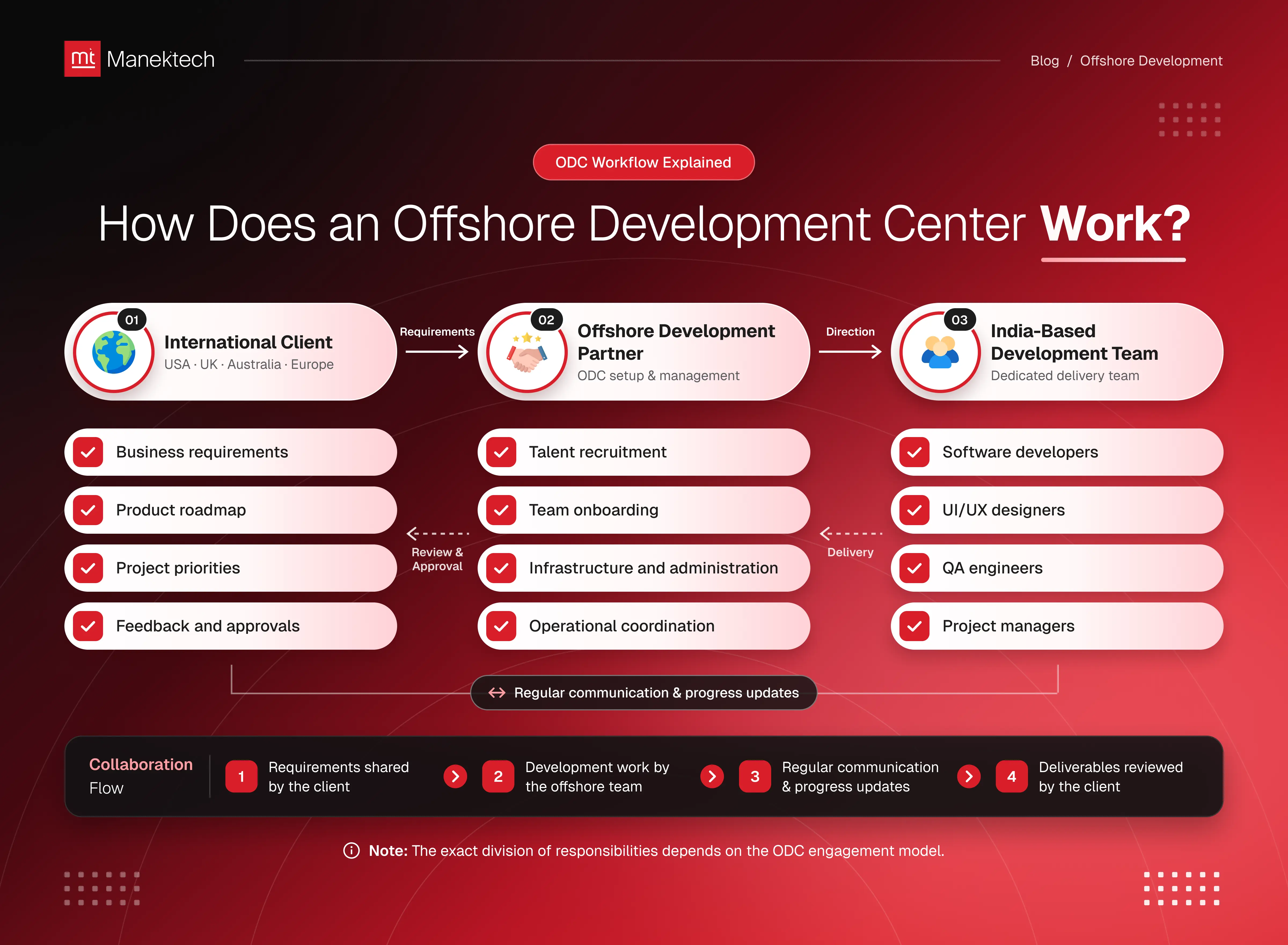
ODCs follow different engagement models, and the most common ones include:
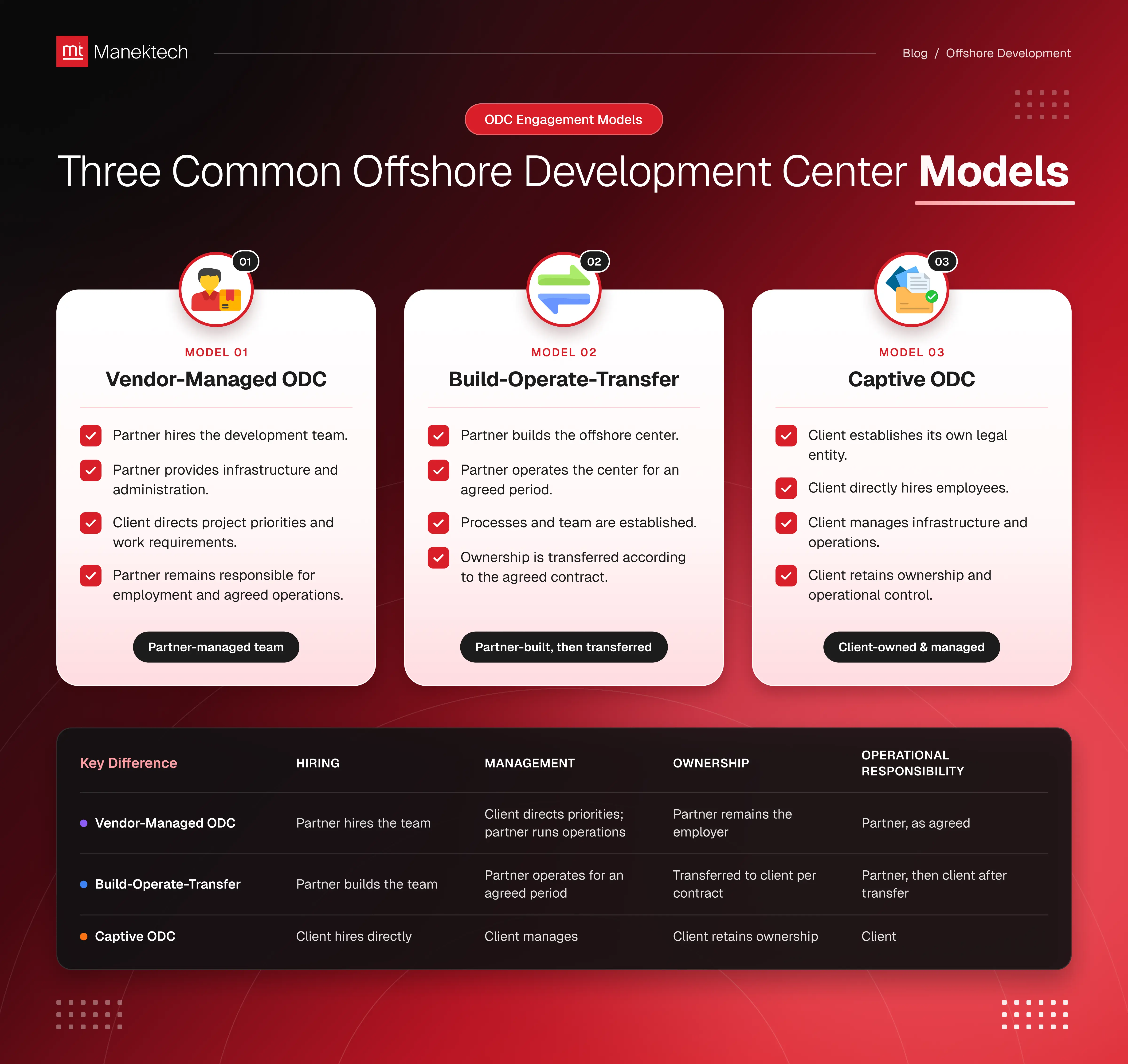
Vendor-managed ODC
The ODC partner hires the team, provides the office and infrastructure, and handles HR and compliance. The client directs the work, but the partner remains the employer.
- Talent sourcing: The ODC partner finds, screens, and replaces developers from its existing talent pool, so the client does not run its own recruitment.
- Team management: The partner’s delivery manager handles attendance, leave, and day-to-day team coordination.
- Security and tools: The partner sets up secure workstations, network access, and software licenses, following the client’s security requirements.
- Performance and quality: The client reviews deliverables and gives feedback, while the partner handles appraisals and corrective action for team members.
- Contract terms: The client and partner agree on team size, billing, service levels, and notice periods, which makes it easy to scale the team up or down.
Build-operate-transfer (BOT)
The ODC partner sets up and runs the center for an agreed period. After that, the client takes full ownership of the team and the legal entity.
- Setup planning: The client and partner agree on the team structure, hiring plan, timeline, and budget before the build begins.
- Leadership hiring: The partner recruits the senior roles, such as the center head and engineering leads, who will later lead the team under the client.
- Process building: The partner sets up the HR policies, workflows, and delivery processes that the client will inherit.
- Knowledge transfer: Both parties plan the handover in advance, including documentation, training, and a transition period to avoid disruption.
- Transfer terms: The contract defines the transfer date, the fee, the employee transfer process, and what support the partner gives after the handover.
Captive ODC
The client registers its own legal entity in India, hires its own employees, and manages everything directly, without a partner in between.
- Leadership appointment: The client appoints a country head or center lead in India to manage local operations and report to headquarters.
- Local advisors: The client usually works with legal, tax, and accounting advisors to meet Indian regulations.
- Talent acquisition: The client builds its own employer brand and recruitment process to attract engineers in a competitive market.
- Culture and retention: The client is responsible for training, career growth, and keeping attrition low.
- Long-term commitment: The client takes on fixed costs and the full risk of running the center, but gains complete control over strategy and scaling.
Why Do Companies Set Up ODCs in India?
Companies open an offshore development center in India because of the highly efficient and resourceful IT talent pool in the country. Among other benefits of ODCs, clients can find skilled, reliable, and cost-efficient IT specialists who are trained to work across time zones.
Let us closely look into the aspects that make India a suitable choice for partners wanting to establish an offshore software development team in India:
Access to Qualified Engineering Talent
India is home to one of the largest talent pools in cloud, AI, mobile, data, cybersecurity, and enterprise software. Whether a company needs a junior developer or a senior project manager, ODC providers can bring experienced and skilled experts to work with you.
The ODC engagement model gives you access to individuals proficient in various rare and valuable skills.
Ability to Work in Multiple Time Zones
When it comes to collaborating with the UK and Europe, there’s a nice chunk of overlapping working hours throughout the day. For teams in the US, it’s easy to carve out a brief daily overlap for meetings and handovers.
Many companies cleverly leverage this time difference: while the home team is offline, the team in India keeps the development wheels turning, ensuring that progress never stalls. With clear communication guidelines and established overlap hours, this setup runs like a well-oiled machine.
Team Growth Prospects
Businesses grow with time, and their tech teams should evolve with them to manage the increasing workload and expectations. Finding an addition for your team on short notice becomes extremely difficult.
But with the help of an offshore development center hiring model, businesses can promptly scale their talent pool. Since the ODC partner already has a wide range of skilled talent available, they can easily find a suitable candidate for your team.
Team Sustaining Costs
Cost is a big reason why ODC partners prefer India over any other country. The setup cost not only includes the salaries, but also the office rent, maintenance costs, expenses, compliance, and vendor fees.
Managing a full-fledged ODC organization with multiple employees or IT experts becomes expensive, especially in the US, the UK, or European countries. But India offers a better ROI and reduced cost structure, therefore attracting potential ODC investors.
How to Set Up an ODC in India: Step by Step
The process of offshore development center services setup is quite straightforward but requires extreme precision and a well-structured strategy.
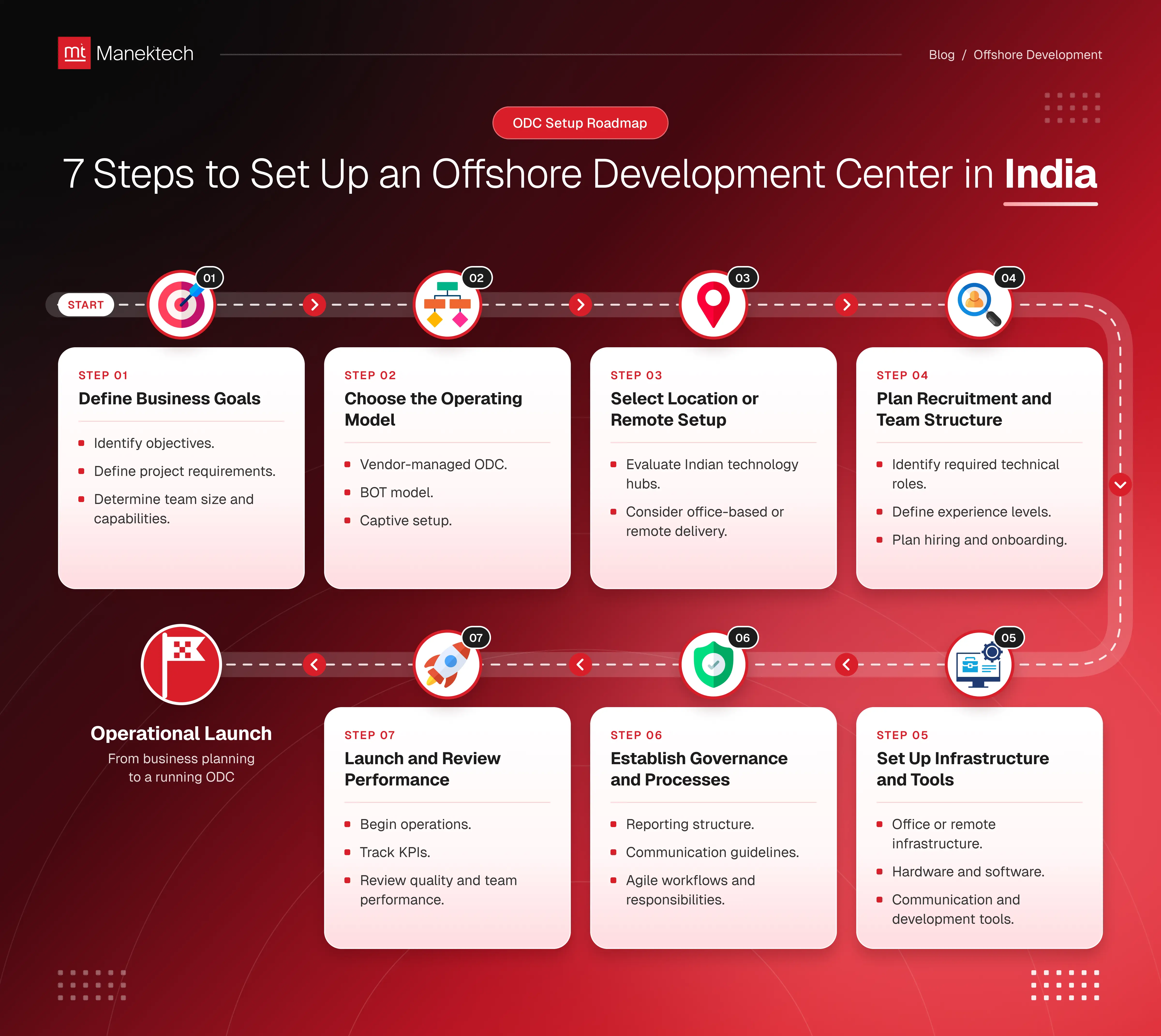
Define business goals and team requirements
The first step here is to have a clear understanding of what you want. Your vision for the ODC and the business scale you are aiming at.
Choose the right engagement and operating model
Based on your budget, timeline, and management, finalize the most suitable hiring model: vendor-managed, build-operate-transfer, or captive. A vendor-managed setup is faster and needs less investment. A captive center costs more but gives full ownership. Match the model to your long-term plans.
Select a city or remote delivery arrangement
This is an essential step, and it affects the overall cost of setting up an ODC. Compared to establishing an office in a city, a remote setup costs less as you save money on rent, conveyance, and other fees, but it requires extra management to ensure all the team members have a clear understanding of the project.
Plan recruitment and team structure
Create a solid plan on how your team will be organized, and the level of expertise you expect from the candidates. Start by onboarding the leadership roles, as they will be the ones handling the rest of the team. Establish a hiring timeline, outline salary ranges for each position, and decide if the recruitment will be led by your partner or your own team.
Set up infrastructure, tools, and access controls
This step involves getting the office space organized with the laptops, software licenses, and network setup that the team will need to hit the ground running. Each team member should have access to code repositories, project management tools, and communication platforms tailored to their specific role.
Establish governance, communication, and delivery processes
Agree on the rules and regulations that the team mandatorily has to follow. Set meeting schedules, reporting lines, and escalation steps. Choose a delivery method, such as Agile sprints, and fix overlap hours for time-zone coordination. Clear processes prevent confusion and keep work on track from the start.
Define KPIs, security requirements, and reporting
Once the working space is ready, the team should be prepared to begin the work. Set up measurable metrics like how quickly they deliver projects, the quality of their code, the rate of bugs, and even team turnover. You should also set the security standards that everyone needs to follow, covering aspects like data management, device usage, and confidentiality agreements.
Launch the team and review performance
The final step involves getting the team into action. Closely monitor their performance and conduct quality checks regularly. Review the KPIs, collect feedback from your team and the client, and adjust the team size, processes, or model as needed.
How Much Does It Cost to Set Up an ODC in India?
The cost of setting up an Offshore Development Center is not fixed. It is calculated based on several factors like team size, location, the experience level of the roles, and the type of engagement model you choose. Instead of searching for a single figure, it is more useful to break down the costs into their key components.
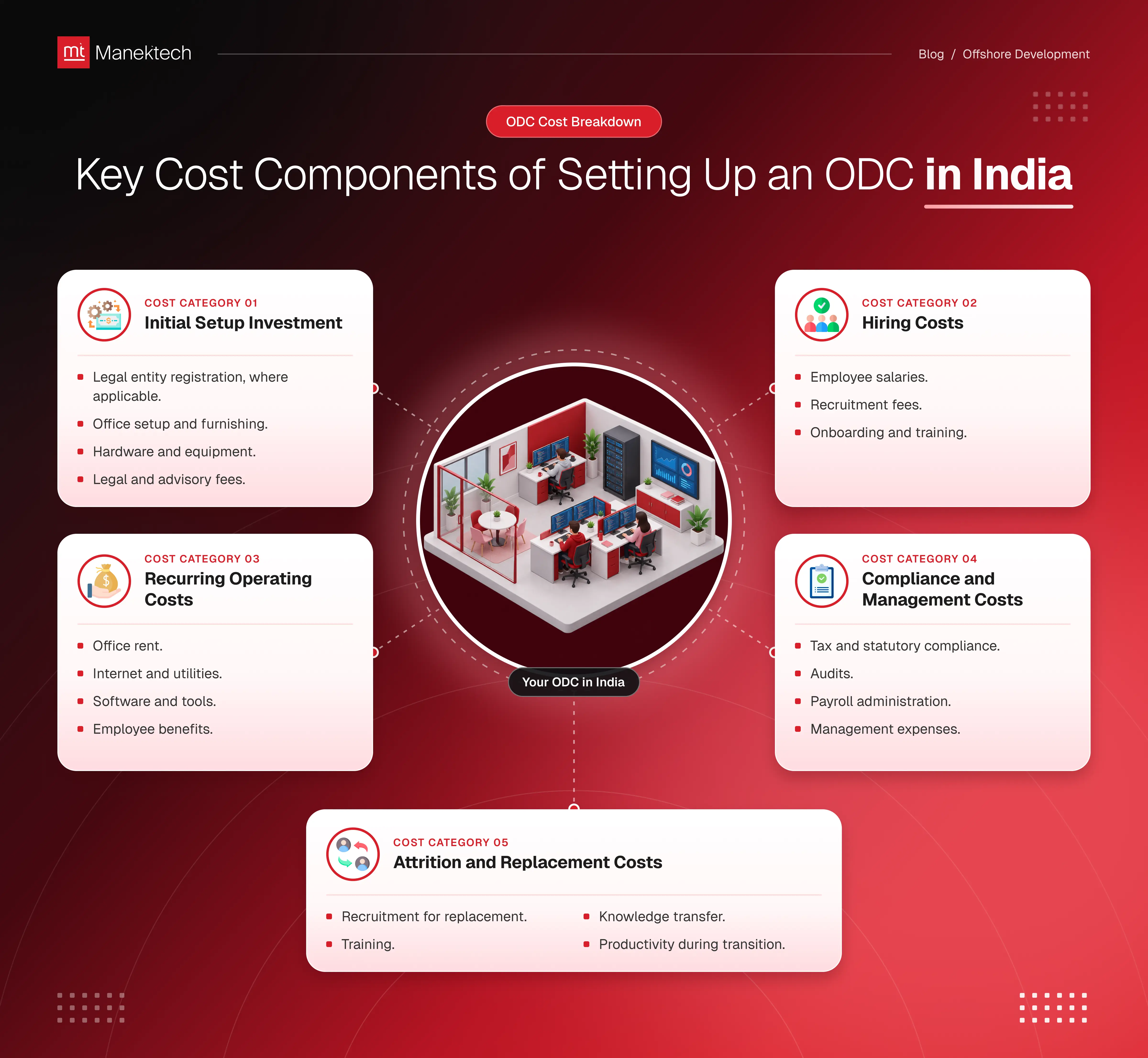
- Setup investment: These are one-time expenses that include things like registering a legal entity, outfitting your office, purchasing equipment, acquiring software licenses, and covering legal and advisory fees.
- Hiring costs: This includes salaries, recruitment fees, onboarding, and training expenses. It is important to note that salary levels can differ significantly depending on the role, skill set, and city.
- Recurring operating costs: These are ongoing expenses such as rent, utilities, internet, tools, payroll administration, insurance, and employee benefits.
- Compliance and management costs: This includes tax filings, statutory payments, audits, and the management time required to keep the center running smoothly.
- Attrition costs: Don’t forget about the costs associated with replacing and training staff who leave, especially in a competitive talent market where this can really add up.
ODC vs. GCC: What Is the Difference?
While the core objective of an ODC and GCC is the same: providing companies access to IT talent in India. They differ in various other aspects like the primary functions, structure, costings, and the level of commitment.
Allow us to provide a detailed comparison of different factors that distinguish between an ODC and GCC.
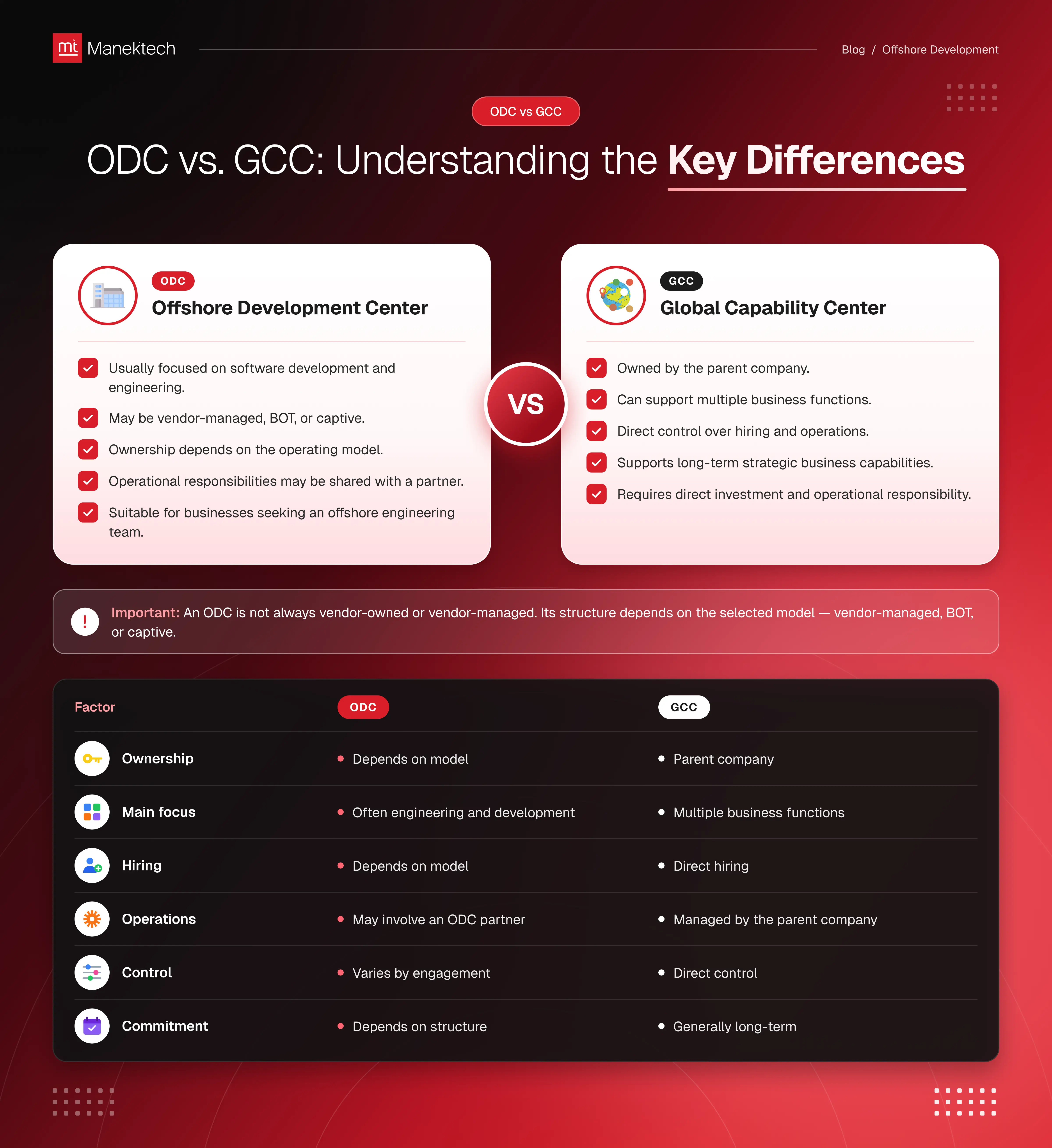
What is an ODC and GCC?
An ODC, or Offshore Development Center, is essentially a specialized team that boosts a company’s engineering capabilities. Typically, it focuses on software development, testing, and maintenance, and is often established with the assistance of an ODC partner. Clients hire talent from ODCs to work with their in-house team for IT development.
On the other hand, a GCC, or Global Capability Center, is a company-owned hub located in India that enhances the broader operations of its parent company. Its functions can extend well beyond just development, encompassing areas like data and analytics, product engineering, finance, HR, and IT support. Unlike a temporary team, it serves as a lasting component of the business.
Ownership
In an ODC, ownership depends on the engagement model.
- A vendor-managed ODC is owned and operated by the partner.
- A BOT model moves ownership to the client later.
A GCC is owned by the parent company from the start, through its own legal entity in India.
Control
Control is an essential component that clearly separates an ODC from a GCC. In an ODC setup, the client holds the power to make decisions on the work, such as priorities, tasks, and quality. But they do not have much power over hiring and talent management.
A GCC setup provides the ultimate power to the client or company. They control everything, including strategy, hiring, culture, and how the center grows. They make the decisions on the projects, team structure, and other related workflows.
Operations
In an ODC, the ODC partner manages the team, daily operations, infrastructure, hiring, and administration. So, all the operational work is taken off the hands of the client.
However, that’s not the same as the GCC model. The company itself manages all these things, including the administration work.
Responsibility
An ODC partner takes on a shared role in hiring, compliance, and managing team operations. On the other hand, in a GCC, the company handles everything, from legal compliance to keeping talent engaged and planning for the long haul.
Which One Should You Choose?
Choosing an IT staff augmentation partner can be tough. An ODC can be a great choice for businesses looking to quickly get their hands on a skilled and equipped IT team, experiment with the market, or expand their team without a hefty initial investment.
On the other hand, a GCC is ideal for companies aiming to establish a long-term, strategic foothold in India. However, they should be prepared to take on the management themselves because the hired team will operate under their management.
Common ODC Setup Challenges and How to Reduce Them
An offshore development center setup process can pose various challenges. Even after carefully planning everything, certain challenges might occur. The best way to make an ODC model successful is by preparing for these challenges, so you do not face any roadblocks in the long run.
We have listed the most common ODC setup challenges and how you can overcome them:
Communication Problems and Misunderstandings
Challenge: Since ODC teams work remotely, coordination can become a bit challenging. Time-zone differences, cultural nuances, and vague instructions can affect the project timeline and the team’s productivity.
Solution: To tackle this, make sure to establish overlapping work hours, schedule regular meetings, and utilize shared tools for documentation and tracking. Provide clear guidelines when outlining requirements, and foster an environment where the team feels comfortable asking questions right from the start.
Quality Control Issues
Challenge: The client should have complete visibility over the project and daily work. However, the remote setup often poses a huge challenge in gaining timely insights.
Solution: Set coding standards, use code reviews, and automate testing. Track delivery with defined KPIs, so problems are detected and solved on time before they turn into a bigger issue.
Security Problems
Challenge: Remote access to the company documents, customer details, and other confidential information can pose security risks.
Solution: Access should be granted according to the roles, and the team should use secure devices and networks. They should also be trained to handle data carefully.
Vaguely-defined Responsibilities
Challenge: If the roles and responsibilities are not defined clearly, the team may face confusion. The staff might leave certain tasks assuming that the client will handle management.
Solution: It is best to define each party’s role in writing before the ODC setup process begins, and review it as the team grows.
Talent Retention
Challenge: The IT market in India is very competitive, and highly skilled individuals get frequent offers with decent salaries and benefits. Retaining them can be a challenge.
Solution: Candidate loss can be reduced with fair pay, clear career paths, learning opportunities, and a strong team culture. Clients should keep the team connected to their product, so they feel like part of the company.
When Should a Business Consider an ODC in India?
Hiring an offshore development center in India depends on a number of factors. Companies operating in the international market should be very careful while making the decision.
Though an ODC offers a high ROI and great benefits, it is essential to discuss whether the scenario matches your requirements and business model.
A business should hire an ODC in the following situations:
Sustained Development
Relying on freelancers or outsourcing each task can be a bit chaotic if your product requires ongoing attention, like new features, updates, bug fixes, and regular maintenance. Hiring an ODC team ensures dedication to your product and expertise.
Long-term Assistance
For companies with long-term product roadmaps that stretch over a year or more, a stable team is a real asset. These engineers become familiar with the codebase, understand the users, and align with the business goals. This familiarity not only enhances the quality of the work but also speeds up delivery as the roadmap progresses.
Constant Engineering Requirements
Some businesses include heavy IT work for their products. Their tech stack needs constant upgrades, which can only be done by skilled engineers who can handle cloud migration, app development, and other complex work.
Hiring from an ODC for these long-term needs is more cost-efficient and easier than searching for new talent each time.
Conclusion
Setting up an offshore development center in India is a big decision, but it can become a huge asset when done carefully.
Start with your goals. Know what you want the team to do, how big it should be, and how long you need it.
From there, choose the model that fits: a vendor-managed ODC if you want speed and lower upfront effort, a build-operate-transfer arrangement if you want to own the center later, or a captive setup if you want full control from day one.
Another important aspect here is to keep an eye on costs. The expenses for setup, hiring, and operations can add up quickly, and they vary from one company to another. It is also wise to anticipate challenges like retention, communication, security, and intellectual property protection before they escalate into bigger issues.
Now that you have ample information on ODC, it’s time to make the decision. If you need help with finding the right talent, or you wish to set up an ODC in India, ManekTech is your go-to solution.
With over 14 years of serving US startups and tech giants by outsourcing reliable and skilled talent, we provide flexible and on-demand team augmentation.
Our expert IT professionals work on multiple solutions like app development, software development, web development, quality assurance, and more.
Have a doubt or need to discuss your project? Feel free to contact our team!
Frequently Asked Questions
Ans: Most ODCs in India are up and running within 2 to 6 months when set up with a partner, and 6 to 12 months when built independently. The exact timeline depends on team size, office infrastructure, resource availability, and any additional requirements.
Ans: The team size, work environment (remote or in-office), hired professionals, tools, AI subscriptions, and various other factors together contribute to the overall ODC setup costs.
Ans: No. An ODC is a fully structured team working exclusively for the client under their control, while an outsourcing company hands entire projects to a vendor who manages delivery, staff, and processes independently.
Ans: An ODC is essentially a specialized team located overseas, typically established through a partnership. This setup is geared towards software development and comes with the perks of lower initial costs and a quicker launch time.
On the other hand, a GCC is a fully owned unit that handles a wider range of functions. It requires a bigger investment and takes longer to set up, but it gives you complete control over operations.
Ans: Companies hiring ODC teams should be careful with the data. Adopting security approaches like role-based access, security updates of the CMS and data storage platforms, and NDA (Non-disclosure Agreement) signing can help strengthen intellectual property and confidential data.
Ans: Yes. An ODC business can first establish a small team of coders, developers, and designers. Once you have the budget, you can always scale to a larger team with multiple developers and designers who can handle various projects simultaneously.
Related Blogs
Looking for the trusted mobile app development companies from India? Check out top 10 trusted mobile application development companies in India for outsource remote app projects.
15 Min ReadJun 23, 2026

Nikhil Solanki
Mobile Lead at ManekTech
Learn the mobile app development process in 10 essential steps. Discover how to plan, design, develop, test, launch, and maintain successful apps in 2026.
16 Min ReadJun 23, 2026
Nikhil Solanki
Mobile Lead at ManekTech