


Scaling AI & Cloud Engineering Capacity: When to Augment vs. Hire In-House

Introduction
As businesses invest more in AI and cloud initiatives, engineering capacity has become one of their biggest constraints. Roadmaps now include generative AI features, cloud migrations, and data platform upgrades. However, the teams responsible for delivering them often stay the same size. As a result, projects slow down, and deadlines begin to slip.
Here, the natural response for most companies is to add engineers, but the harder question is how to add them. As a CTO, you should know that recruiting permanent AI and cloud talent is slow and expensive. This is particularly relevant for niche roles such as ML engineers and cloud architects.
With AI staff augmentation services, companies can have faster access to skills, but there are concerns surrounding cost, control, and knowledge retention. The perfect choice depends on several factors like cost, talent, availability, flexibility, project duration, and technical expertise.
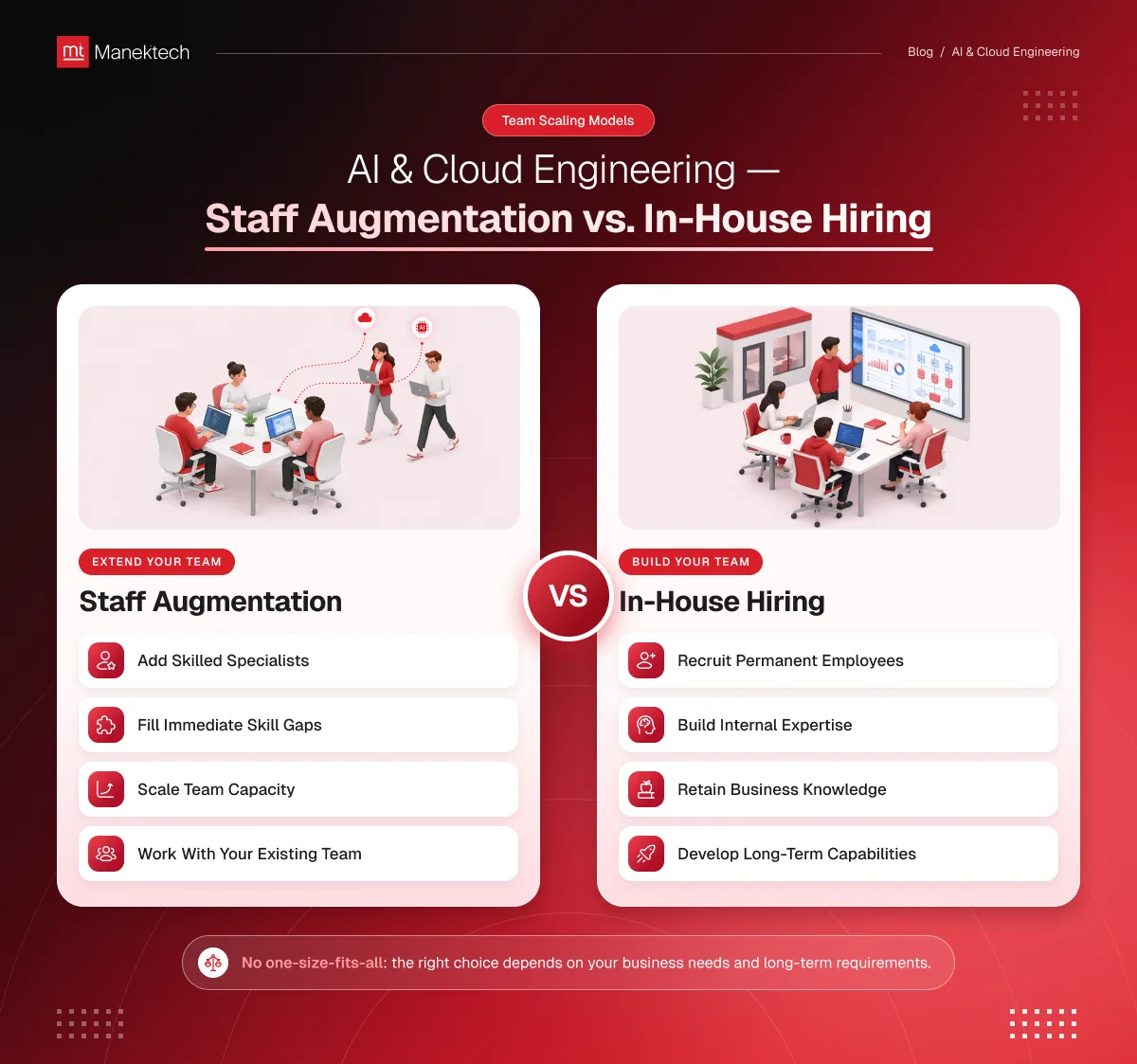
In most cases, staff augmentation works well when you need specific skills quickly or for a limited period. On the contrary, in-house hiring makes more sense when the work is long-term and central to your business.
This blog helps you understand the problems associated with scaling AI and cloud engineering teams, the concept of staff augmentation and in-house recruitment, and when to choose each option.
Why Scaling AI and Cloud Engineering Teams Is Difficult Today
If you are willing to grow your AI or cloud team, you face significant challenges that you won’t face with other teams. The skills involved are highly specialized, change quickly, and are in demand across almost every industry. The main challenges include:
a) It is hard to find skilled talent: To achieve your objective, you require ML engineers, MLOps specialists, data engineers, generative AI developers, DevOps and Kubernetes engineers, LLM engineers, and cloud architects. But the issue is that there are fewer qualified people than open positions. According to ManpowerGroup’s 2026 Talent Shortage Survey, 72% of employers report difficulties while recruiting new talent, and AI skills have now become the hardest to find globally.
b) Hiring takes a long time: The HR department needs to source candidates, and you have to conduct interviews and take technical tests. Specialized roles take even longer. More often, strong candidates receive multiple offers. Chances are that a preferred candidate declines the offer late in the process. In that scenario, you have to restart the search.
c) Rising salaries: Because of heavy demand, senior AI and cloud engineers expect strong pay packages. This is an area where small firms lag and are unable to compete with large tech firms. To manage these costs, many companies choose to hire offshore machine learning developers.
d) Change in workloads: There are chances for an AI pilot to grow into a full product or get dropped after a few months. If you aim for cloud migrations, you need a lot of people at first, but fewer later. For example, moving workloads to AWS, Azure, or GCP involves assessing existing systems, re-architecting applications, migrating databases, and running old and new environments in parallel until the final cutover. When systems are stable, fewer engineers are needed to manage them.
What Is AI & Cloud Engineer Staff Augmentation?
When you add external professionals to your existing team for a defined period, the engagement model is known as staff augmentation. These engineers aren’t a separate vendor team working on their own. They join your daily stand-ups, use your tools and repositories, follow your coding standards, and work toward the same sprint goals as your in-house developers.
Usually, companies resort to this approach when they need to fill skill gaps and increase capacity. This way, they can move toward an AI and cloud engineering project faster. As the client, you maintain full direction and oversight, and the staffing partner handles sourcing and employment logistics.
A Practical Example
Consider a mid-sized fintech company. Their fraud detection model performs well in testing, but it has never been deployed into production because the team lacks experience with MLOps. The company is adding an augmented MLOps engineer for 5 months, reporting to the head of data science. The engineer is working on automating deployments, setting up model monitoring, and training 2 internal developers to maintain the pipeline. The company can move the model forward to production without adding permanent staff, through a well-planned transition.
What Does In-House Hiring Mean?
At times, companies may be inclined to hire permanent, full-time employees for one reason or another. When that happens, they need to pay salaries to their employees. Along with salary, the employees also receive health insurance, leave, and bonuses.
The investment goes beyond pay, though. Companies spend on recruitment, including job postings, recruiter fees, interviews, and technical assessments. The onboarding can take several weeks before a new engineer is fully productive.
Hiring in-house is a long-term employment commitment. If you plan to hire in-house when it comes to scaling cloud and AI projects, arrangements for training and upskilling must be made. This is because AI tools, frameworks, and cloud services keep changing.
In return, this investment builds lasting value. Engineers take ownership of critical systems, understand the product deeply, and build strong internal engineering capabilities that support future AI and cloud initiatives.
Augmentation vs. In-House Hiring: A Side-by-Side Comparison
Scaling is possible with both models, but the thing is, they work very differently. Let’s have a look at the table below:
| Factor | Staff Augmentation | In-House Hiring |
|---|---|---|
| Recruitment and onboarding time | Often one to four weeks or several months, depending on the role and the partner’s talent pool. | Typically several weeks to a few months, depending on seniority, market demand, and notice periods. Onboarding adds further ramp-up time. |
| Cost structure | Variable. Here, you pay for the skills and time you use. Rates may be higher than equivalent salaries, but recruitment, benefits, and HR costs are usually included in the rate. | Largely fixed: salary, benefits, recruitment, training, and equipment. Total cost depends on retention, utilization, and how long the role is needed. |
| Flexibility and scalability | As requirements change, you have the option to scale this model up or down easily. | Harder to adjust once people are hired. |
| Access to niche skills | You gain quick access to specialists like MLOps or LLM experts. | The provision is limited by what you can find and afford. |
| Control and management | You direct daily tasks, priorities, and technical decisions, while the vendor handles employment, payroll, and HR matters. | Full control over daily work, along with hiring, performance management, and career development. |
| Knowledge retention | Knowledge may leave when the contract ends. | Knowledge stays and grows within the company. |
| Security and compliance | Can meet strict requirements through NDAs, role-based access, secure environments, and vendor security certifications. Suitability depends on regulations, data residency, and contract terms. | Internal policies apply directly to employees, but strong access controls, training, and compliance processes are still required. |
| Management overhead | Lower HR and administrative workload, but internal leads must onboard, guide, and integrate external engineers. | Higher HR effort for hiring, reviews, training, and retention, though team integration tends to be more natural. |
| Long-term value | Supports both short-term projects and longer engagements. Long-term value depends on knowledge transfer and partner continuity. | Builds lasting internal capability, institutional knowledge, and future technical leaders. |
| Main risks | Vendor dependency, uneven quality, and IP concerns | Slow hiring, high fixed costs, and attrition |
AI vs. Cloud Engineering: How Do Staffing Requirements Differ?
More often, AI and cloud engineering are grouped together, but they involve different skills, project patterns, and long-term needs. If you understand these differences, you can decide which roles to augment and which to build in-house.
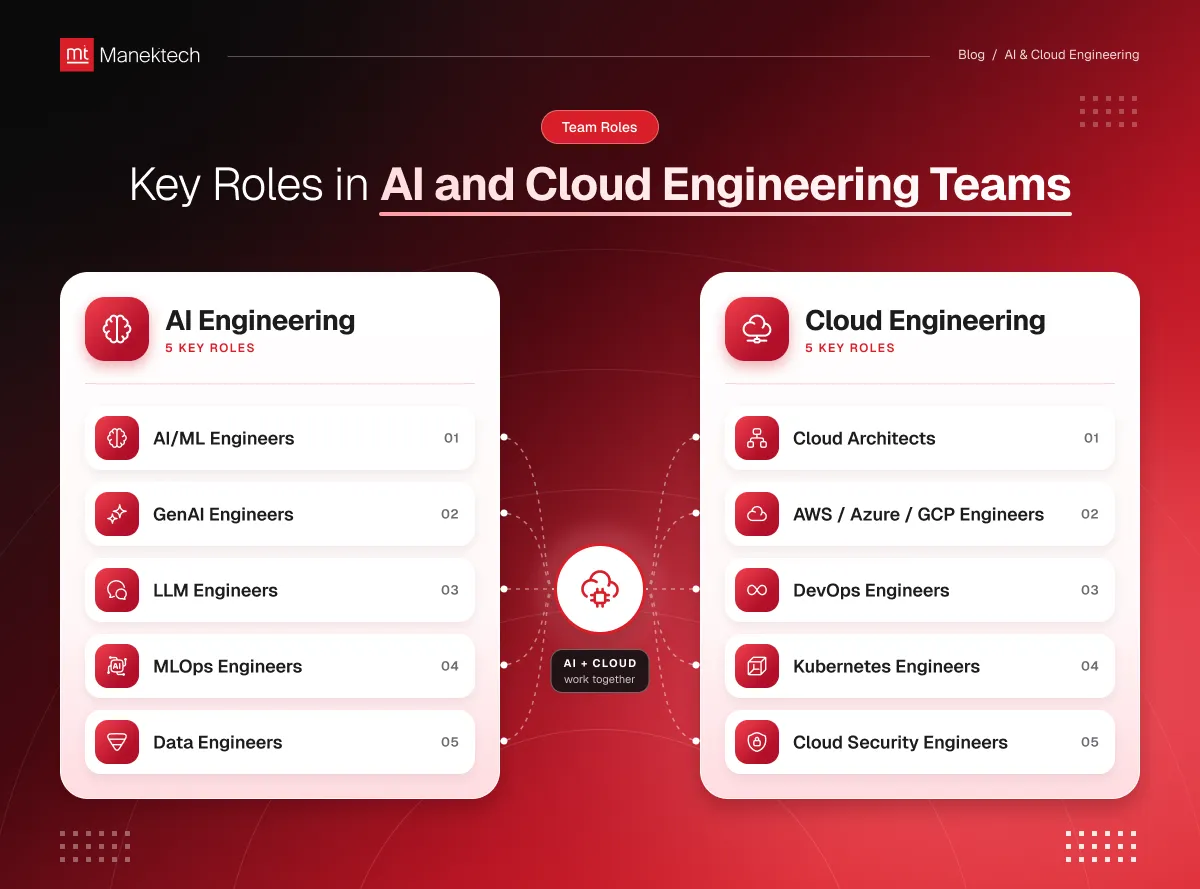
AI Engineering Roles
Usually, AI work is iterative and experimental. Teams test ideas, refine models, and often change direction based on results. Typical roles include:
- AI/ML engineers
- Generative AI developers
- LLM engineers
- MLOps specialists
- Data engineers
Cloud Engineering Roles
Cloud work focuses on infrastructure, reliability, and security. It starts with a large build or migration phase, followed by ongoing operations. Some common cloud engineering roles include:
- Cloud architects
- AWS/Azure/GCP engineers
- DevOps engineers
- Kubernetes specialists
- Cloud security engineers
Why Hiring Approaches May Differ
AI and cloud projects follow different patterns, and hence, the same staffing model doesn’t always fit both.
a) AI projects start with uncertainty: Many begin as pilots or proofs of concept, and it isn’t always clear whether they’ll scale. You can test ideas without long-term commitments if you augment with generative AI developers or LLM engineers. Results from a pilot clearly highlight which skills the project actually needs. These can be fine-tuning, data engineering, or production deployment. Once a model proves its value, building an in-house team is more reasonable.
b) Cloud projects have clear peaks: A migration to AWS, Azure, or GCP may need several cloud and DevOps engineers for a few months, but the requirement is less afterward. During this period, teams require extra hands to set up landing zones, containerize applications, and rebuild CI/CD pipelines for the new environment. Augmentation suits the migration phase, while a smaller in-house team can manage day-to-day operations.
c) Security and compliance shape cloud staffing: Cloud security deals with sensitive systems and regulated data. It’s the reason why many companies prefer to keep at least core security ownership in-house. This ownership covers identity and access management (IAM), encryption key management, audit logging, and compliance with standards such as SOC 2, ISO 27001, or HIPAA.
Specialist cloud security engineers can be augmented for focused work like security audits, penetration testing, or zero-trust implementation projects.
d) Some roles sit between both areas: MLOps specialists and data engineers work on AI projects, but most of their day-to-day work happens on cloud infrastructure, such as storage, compute, and container platforms. Their work includes building data pipelines, managing model deployments on Kubernetes, and controlling the compute costs of training and inference. Mostly, companies augment these roles first since they are harder to find. Companies hire permanently once their AI workloads become stable.
When to Augment Your AI and Cloud Engineering Team
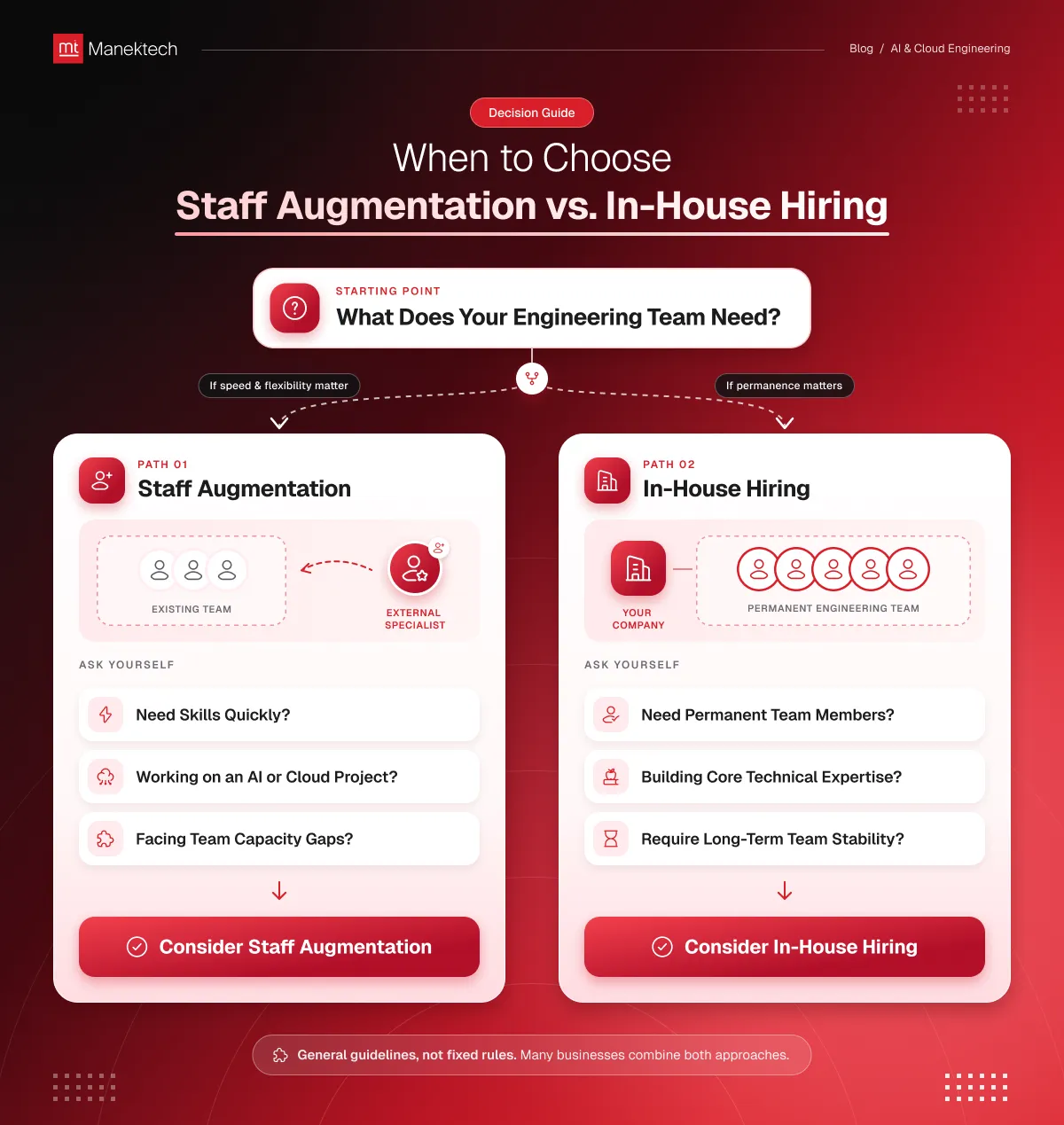
AI staff augmentation services work best when you need skills or extra capacity without adding permanent headcount. Here are five situations where AI and cloud engineer staff augmentation makes sense:
1. When AI or cloud skills are required quickly
Some projects can’t wait for a long recruitment cycle, especially when the skill is rare in the local market. AI augmentation gives you access to engineers who have already worked with the tools and platforms your project needs, so they need less ramp-up time.
Example: For example, an e-commerce company wants to roll out AI-powered product recommendations before the holiday season, but its in-house developers have never built a recommendation system. It hires an ML engineer who has done similar systems instead of waiting several months to hire. Since the engineer already knows the tools, they don’t need training on the technology. Instead, they can spend their first few weeks learning the company’s data, product catalog, and customer behavior.
2. When building an AI proof of concept or pilot project
Before investing in an AI team, most companies need to confirm that an idea works with their data and delivers business value. AI augmentation lets you run that experiment with the experts while keeping your options open. If the pilot succeeds, you can decide whether to hire. If it doesn’t, you won’t be left with permanent roles you no longer need.
Example: A logistics company wants to test if standard artificial intelligence can predict delivery delays based on its shipment and route data. It is adding a data scientist and an ML engineer to its AI development team for a 12-week pilot. At the end of the day, leadership will look at the results and decide whether to build an internal team, extend the engagement, or pause the project.
3. When handling temporary cloud migration or infrastructure projects
Cloud migrations, platform upgrades, and infrastructure modernization usually have a defined start and end. They need a team during the transition but fewer people once systems are stable. Permanent hires made for the peak can leave you overstaffed later.
Example: A healthcare SaaS provider is migrating from on-premises servers to AWS. It adds two cloud engineers and a DevOps specialist for the migration phase, working alongside its internal infrastructure team. Because the provider handles patient data, the augmented engineers work within its existing security policies and access controls. After the migration, the internal team will resume day-to-day operations.
4. When the existing team needs capacity to meet deadlines
Sometimes the issue isn’t missing skills but too much work. When engineers are stretched across feature development, bug fixes, and routine infrastructure tasks, deadlines slip, and the team is at risk of burnout. DevOps staff augmentation services can take over work such as CI/CD maintenance and environment management. Your core engineers can focus on product delivery.
Example: Imagine a fintech startup that has a hard regulatory deadline to meet, but is also dealing with infrastructure issues and support requests from its core team. It has added a DevOps engineer and two backend developers to handle infrastructure and support tickets. This way, the core team gets more time to finish the compliance features before the deadline.
5. When the business needs expertise that’s unavailable internally
Some projects require knowledge your team has never built, such as designing RAG pipelines, deploying AI agents, or setting up a multicloud security framework. Here, augmented engineers do more than just add hands. They bring proven practices, help your team avoid mistakes, and pass on their knowledge through documentation and pair programming.
Example: A media company building its first AI agent for content tagging may have strong developers but no one with LLM experience. It brings in an LLM engineer who designs the architecture, reviews it with the internal team, and trains two internal developers to maintain and extend it after the engagement ends.
When to Hire In-House
In-house hiring requires a larger upfront investment of time and money, but pays off handsomely when the work is long-term and core to your business. You should consider building an in-house team in the following situations:
1. You have a persistent long-term need for the same skills
If your business needs the same technical skills month after month, with no clear end date, a permanent hire is the better option. For example, a company running AI models in production needs constant monitoring, retraining, and optimization. A dedicated internal team will generally be cheaper in the long run than re-tendering the work and will build greater expertise in your systems.
2. Assess sensitive data carefully
Just because you’re dealing with sensitive data doesn’t mean you need to hire in-house. Your regulatory obligations, internal security policies, data residency requirements, controls on access, contractual commitments with clients, and your overall risk tolerance will determine the right solution for you.
Many companies safely work with augmented engineers, using NDAs, role-based access, and secure environments. But if the rules restrict third-party access, or the data is highly confidential, then the safer route may be to keep that work in-house.
3. The capability is part of your competitive advantage
A product might use proprietary AI models, a custom data platform, or a unique recommendation engine. When this is the case, ideally you should build it yourself. This work defines what makes your company different. Here, control and continuity matter more than short-term speed.
4. The work requires deep business and domain knowledge
Good AI and cloud solutions require an understanding of how the business works, including its customers, data, and workflows. This information is built up over time, and engineers who stick around for years make better decisions than those who join for a few months.
5. Your product roadmap is predictable
When your roadmap has a clear, stable direction, like steadily expanding one AI platform, you can confidently define long-term roles and hire for them. If you’re constantly shifting priorities between unrelated projects, flexible staffing may be the better fit until direction is clear.
The Cost of Getting It Wrong
Both staffing models work great when the job fits. The problem is when a company uses the same model for every need, and those costs don’t pop up until months later.
Relying too heavily on staff augmentation
a) Vendor dependency: If external engineers handle core systems for too long, your company may struggle to operate or change those systems without the vendor.
b) Knowledge loss: When a contractor rotates out, some knowledge goes out with them. Gaps in documentation lead to duplicated effort, bugs, and delays.
c) Loss of control over core capabilities: Over time, the company may lose ownership of the systems that set it apart from competitors.
Relying too heavily on in-house hiring
a) High fixed costs: Hiring permanently for a short-term peak, such as a cloud migration, can leave you with underused capacity and ongoing salary commitments once the work ends.
b) Attrition: AI and cloud engineers are in high demand, and losing a key team member can stall projects and restart the hiring cycle.
c) Skill gaps: A fixed team may not have the specialized skills a new initiative needs, such as LLM fine-tuning or Kubernetes at scale.
The Hybrid Model: Getting the Best of Both
In most instances, companies choose to go either with staff augmentation or in-house recruiting. But there is a hybrid approach that blends the two. It won’t be an exaggeration to state that many of the high-performing AI and cloud teams implement a hybrid structure.
When companies augment AI development team capacity through a hybrid setup, a stable internal management team stays in charge of strategy, architecture, and institutional knowledge. On the other hand, it’s the job of augmented specialists to provide execution and velocity in AI disciplines. The common ways companies set this hybrid model include:
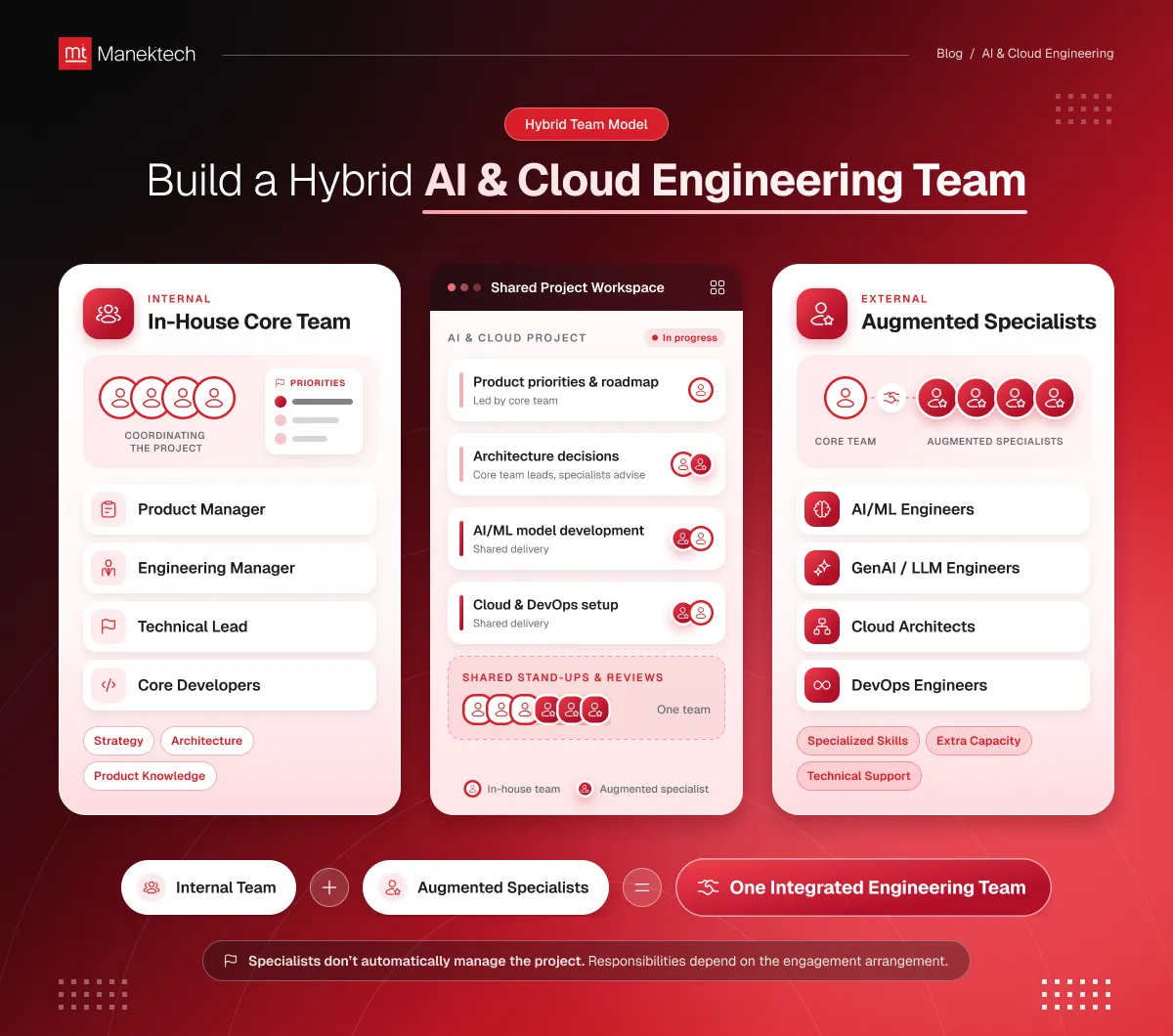
a) Core + flex: In this approach, the architecture, strategy, and key decisions are owned by the small in-house team. Only when workload grows, augmented engineers join them. For example, workloads can increase during cloud migration or a major AI feature launch.
b) Augment-to-hire: Some companies bring in engineers on a contract-to-hire basis. A major benefit of this model is that both sides get the time to test the fit before making a permanent commitment.
c) Bridge model: If a candidate who qualified in the interview has a lengthy notice period, augmented engineers can cover the role in the meantime. Hence, the projects keep moving, and the new employee joins a team that hasn’t fallen behind.
When Should You Consider Managed Services or Project-Based Outsourcing?
Staff augmentation and in-house hiring aren’t the only options. If your team lacks the time or leadership to manage engineers day-to-day, managed services or project-based outsourcing may be a better fit. The key difference between these models is who manages the work and who is responsible for the outcome. Let’s have a detailed look:
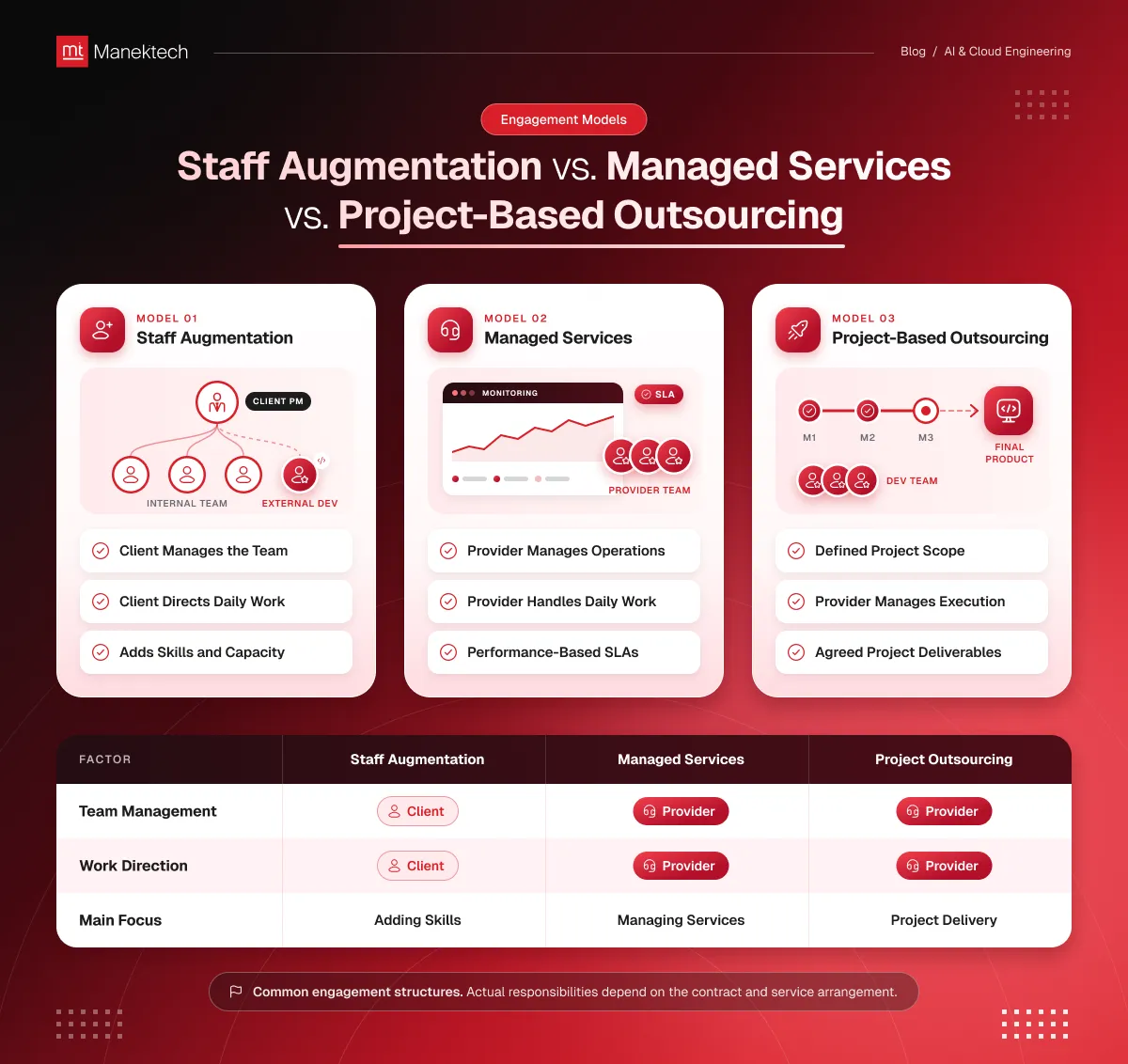
a) Managed services: The vendor is responsible for a continuous function, like cloud operations, MLOps, or infrastructure monitoring. Performance is typically measured against agreed service levels (SLAs) such as uptime or response times. You set the expectations, and the vendor takes care of the team, tools, and processes needed to achieve them.
b) Project-based outsourcing: The vendor provides a well-defined project (e.g., building an AI chatbot, completing a cloud migration) within an agreed scope, timeline, and budget. Once the project is delivered, it’s handed over to your team for ongoing ownership.
When to Consider Each Option
- Managed services are great for ongoing functions that are not central to your competitive advantage, and you don’t want to build an internal team to run it. Typical examples are cloud infrastructure management and 24/7 monitoring.
- If you have clear, stable requirements, the project has an end point, and you don’t need to be involved closely in day-to-day development, project-based outsourcing is a good fit.
Questions to Ask Before You Decide
Before you settle the augment vs. hire in-house AI engineers debate, you need to step back and look at the work itself. These are some of the questions that you should ask yourself to judge which model is the best fit for you:
1. How long will we need this skill?
If it’s required for a few months, you should opt for augmentation. However, if you require this skill permanently, go with in-house hiring.
2. Is the work core to our product or IP?
If it is, prioritize building that capability within your own team. Supporting or specialized tasks around it can still be augmented.
3. How quickly do we need people to be productive?
Permanent hiring can take months, especially for niche roles. If you have urgent deadlines, augmented talent can help you start sooner.
4. Do we have internal technical leadership to manage augmented engineers?
Augmented engineers need clear direction, task assignment, and code reviews from your side. If you have experienced tech leads or architects, augmentation works well. If not, consider managed AI development, or hire a technical lead first.
5. Does our budget favor fixed or flexible spending?
Augmentation comes with variable costs that rise and fall with your needs. In-house hiring means long-term fixed costs but often lower costs over time for steady work.
6. What security, compliance, and IP requirements apply?
You need to review your regulatory obligations, data residency rules, client contracts, and IP ownership needs. Many of these can be handled through NDAs, access controls, and clear contracts with an augmentation partner. Where third-party access is restricted, keep that work in-house.
Final Thoughts
Scaling AI and cloud engineering capacity isn’t about choosing one model over the other. What’s important is to match the right model to the right work. Yes, you will get benefits like speed, flexibility, and quick access to specialized skills with AI staff augmentation services, but times may arise when it is not the best fit.
In-house hiring gives you ownership, stability, and knowledge that stay with the company. If you want to blend these two approaches, that is also fine, but make sure your business is ready for it.
The most effective decisions are made role by role. The right choice for one position may not suit another. Evaluate how long you’ll need each skill, how central the work is to your business, and how much control and security oversight it requires.
Not sure which model suits your roadmap? ManekTech’s IT Staff Augmentation Services enable companies to access skilled AI, cloud, and DevOps engineers on a flexible basis to supplement their current teams. Whether you need to hire dedicated generative AI developers for a pilot project or expand your cloud team for a migration, our experts can help you build the right team for your needs. Talk to us about your project.
FAQs
Ans: Not always. In most cases, augmented engineers have higher hourly rates, but the major advantage is that you save on recruitment, benefits, training, and long-term salary commitments. When it comes to short-term or specialized work, augmentation costs less. But for steady full-time work over several years, in-house hiring is cheaper.
Ans: In staff augmentation agreements, the client owns the code, models, and other IP created during the engagement, but this depends entirely on the contract. Make sure the agreement includes a clear IP assignment clause, confidentiality terms, and NDA requirements. It’s also worth checking how the contract treats the vendor’s pre-existing tools or code, the use of open-source components, and whether the staffing partner’s agreements with its own engineers transfer IP rights to you.
Ans: You should give augmented engineers access only to the systems and data that they require to perform the tasks. It’s advisable to use role-based permissions, secure VPNs, and company-managed devices or environments. Also, strong security practices and strict data protection agreements must be followed by your staffing partner.
Ans: There are several factors to consider, and to be specific, you have to look beyond hourly rates and check the partner’s experience with AI, ML, and cloud projects. A reliable AI staff augmentation partner offers replacements if someone isn’t the right fit.
Ans: It depends on the provider. There are some engagements as short as a month, while others prefer three to six months for complex AI or cloud projects. Make sure you understand the notice period and how quickly you can scale the team up or down.
Ans: AI staff augmentation is when you bring in external engineers to join your team, and you direct their daily work, priorities, and technical decisions. Delivery remains at your risk.
When you outsource AI development, you hand over a specific project to a vendor. The vendor manages its own team and provides you with the completed solution. Augmentation works for companies with strong internal technical leadership, and outsourcing works for companies that want a specific outcome without managing engineers directly.
Related Blogs
Learn how to set up an offshore development center in India. Explore ODC models, setup costs, hiring, benefits, challenges, and ODC vs. GCC.
15 Min ReadNov 13, 2026
Jayendu Vyas
VP of Sales at ManekTech
Looking for the trusted mobile app development companies from India? Check out top 10 trusted mobile application development companies in India for outsource remote app projects.
15 Min ReadJun 23, 2026

Nikhil Solanki
Mobile Lead at ManekTech