
Project Overview
Phone Location Tracking App is a tailored solution that was designed for a US company that specializes in logistics services for online retailers and Direct-to-Consumer (D2C brands. Being in charge of delivery agents, third-party couriers, and warehouses located in different locations, our client had a need for a convenient tool for tracking deliveries, monitoring orders, and managing last-mile performance. Our client previously had to use spreadsheets, third-party software, and coordination to manage its delivery network. However, that made it hard to access reliable location data, manage operations with dispatches, and analyze delivery performance.
Project Objectives
- GPS tracking of delivery agents and field staff should be allowed.
- Increase visibility of last-mile deliveries and order tracking.
- Optimize delivery routes to avoid unnecessary travel and fuel consumption.
- Coordinate dispatches and provide delivery status alerts through automation.
- Evaluate the performance of delivery agents through performance dashboards.
- Enhance communication with customers through updated delivery information.
- Provide reliable location tracking even in low network availability locations.
- Maintain location privacy through configurable privacy settings and data handling.
Let's Shape Your Project Together
Have an idea, a challenge, or a new project in mind? Our team is here to help.
Business Challenges
1. Lack of Real-time Delivery Tracking
The customer had a vast network of delivery agents, third-party couriers, and warehouse employees working in several cities. Spreadsheets and disconnected GPS solutions made it tough to get the present location of the delivery agents and track order status from a single point.
2. Low Efficiency of Delivery Management
It was hard for dispatchers to track delivery agents’ locations, delivery status, and route-related questions, as dispatchers had to phone delivery agents quite often. Such manual processes affected the decision-making process and increased the chance of mistakes.
3. High Fuel Expenses and Poor Route Planning
Poor route planning and lack of efficient delivery management led to extra travel for delivery agents, inefficient routes, and delays. This resulted in rising fuel costs and lower productivity.
4. Poor Tracking Performance Metrics Analysis
There was no efficient way of gaining insights into delivery times, route efficiency, active hours, and delivery agents’ performance in the previous process. This analysis process required considerable manual effort from the managers and was likely to involve errors on their part.
5. GPS Accuracy, Power Consumption and Connectivity
Continuous GPS monitoring would have an effect on mobile battery life, and insufficient internet connection could hinder the accuracy of location sharing. An app should be able to manage location sharing without draining the device’s battery power and maintaining proper connectivity.
6. Data Management and Security of Location Sharing
Location monitoring of delivery agents requires secure management of the information gathered. The application had to have adjustable levels of confidentiality and the ability to manage tracking information appropriately.
Our Solutions
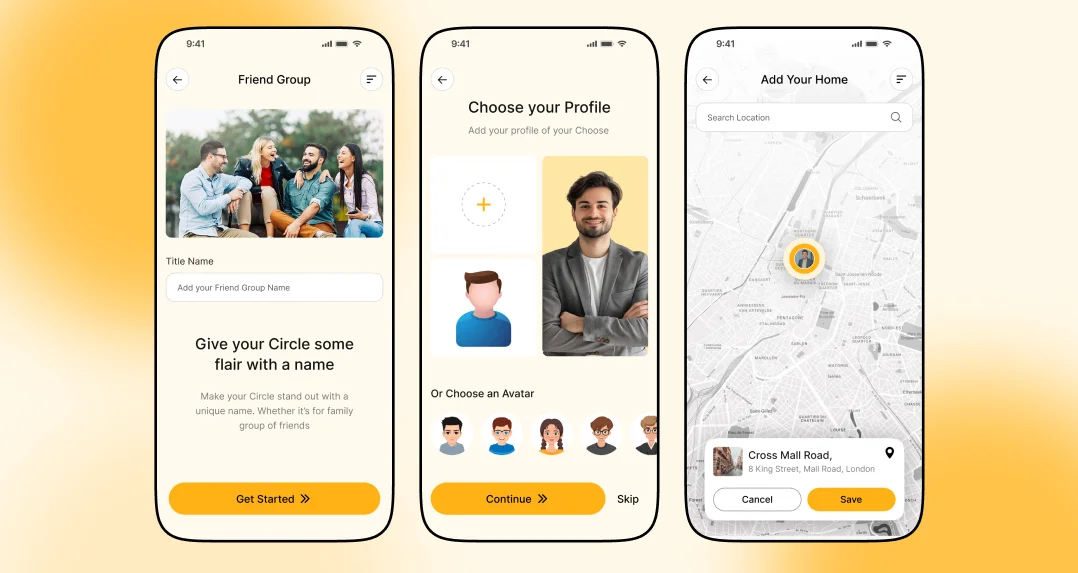
To solve the client’s problems with delivery management, we have created an integrated Phone Location Tracking App that includes all necessary functions of GPS tracking, delivery, routing, notifications, and report generation. Our Mobile app development team used a business-oriented methodology to create the app that started with requirements analysis and workflow mapping in order to comprehend the company’s delivery chain, its agents and their activities, as well as reports. As for the technology stack, the cross-platform mobile app was created via React Native, and Node.js and Express.js were used to develop the back-end. MongoDB handled the tasks of data tracking and management, Google Maps API was used to visualize locations and routes on the map, Firebase Cloud Messaging sent notifications, and AWS cloud services hosted and stored the app. The solution is created to improve control over the operations of the dispatch manager and delivery agents. Real-Time GPS Tracking and Integration With Google Maps We also integrated real-time location tracking powered by GPS with the Google Maps API. This is in order to facilitate managers in visualizing delivery agents through Google Maps. The system is enabled to push location update messages periodically as set by the manager. This feature will eliminate multiple phone calls and facilitate efficient coordination within the delivery network. Intelligent Routing and Geofencing In addition to this, our application possesses route optimization abilities that assist businesses in assessing the distance to be travelled, weather conditions, etc. Geofencing is a feature in the application that will allow managers to get alerts once an agent enters or exits a particular geographical zone. It will be easier for companies to know inefficiency in their route planning and delivery activities. Automated Alerts and Delivery Status Updates Firebase Cloud Messaging has been used for the delivery of timely alerts in relation to location updates, orders, and deliveries. Such alerts assist the management team in staying up-to-date on all delivery activities. Offline Capability and Data Synchronization In response to the issues with connectivity, the system allows for offline capability and synchronization once the network connectivity is back. It allows keeping the tracking information during periods of network outage. Performance Metrics and Delivery Reports The delivery times, active hours, route efficiency, and delivery history have been gathered into a single report using a performance dashboard. The dashboard allows managers to assess the productivity of agents and the existing bottlenecks. Key Benefits
- Monitor delivery drivers through GPS tracking.
- Enhance visibility of last-mile deliveries.
- Avoid unwanted travel with routing and optimization.
- Get geofencing alerts based on location.
- Notify the delivery crew using push notifications.
- Access past routes and delivery analysis.
- Make better decisions with analytics.
- Allow location data synchronization even in case of network outages.
- Offer flexible controls for location sharing.
- Develop a cross-platform solution for Android and iOS.
- Create a scalable base for a growing delivery fleet.
Key Features
Technology
| Frontend / Mobile App | React Native |
| Backend | Node.js, Express.js |
| Database | MongoDB |
| Maps & Location APIs | Google Maps API, Geolocation API |
| Push Notifications | Firebase Cloud Messaging (FCM) |
| Cloud Hosting | AWS EC2 |
| Cloud Storage | AWS S3 |
| Location Tracking | GPS, Geolocation Services |
| Geographical Monitoring | Geofencing |
| Architecture | Cross-Platform Mobile App with Cloud-Based Backend |
Business Results
40%
Reduction in Delivery Delays and Idle Time
Real-time location visibility helped dispatch managers identify delivery bottlenecks, coordinate field teams, and respond to operational issues more efficiently.
25%
Decrease in Fuel Consumption
Route planning and optimization capabilities helped reduce unnecessary travel and support more efficient delivery journeys.
50%
Improvement in Delivery Agent Productivity
Automated tracking, delivery history, and centralized performance reporting helped managers monitor agent activities and identify opportunities to improve productivity.
35%
Faster Dispatch Coordination
Live location updates and automated notifications reduced reliance on repeated phone calls and supported quicker communication between dispatch managers and delivery agents.
60%
Reduction in Customer Complaints
Improved delivery visibility and timely status updates helped address common customer concerns related to late or missed deliveries.
45%
Improvement in Customer Satisfaction
More accurate delivery information and better operational coordination contributed to a smoother delivery experience for customers.
30%
Increase in On-Time Delivery Rate
Better route visibility, delivery monitoring, and dispatch planning supported improvements in the percentage of orders delivered on schedule.
Product Gallery
Planning a Similar Mobile Application Project?
Whether you’re building from scratch, modernizing an existing application, or expanding your engineering team, our experts are ready to help.
- 450+ Engineers
- 14+ Years
- Flexible Engagement
- US Business-Hour Collaboration
Frequently Asked Questions
A phone location tracking app uses GPS and location services on the phone to share the phone’s location. In the logistics industry, it enables logistics firms to track their delivery agents, delivery status, logistics dispatch operations, and last-mile delivery operations.
This app enables logistics firms to track delivery agents, track delivery routes, perform logistics dispatch operations, receive geofence alerts, and analyze performance. All these features will enable logistics firms to avoid delays and plan deliveries better.
React Native was used to develop the front-end of the application. Node.js and Express.js were used to develop the back-end of the application, while MongoDB was used for data storage. Google Maps API was used for location visualization, Firebase Cloud Messaging for push notifications, and AWS EC2 and S3 for cloud infrastructure.
Yes, as the application employs GPS location tracking updates and Google Maps integration to assist authorized managers in monitoring the movement of the delivery agents and analyzing their routes.
The app has the ability to work offline and synchronize the data to overcome any potential connectivity issues. The effectiveness and availability of real-time location tracking are dependent on GPS signal, access permissions, battery settings, and network connectivity.
Geofencing creates a virtual fence around the specified area. If the location tracking participant goes in and out of this area, an alert can be created to track such events within the area and monitor them.
The price will depend on the set of features needed, mobile operating systems to be supported, backend needs, map integrations, security needs, and other factors. Real-time GPS location tracking, path optimization, geofencing, and many other features can affect the budget greatly. For more information, read our guide on application development cost estimation.