
Project Overview
Smart Security Camera App is an innovative mobile application designed for the needs of a company engaged in home security services in the United Arab Emirates. With the help of the app, it is possible to watch the security of your house, office, family members, pets, and other people remotely through your smartphone. The application provides real-time video feed, motion detection, notifications, and two-way audio communication. The previously used approach involved the application of software and hardware for monitoring that was mostly used at desktop computers. However, the clients needed to monitor their property even when they were away from home or traveling. Thus, it was necessary to design a smart security camera application with an integrated remote monitoring and surveillance service. Businesses can develop custom surveillance applications tailored to their camera hardware, customer requirements, subscription model, and security workflows. Explore our Android app development services, Flutter app development services, and iOS application development services to learn more
Project Objectives
- Create a mobile security camera application for remote surveillance of homes and offices.
- Provide real-time video streaming from linked security cameras.
- Provide instant alerts about any movement and sound in order to take action regarding any suspicious activities.
- Provide two-way communication via the linked devices.
- Provide surveillance and management capabilities for multiple cameras through one application.
- Provide privacy protection in videos through secure data transfer and access.
- Provide good user experience with user-friendly interface.
- Provide assistance to the client to grow in the market of smart home security.
Let's Shape Your Project Together
Have an idea, a challenge, or a new project in mind? Our team is here to help.
Business Challenges
1. Restricted Accessibility of Remote Cameras
Previously, the customer’s solutions were mostly based on desktop software applications or even physical equipment. It was hard for clients to get access to the security footage remotely since there was no such option available. It was time to make an application that would enable the user to do that anytime he or she needed.
2. Ineffective Notifications About Security Issues
Users could easily miss any significant security issue due to no notifications about movements and unusual noises. Thus, it was crucial to create a platform that would send instant alerts whenever something happens.
3. Hard Multi-Camera Management
Users sometimes have to monitor several places, different rooms, or even a couple of properties simultaneously. It becomes harder to control all cameras separately.
4. Performance of Video Streaming and Reliability
Video surveillance must provide reliable video streaming and responsive playback, even in cases where the users do not have sufficient network bandwidth. Providing users with a seamless video experience on different mobile devices and networks was another technical challenge.
5. Privacy and Protection of Video Streams
Security cameras collect sensitive video from homes, offices, and other private premises. Video streams, recordings, and customer accounts had to be protected for ensuring customer confidence. Secure communication, access control, and proper protection of data were necessary.
6. User-Friendly Smart Security Controls
The application had to cater to both technologically savvy customers and those who were using smart home solutions for the first time. Complex camera settings and monitoring options might deter the use of such applications.
Our Solutions
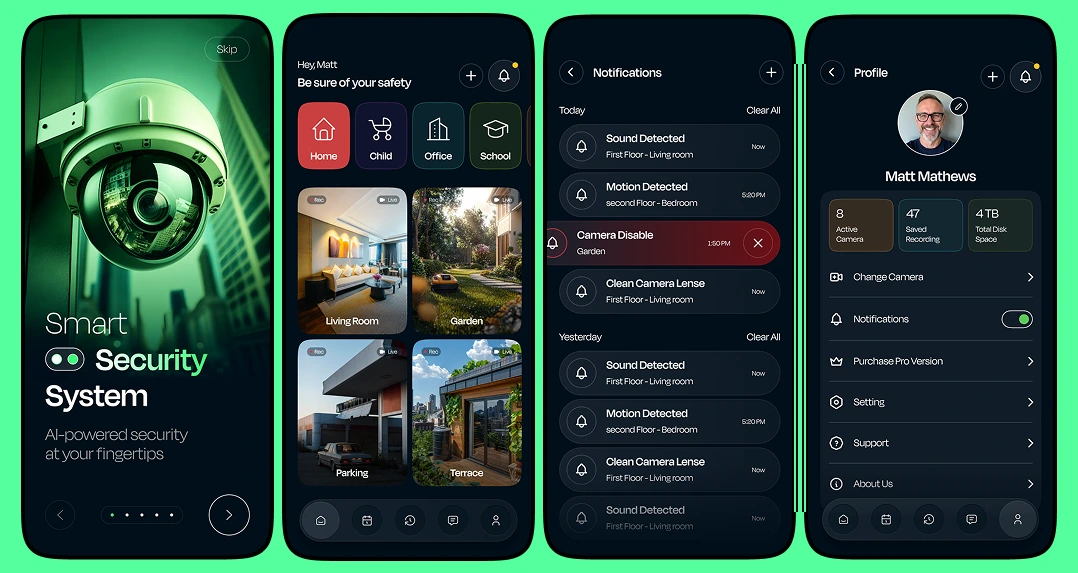
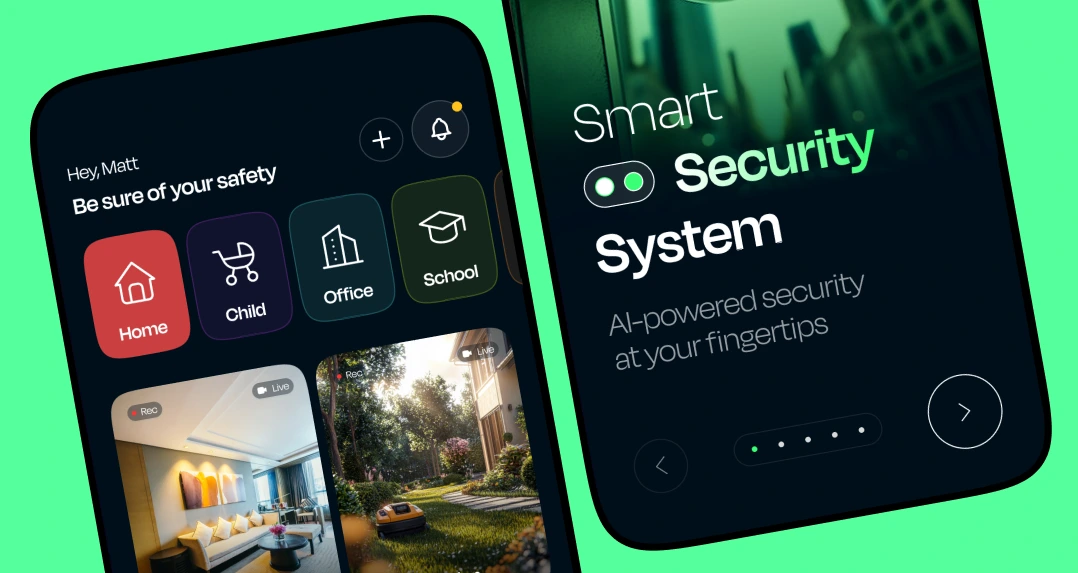
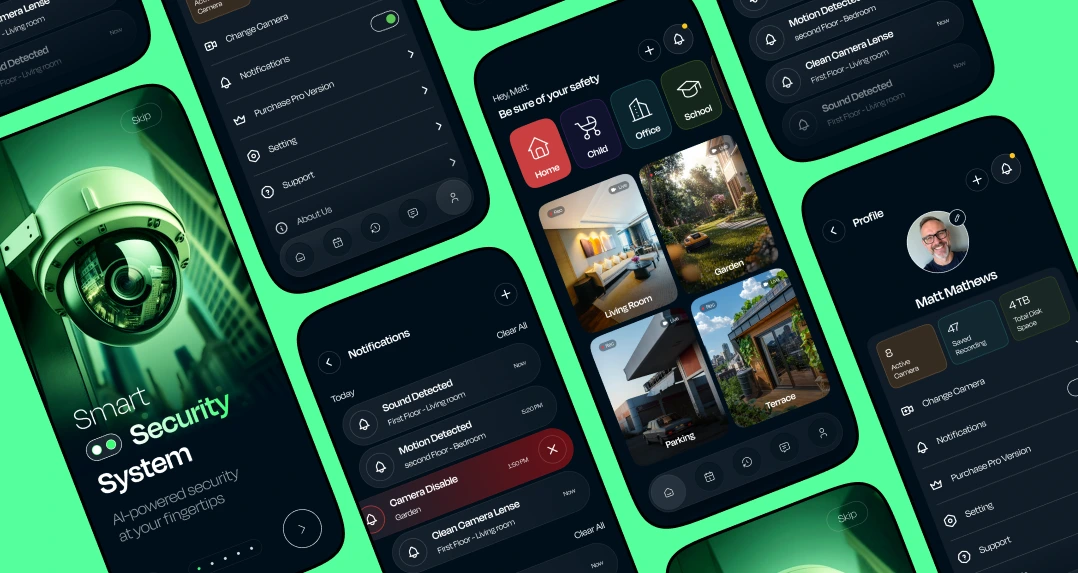
Being a leading Flutter app development company USA, we first did research for the best security camera apps that are already performing great in the market. we have created an intelligent security camera mobile app that incorporates remote surveillance, live video streaming, smart alerts, and multiple-camera management within one mobile environment. In our case, the main focus is the creation of a reliable, accessible, and security-minded tool for connecting with one’s property from literally anywhere around. Combining mobile app development solutions with real-time communication possibilities, along with cloud technology, provides a great opportunity for live surveillance, communication via connected devices, and receipt of alerts concerning potential security concerns. Enable Real-Time Video Surveillance For users to view their connected security cameras through their smartphones, we created a possibility of live video streaming. Using WebRTC technology, as well as streaming optimization and video compression, this feature was created to provide responsive video streaming in different conditions. This helps users to control their houses, offices, children, or pets not depending on any desktop surveillance system. Provide Smart Motion and Noise Notifications This app is designed to have motion detection and notification functions for users to be aware of any possible incidents. Motion and noise alerts were implemented to enable intelligent recognition and differentiate what actions are related and what are not related to security notifications. Such notifications can make people aware of the incidents happening on their property and take adequate actions. Multi-Camera Monitoring Simplified This app also allows for multi-camera monitoring, meaning that a user can monitor several cameras using one application. That means that people will not need to switch between different systems to monitor different rooms/locations of their business. The platform also includes user access controls to help manage who can view camera footage. Enhance Video Security and Communication Securing any sensitive information from surveillance was one of the most important features to consider when developing. The system allows for encryption and secure cloud storage for protecting the video data. Two-way audio lets the users communicate with anyone close to the camera through the built-in microphone and speaker. Key Benefits
- Monitor your homes, offices, kids, and pets remotely.
- Check security camera footage via a mobile app.
- Get alerts for motion detection and noise detection.
- Communicate via connected security cameras using audio.
- Control multiple security cameras from one central place.
- Gain better awareness of security incidents with intelligent alerts.
- Protect video privacy with encryption and secure access.
- Gain convenience with mobile monitoring instead of desktop monitoring.
- Boost your digital security service with smart surveillance systems.
- Open up new avenues for subscription-based security services.
Key Features
Technology
| Mobile App Development | Flutter, React Native |
| Programming Language | Dart |
| Backend Development | Node.js |
| APIs | RESTful APIs |
| Video Streaming | WebRTC |
| Camera Streaming Protocol | RTSP |
| Video Processing | FFmpeg |
| Database | MongoDB, Redis |
| Authentication | OAuth 2.0, JWT |
| Data Encryption | AES-256, SSL/TLS |
| Cloud Infrastructure | AWS |
| Cloud Storage | Amazon S3 |
| Content Delivery | Cloud CDN |
Business Results
35%
Increase in New Subscriptions
The mobile security solution helped the client strengthen its digital service offering and attract new subscribers within three months of the application’s launch.
40%
Improvement in Customer Engagement
Convenient access to live video feeds and security alerts encouraged customers to interact more frequently with the application and monitor their properties remotely.
50%
Reduction in False Alarms
AI-powered motion and noise detection helped reduce unnecessary alerts, making security notifications more relevant and useful for customers.
30%
Faster Response to Security Events
Real-time notifications and remote camera access helped users become aware of potential security incidents sooner and respond more quickly.
45%
Growth in Multi-Device Usage
Multi-camera monitoring encouraged customers to connect and use multiple cameras, supporting broader surveillance coverage across rooms, homes, and business locations.
Product Gallery
Planning a Similar Mobile Application Project?
Whether you’re building from scratch, modernizing an existing application, or expanding your engineering team, our experts are ready to help.
- 450+ Engineers
- 14+ Years
- Flexible Engagement
- US Business-Hour Collaboration
Frequently Asked Questions
A smart security camera app is the application that enables users to keep track of connected cameras, monitor live videos, and receive notifications for security purposes.
It provides live streaming, two-way audio communication, motion and sound notifications, multi-camera control, remote viewing access to cameras, controlling access to accounts, night vision cameras and cloud-based video storing.
Surely, users have the opportunity to connect to their cameras using the mobile app and monitor the safety of their house and other real estates from far distances via internet connection.
It makes a combination of live streaming and alert notifications for any movements and sounds.
The solution uses such tools as encryption, secure communication, authentication, and access control in order to provide security for camera footage and user accounts. Whether it really works is defined by the implementation, configuration of the device and security measures used in the system.
Yes, multi-camera support is possible and enables users to control multiple cameras from one application. Such functionality makes the app relevant for use in both private houses and offices.
It largely depends on the features needed, platforms where the app will work, camera compatibility, streaming capabilities, cloud storage, security, and back-end development. For a detailed breakdown, read our guide on mobile app development costs.