


Best Cities in India to Set Up a GCC or Offshore Development Center
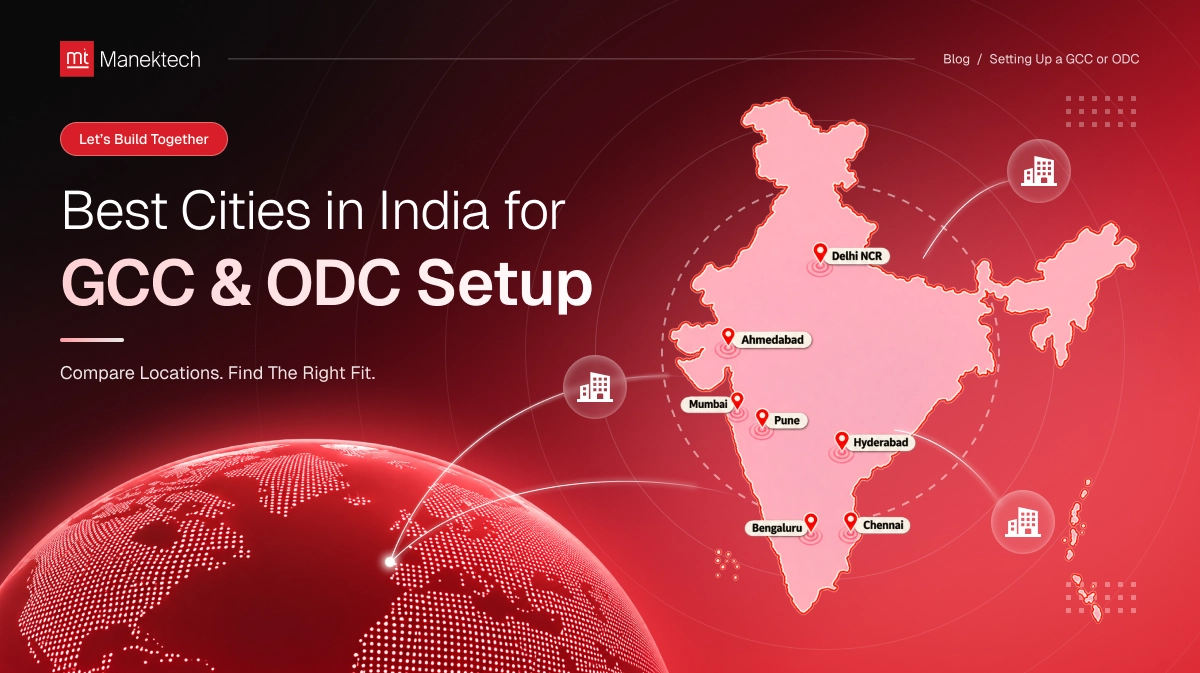
Global Capability Centers (GCCs) and Offshore Development Centers (ODCs) allow international businesses to build and expand their technology and business operations in India. With established IT ecosystems, a large engineering workforce, and different operating environments across cities, India offers several locations for companies planning offshore expansion.
However, choosing the right city requires more than comparing salary levels or office rental costs. Businesses need to consider specialized talent availability, hiring scalability, industry expertise, infrastructure, employee retention, and long-term operating expenses.
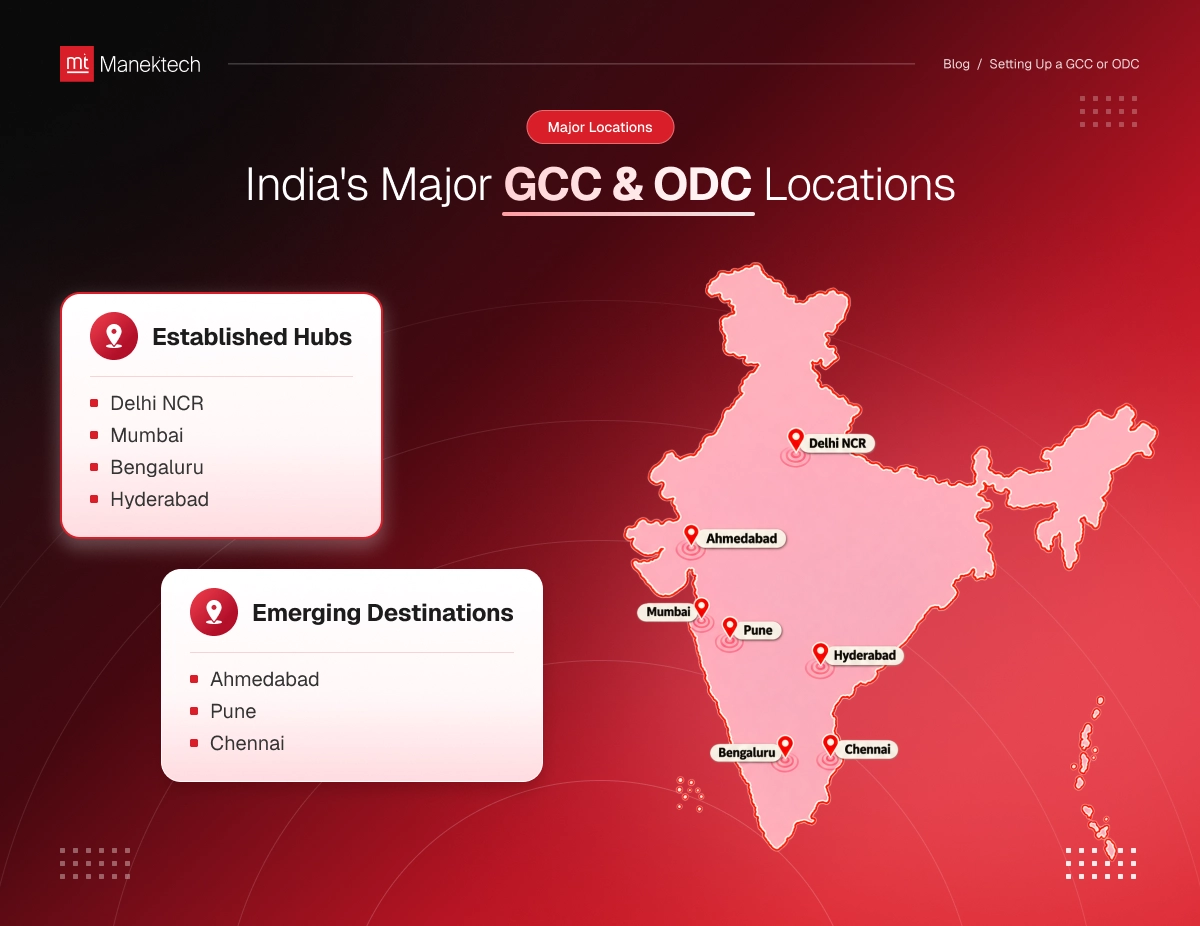
Cities such as Bengaluru, Hyderabad, Pune, Chennai, Mumbai, and Delhi NCR have established technology and business ecosystems. Emerging destinations such as Ahmedabad, Jaipur, Coimbatore, Kochi, and Mysuru may also suit companies with specific hiring and operational requirements.
This guide compares the leading GCC and ODC destinations in India, explains the strengths and limitations of each location, and highlights the factors businesses should evaluate before making a decision.
Which Cities Are Best for GCC and ODC Setup in India?
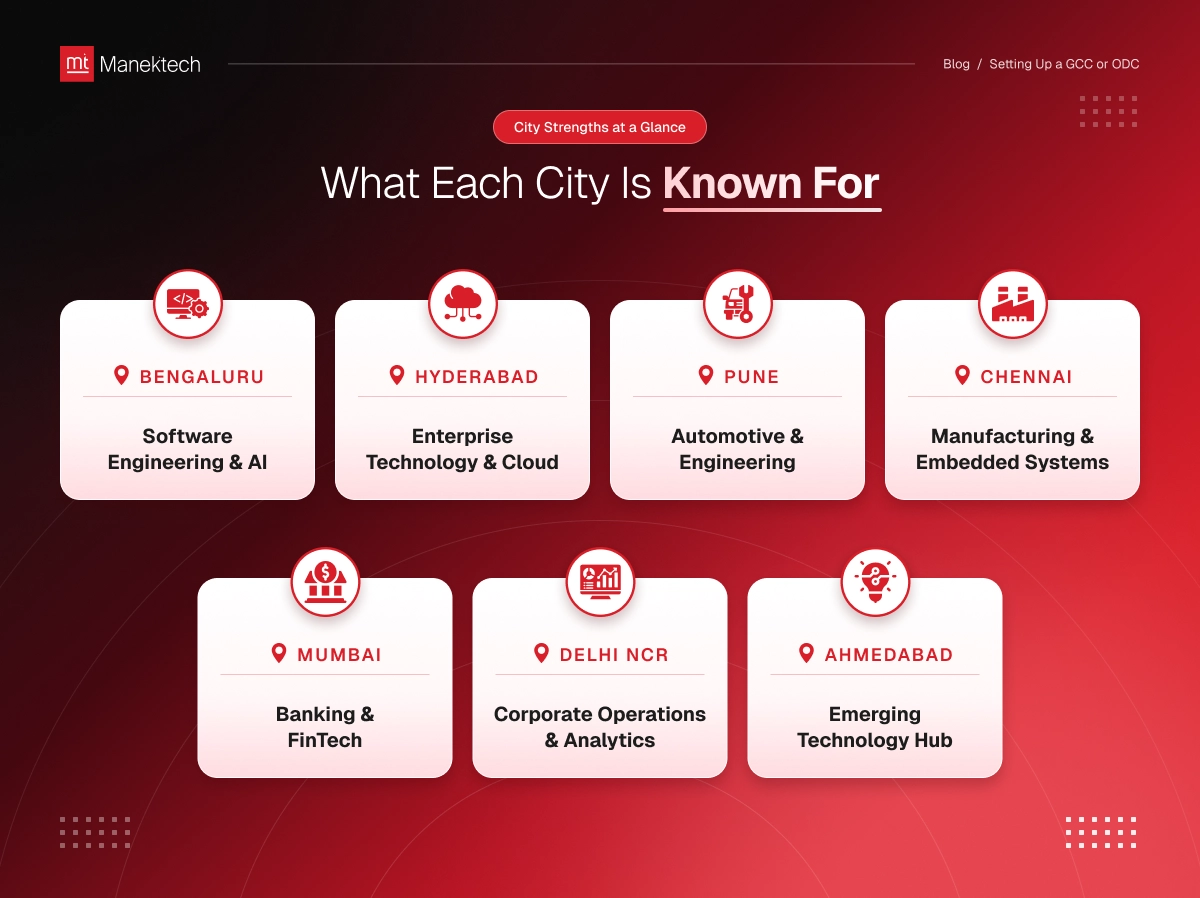
The best city depends on your business requirements, technology needs, and operating model. Here is a quick overview of the major GCC locations in India and their primary strengths:
- Bengaluru: Software engineering, artificial intelligence, research and development, and product engineering.
- Hyderabad: Enterprise technology, cloud computing, data engineering, and large-scale GCC operations.
- Pune: Automotive technology, engineering, embedded systems, and enterprise software.
- Chennai: Manufacturing technology, industrial engineering, embedded systems, and financial services operations.
- Mumbai: Banking, financial services, insurance, fintech, and enterprise operations.
- Delhi NCR: Corporate operations, consulting, analytics, telecommunications, and technology services.
Emerging destinations such as Ahmedabad, Jaipur, Coimbatore, Kochi, and Mysuru are also worth evaluating for smaller teams and specialized operations, depending on talent requirements, hiring plans, and operating costs.
Why Is India a Preferred Destination for GCC and ODC Setup?
India has become an important destination for international companies looking to establish Global Capability Centers and Offshore Development Centers. Its established IT services industry, engineering talent pool, technology infrastructure, and experience supporting global businesses make it a viable location for different types of offshore operations.
Companies can build teams across software engineering, artificial intelligence, cloud computing, cybersecurity, data analytics, product development, and business operations. The country’s diverse technology ecosystems also allow businesses to evaluate locations based on their specific hiring requirements and operational priorities.
Skilled IT Workforce
India has an established technology workforce supported by engineering institutions, technical universities, professional training programs, and a mature IT services industry.
Businesses can recruit professionals across software development, UI/UX design, cloud engineering, cybersecurity, data analytics, quality assurance, and other technology disciplines. The availability of talent varies by city, experience level, and specialization, so companies should assess the local hiring market before selecting a location.
Competitive Talent and Operational Costs
India can offer a different cost structure compared with many Western markets, particularly for technology hiring and certain operating expenses. However, actual costs vary by city, experience level, technical specialization, and office location.
Businesses should compare the total cost of operations, including salaries, recruitment, employee benefits, office rentals, infrastructure, management, and employee retention. A city with lower average salaries may not necessarily be the most cost-effective choice if specialized hiring is difficult or employee turnover is high.
Global Exposure and English Language Proficiency
India’s large professional workforce includes many English-speaking technology specialists and business professionals. This supports communication with international stakeholders, participation in cross-border projects, and coordination between offshore teams and headquarters.
Growing Demand for Advanced Technology
Global companies are stepping up their game by expanding beyond just support roles to create high-value centers that specialize in product engineering, AI, analytics, and research. This creates opportunities for companies to establish teams that contribute to product development, technical innovation, and core business operations rather than limiting offshore centers to routine support functions.
For businesses planning long-term offshore operations, this growing technology ecosystem provides opportunities to develop specialized capabilities and expand teams as their requirements evolve.
Top Cities in India to Set Up a GCC or Offshore Development Center
The following Indian cities offer different advantages for GCC and ODC operations based on their technology ecosystems, talent availability, infrastructure, and business suitability.
Ahmedabad, Gujarat
Ahmedabad is emerging as an alternative destination for companies exploring a GCC or offshore development center in India. The Ahmedabad–Gandhinagar region boasts engineering institutions, a growing business ecosystem, and operating costs that may be competitive for certain technology and business operations.
The region is home to institutions such as IIT Gandhinagar, IIM Ahmedabad, and NIRMA University. These institutions contribute to the area’s broader academic and professional ecosystem.
The wider Ahmedabad–Gandhinagar region offers additional considerations for businesses evaluating Gujarat as a location for offshore operations. Gandhinagar is home to institutions and infrastructure that support the region’s technology and business ecosystem. GIFT City, also located in Gandhinagar, has a specialized financial services and international business environment that may be relevant to companies operating in financial technology and related sectors.
The Gujarat GCC Policy 2025–30 is another factor worth evaluating. The state government introduced the policy to attract Global Capability Centers, encourage high-value employment, and support technology and research-led operations. The government has also issued Operational Guidelines 1.0, which explain the procedures and criteria for GCC recognition, eligibility assessment, and incentive claims. Businesses considering Gujarat should review the applicable eligibility criteria and guidelines rather than assume that every GCC investment automatically qualifies for incentives.
Ahmedabad may offer a comparatively cost-conscious environment for businesses that do not require the scale of hiring available in India’s largest technology hubs.
However, companies planning to recruit large numbers of senior engineers or professionals in specialized areas should evaluate the local talent market carefully. They should also consider whether their hiring plans can be supported by the wider Ahmedabad–Gandhinagar region or require recruitment from other locations.
Advantages: Access to engineering and academic institutions, a growing business ecosystem, a state-level GCC policy, and potential cost advantages for suitable operations.
Limitations: A comparatively smaller pool of senior and highly specialized technology professionals than established hubs such as Bengaluru and Hyderabad, making role-specific talent assessment and hiring planning important.
Bengaluru, Karnataka
Bengaluru is India’s most established technology hub. The city offers a vast concentration of software, product engineering, AI, and cloud talent, built over three decades of IT growth. Experienced professionals are available across every level, from developers to architects and senior technology leaders, which makes it easier to staff complex, high-value mandates.
Many global capability centers operate here, including those of major technology, banking, retail, and healthcare companies. This density creates a strong network of vendors, recruiters, advisors, and peer organisations that shortens setup time and supports scaling.
The startup and innovation ecosystem is equally strong. Venture capital, accelerators, research institutions such as IISc, and active R&D centres make Bengaluru a natural home for work in AI, deep tech, semiconductors, and product development.
Infrastructure in Bengaluru is also worth mentioning here. An international airport, metro expansion, and extensive office parks are easily available. Operating costs can be relatively high compared with several other Indian technology hubs.
Advantages: Extensive technology talent, an established GCC ecosystem, strong startup and research networks, and access to specialized engineering and leadership capabilities.
Limitations: Competition for experienced professionals, potentially high hiring and office costs in key business districts, and traffic congestion that can affect daily commutes.
Hyderabad, Telangana
Hyderabad has grown into one of India’s leading GCC destinations, supported by a fast-expanding IT and life sciences ecosystem.
The city has a well-developed technology ecosystem, supported by a strong presence of global companies, established commercial districts, and a growing pool of professionals across software engineering, cloud computing, data analytics, and enterprise technology.
Hyderabad is particularly suitable for businesses planning large-scale enterprise technology operations. Its ecosystem supports areas such as cloud engineering, data management, cybersecurity, AI, and enterprise software development.
The city is also home to institutions such as IIIT Hyderabad, IIT Hyderabad, and the University of Hyderabad, which contribute to its academic and research environment.
The city is also developing its digital infrastructure, including data center capacity and cloud-related facilities. This makes Hyderabad relevant to companies evaluating locations for data-intensive operations and technology infrastructure.
However, businesses should distinguish between the availability of digital infrastructure and the availability of specialized professionals needed to manage and develop these systems.
Advantages: Established GCC and enterprise technology ecosystem, access to cloud and data-related capabilities, a strong life sciences and healthcare network, and a range of commercial office districts.
Limitations: Competition for experienced technology professionals, location-dependent commuting challenges, and the need to assess office and hiring costs in key business districts.
Pune, Maharashtra
Pune is an established destination for companies exploring a Global Capability Center (GCC) or offshore development center (ODC) in India. It combines a deep engineering heritage with a thriving software and technology sector. The city is a major centre for automotive and manufacturing industries, which sit alongside established IT parks in Hinjewadi, Kharadi, and Magarpatta.
Talent availability is strong, supported by well-regarded institutions such as the College of Engineering Pune, Symbiosis, and numerous technical colleges and research bodies. The student population creates a steady pipeline of graduates, and the city’s lifestyle and climate help retain professionals.
One of Pune’s key differentiators is its automotive and engineering ecosystem. The city and its surrounding industrial areas, including Pimpri-Chinchwad, Chakan, and Bhosari, have a significant presence of automobile manufacturers, component suppliers, and engineering companies. This industrial base creates opportunities for businesses working in automotive software, embedded systems, industrial automation, product engineering, and mobility technology.
Advantages: Established IT and manufacturing ecosystems, strong automotive and engineering capabilities, access to research and development institutions, and a broad base of technology and industrial businesses.
Limitations: Traffic congestion and commute times in key business districts, competition for experienced professionals in specialized roles, and the need to assess talent availability for large-scale or highly specialized hiring.
Chennai, Tamil Nadu
Chennai has a diverse economy built on IT services, engineering, automotive, and manufacturing, giving it a stable and balanced business ecosystem. This combination makes the city particularly relevant for companies that need software development capabilities alongside industrial and product engineering expertise.
The city has several established IT and commercial clusters, including Old Mahabalipuram Road (OMR), Sholinganallur, Siruseri, and Guindy. These locations host IT parks, technology companies, and business operations.
The Software Technology Parks of India (STPI) identifies Chennai as one of India’s leading IT clusters, supported by a network of technology businesses and software export activity across Tamil Nadu.
The city produces a large number of engineering graduates through institutions such as IIT Madras and numerous technical colleges. This supports a reliable talent supply, particularly in software engineering, embedded systems, and manufacturing technology.
Beyond engineering, Chennai has an established presence in financial services, banking, and enterprise technology operations. This broadens its suitability for companies considering technology, analytics, and business support functions. However, businesses should evaluate the availability of professionals with the specific skills and industry experience required for their planned teams.
Companies setting up operations in Chennai should also consider the location of their offices in relation to employee residential areas and industrial or technology clusters. Traffic conditions and commute times can vary considerably across the city.
Advantages: Strong automotive and manufacturing ecosystem, established IT clusters, access to engineering and research institutions, and opportunities across embedded systems, industrial technology, and enterprise operations.
Limitations: Commute times can vary across major business districts, and companies recruiting for highly specialized or large-scale teams should evaluate local talent availability and hiring competition.
Delhi NCR: Gurugram and Noida
Delhi NCR is home to one of the largest corporate ecosystems in India, brimming with a wealth of technology and business talent.
Two major locations within the region are Gurugram and Noida, each offering a somewhat different business environment. Gurugram has a strong concentration of multinational companies, corporate headquarters, consulting firms, and financial services operations.
Business districts such as Cyber City, Golf Course Road, and Udyog Vihar host offices for global enterprises and technology companies. This makes Gurugram relevant for organizations building teams in enterprise technology, analytics, consulting, finance, and corporate operations.
Noida, on the other hand, has an established IT and electronics ecosystem. Areas such as Sector 62, Sector 125, and the Noida-Greater Noida Expressway corridor host technology parks, IT companies, and business campuses.
The region boasts excellent connectivity, thanks to Delhi’s international airport and an extensive metro network, making business travel and collaboration a breeze. It’s an ideal spot for companies that want to be close to decision-makers while managing large-scale tech operations.
Advantages: Diverse corporate and technology ecosystem, access to professionals across multiple business functions, established IT clusters in Gurugram and Noida, and strong domestic and international connectivity.
Limitations: Traffic congestion and commute times, location-dependent office and operating costs, and different state-level policies and administrative requirements across the NCR.
Mumbai, Maharashtra
Mumbai, Maharashtra, is often hailed as the financial heart of India, boasting a vibrant ecosystem that involves banking, insurance, capital markets, media, and enterprise technology. The city is home to a bustling corporate landscape, with easy access to regulators and financial institutions, along with the international airport.
The city has several established commercial and business districts, including the Bandra-Kurla Complex (BKC), Lower Parel, Powai, and Andheri. Nearby locations such as Airoli and other parts of Navi Mumbai also offer office infrastructure for technology and corporate operations.
Mumbai is particularly suitable for GCCs supporting banking technology, financial analytics, risk management, regulatory compliance, insurance technology, and capital markets. Its financial ecosystem creates opportunities for companies developing or managing digital banking platforms, payment systems, trading technologies, financial data solutions, and enterprise applications.
The Government of Maharashtra’s Mumbai FinTech Hub initiative also reflects the state’s efforts to strengthen the city’s fintech ecosystem by bringing together financial institutions, technology companies, regulators, and other industry stakeholders.
However, companies should carefully evaluate the costs and practical requirements of operating in Mumbai. Office rentals and employee commuting arrangements can vary significantly across business districts. Traffic congestion, travel times, and the availability of suitable office space may influence location decisions.
Advantages: Strong banking and financial services ecosystem, access to fintech and capital markets networks, established corporate infrastructure, and opportunities across financial technology and enterprise operations.
Limitations: Office and operating costs can be significant in established business districts, while traffic congestion, commuting requirements, and office availability need to be considered during location planning.
Emerging GCC and Offshore Development Center Destinations in India
Beyond India’s established technology hubs, several other cities are worth evaluating for businesses planning smaller GCC functions, dedicated development teams, or specialized technology operations.
Ahmedabad has a growing technology and business ecosystem supported by engineering institutions and the wider Ahmedabad–Gandhinagar region. Gujarat’s GCC Policy 2025–30 is another consideration for eligible businesses evaluating the state. Companies should assess local talent availability, recruitment capacity, and operating requirements before selecting the city.
Jaipur has a developing IT and startup ecosystem supported by educational institutions and technology businesses. The Rajasthan GCC Policy 2025 provides an additional policy framework for companies evaluating the state. Jaipur may be worth considering for selected software development teams and business operations, depending on hiring requirements and local talent availability.
Coimbatore has an established engineering and manufacturing base. Its industrial ecosystem may be relevant to businesses working in industrial software, embedded systems, automotive technology, and engineering-led operations.
Kochi has established IT infrastructure, including Infopark and SmartCity Kochi. Businesses can evaluate the city for software development, IT services, and digital operations based on their technical and recruitment requirements.
Mysuru has an established IT services presence and access to engineering graduates. Its proximity to Bengaluru may also be relevant for companies considering distributed technology teams.
These cities can offer alternatives to larger technology hubs, but businesses should compare specialized talent availability, hiring scalability, infrastructure, and total operating costs before making a location decision.
Comparison of the Best Indian Cities for GCC and ODC Setup
The following table provides a qualitative comparison of major and emerging Indian cities based on talent availability, operating costs, technology ecosystems, and their suitability for different GCC and ODC requirements.
| City | Talent Availability | Operational Costs | Technology Ecosystem | Suitable For |
|---|---|---|---|---|
| Ahmedabad | Growing engineering and IT pool; specialized hiring needs assessment. | Costs depend on talent requirements, office location, team size, and applicable policy eligibility. | IT services, engineering, Ahmedabad–Gandhinagar business ecosystem | Smaller GCC functions, dedicated development teams, and selected technology operations |
| Bengaluru | Established talent across software, AI, R&D, and product engineering | Costs can be higher in established technology districts due to competition for talent and office space. | Global technology companies, GCCs, startups, research institutions | Large-scale GCCs, product engineering, AI, and R&D |
| Hyderabad | Established workforce in enterprise IT, cloud, and data engineering | Costs vary by business district, hiring scale, and technical specialization | Enterprise technology, cloud, data, pharmaceuticals, life sciences | Enterprise technology, cloud, data, and large GCC operations |
| Pune | Engineering, automotive software, embedded systems, and enterprise IT professionals | Assess office location, recruitment costs, and commuting requirements | IT services, automotive, manufacturing, industrial engineering | Automotive technology, embedded systems, and engineering R&D |
| Chennai | Engineering, manufacturing technology, embedded systems, and IT talent | Costs depend on business district, workforce needs, and infrastructure | Automotive, electronics, industrial technology, enterprise IT | Manufacturing technology, industrial engineering, and embedded systems |
| Delhi NCR | Diverse talent across IT, consulting, analytics, finance, and business operations | Significant differences between Gurugram, Noida, and other locations | Corporate services, IT, consulting, fintech, electronics | Enterprise technology, analytics, consulting, and corporate operations |
| Mumbai | Financial services, banking technology, analytics, and domain expertise | Office costs and commuting requirements need careful evaluation | Banking, insurance, capital markets, fintech, corporate services | Banking, financial services, fintech, and risk management |
| Jaipur | Growing IT and software development workforce | Evaluate local hiring capacity and office costs | IT services, startups, emerging technology businesses | Smaller software development teams, selected IT operations |
| Coimbatore | Engineering and manufacturing-oriented technology talent | Assess specialized hiring requirements and infrastructure | Industrial engineering, manufacturing, automotive components | Industrial software, embedded systems, engineering-led GCCs |
| Kochi | Software development, IT services, and digital operations talent | Assess local talent availability and long-term expansion needs | Infopark, SmartCity Kochi, IT and digital services | Dedicated development teams, IT services, digital operations |
| Mysuru | Engineering graduates and established IT services workforce | Evaluate recruitment capacity and multi-city operating requirements | IT services, software development, proximity to Bengaluru | Smaller technology teams, selected support operations |
Note: This comparison is a qualitative guide, not a ranking. Actual salaries, office rentals, recruitment timelines, and operating costs depend on the location, required skills, team size, and engagement model. Businesses should obtain current market estimates before making an investment decision.
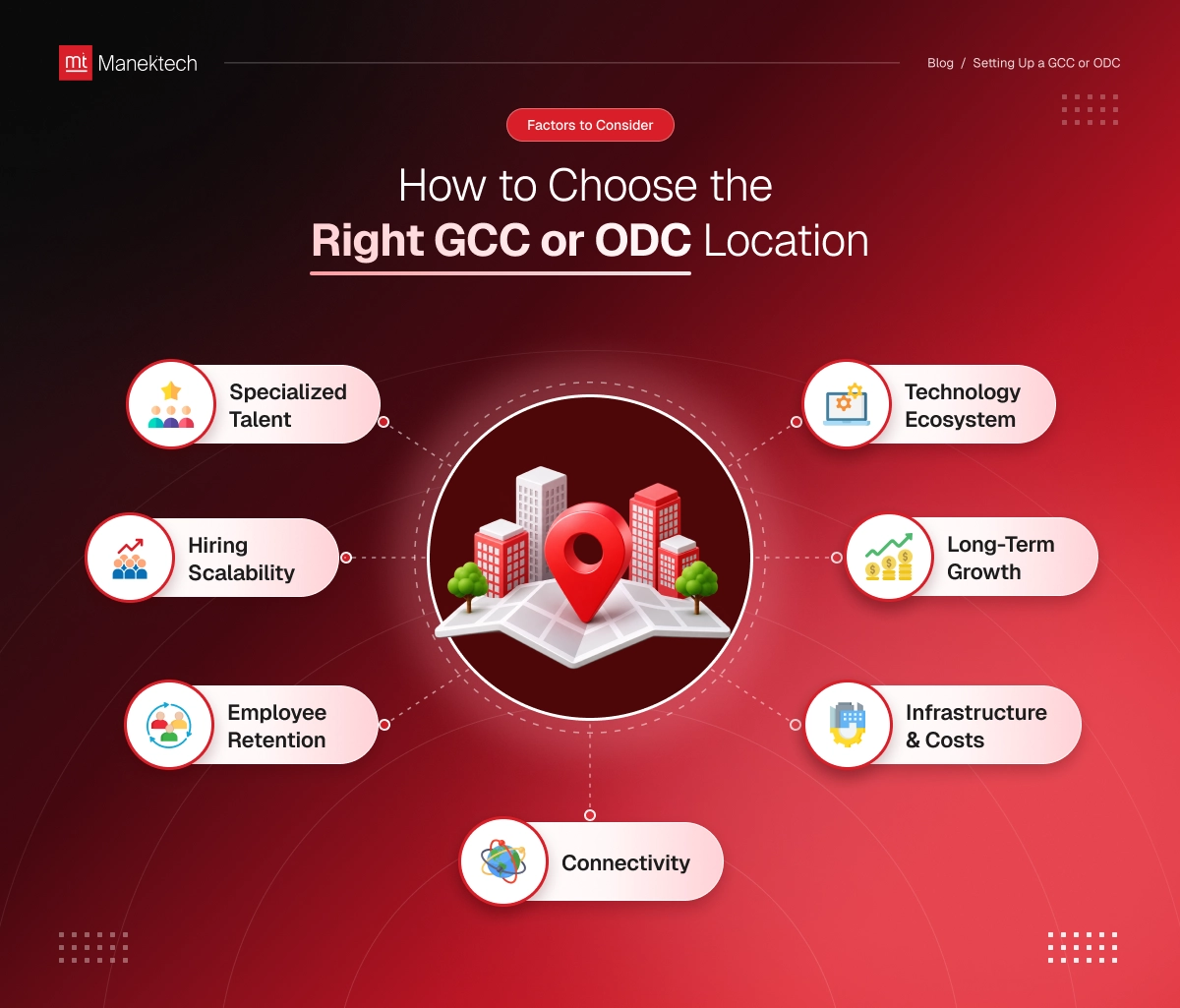
Key Factors to Consider Before Choosing a City in India
Before selecting a city for a GCC or offshore development center in India, businesses should evaluate several factors that can affect hiring, operating costs, and long-term growth. The right location should support the company’s technical requirements, workforce plans, and operating budget.
Specialized Talent Availability
Different Indian cities have strengths in different technology domains. Bengaluru and Hyderabad have established technology ecosystems, while Chennai and Pune have strong engineering and manufacturing backgrounds. Other cities may also be suitable for specific roles and team sizes.
Before selecting a location, businesses should assess whether the required professionals are available locally and whether the city can support future hiring. A limited talent pool can increase recruitment timelines, create competition for experienced candidates, and make team expansion more difficult.
Hiring Scalability
A location should support both immediate recruitment and future team expansion. Businesses planning to grow from a small development team to a larger GCC should evaluate the local recruitment market, availability of experienced professionals, and competition from other employers.
Consider whether the city can support hiring across multiple roles, including developers, testers, architects, project managers, and technology leaders. Limited recruitment capacity may increase hiring timelines or require businesses to expand their search to other locations.
Employee Retention
Employee retention is another important factor when selecting a GCC or ODC location. Businesses should consider local hiring competition, salary expectations, career development opportunities, and employee commuting requirements.
Choosing a location that supports long-term workforce stability can help reduce repeated recruitment expenses and maintain operational continuity.
Industry and Technology Ecosystem
The surrounding business ecosystem can influence access to specialized expertise, technology partners, recruitment agencies, and industry networks.
For example, Mumbai’s financial services ecosystem may benefit businesses establishing banking or fintech operations, while Pune and Chennai offer advantages for automotive and engineering-related functions. Selecting a city with an established presence in your industry can support recruitment, collaboration, and access to relevant business services.
Long-Term Growth Potential
Businesses should evaluate whether a city can support their future expansion plans. Factors such as the availability of experienced professionals, commercial infrastructure, technology investments, and local business support can influence long-term scalability.
A location suitable for a small offshore team may not necessarily support a much larger operation without additional hiring and infrastructure challenges.
Office Space and Infrastructure Costs
While setting up an Offshore development center in India, cost structure is a key factor. From the current average salary to office maintenance costs, these prices may vary based on the location.
For example, office rentals and operating expenses can vary significantly between Gurugram and Noida, depending on the business district, office size, and infrastructure requirements.
Ahmedabad may offer competitive office rental options for certain businesses, but actual costs should be evaluated based on location, facilities, and long-term expansion plans.
Connectivity and Accessibility
Connectivity is an important consideration when selecting a location for a GCC or ODC. Businesses should evaluate access to international airports, metro networks, major roads, public transportation, and nearby residential areas.
Office location can influence employee commuting time, recruitment, and retention. Companies should also consider how easily employees, clients, and business partners can travel to the office.
The right location should balance accessibility, office infrastructure, employee convenience, and long-term operating requirements.
Which Indian City Should You Choose for Your GCC or ODC?
The right city for a GCC or ODC depends on the company’s technology requirements, hiring plans, operating budget, and long-term business objectives. Different Indian cities offer different advantages, so businesses should prioritize the factors that matter most to their planned operations.
The following recommendations can help narrow down the options based on specific business requirements.
Large-scale Tech and R&D
Bengaluru and Hyderabad stand out with their vast pools of experienced engineers, skilled product professionals, and thriving innovation ecosystems. While you can expect robust hiring opportunities, be prepared for some tough competition for top talent.
Pune is also worth considering for enterprise IT and engineering operations, while Ahmedabad may be suitable for smaller or growing offshore technology teams.
Cost Efficiency
Clients looking for cost-conscious offshore development can consider Ahmedabad, Coimbatore, Kochi, and Jaipur. These emerging technology destinations may offer competitive operating costs for certain teams, but actual expenses depend on talent requirements, office location, and hiring scale.
Financial Services
Mumbai, Pune, and Delhi NCR are strong options for financial services and enterprise operations. Their established financial services, corporate, and technology ecosystems provide access to professionals with experience in finance, compliance, analytics, and enterprise operations.
Engineering and Manufacturing Technology
Chennai, Pune, and Coimbatore are well-positioned for businesses seeking talent in automotive, industrial, and embedded systems. Their established engineering and manufacturing ecosystems support specialized technology and development operations.
Startup and Entrepreneur-friendly
Clients thinking about starting small should not overlook emerging hubs like Ahmedabad, Coimbatore, or Kochi. These cities are worth evaluating for smaller dedicated offshore teams, depending on the required skills, hiring plans, and availability of suitable technology partners.
For example, Ahmedabad-based technology partners such as ManekTech offer software development services for businesses exploring offshore development arrangements.
How Your GCC or ODC Operating Model Affects City Selection
The operating model you choose can influence the location requirements of your offshore operation.
A company-owned GCC may require a more detailed assessment of recruitment capacity, office infrastructure, local leadership, compliance, and long-term operating expenses. Businesses should select a location that can support their workforce and operational plans as the center grows.
An ODC may operate through a technology partner or under another agreed arrangement. In this case, the partner’s location, recruitment capabilities, available infrastructure, and ability to support the required team become important considerations.
Before selecting a city, businesses should determine how much operational control they need, what responsibilities they plan to manage internally, and how they expect the offshore operation to expand.

How Can ManekTech Help Businesses Build Offshore Development Teams in India?
Selecting the right city is an important step when planning an offshore development operation. Businesses also need a technology partner that understands their project requirements, technical priorities, and preferred way of working.
ManekTech is a software development company offering custom software development services to businesses across different industries.
Companies exploring offshore development in India can discuss their software requirements, technology stack, team structure, and project scope with ManekTech. Depending on their needs, they can explore suitable development engagement options, including additional developer support and dedicated development teams.
The right engagement should provide the technical capabilities the business needs while fitting its project timelines and long-term development plans.
Looking to expand your software development team in India? Contact ManekTech to discuss your project requirements.
Conclusion
India offers several locations for businesses planning to establish a Global Capability Center (GCC) or Offshore Development Center (ODC). However, the right choice depends on the type of work, technical skills required, hiring plans, and long-term operating requirements.
Bengaluru and Hyderabad have established technology ecosystems and are worth considering for large-scale technology operations. Pune and Chennai offer strong engineering and manufacturing capabilities, while Mumbai and Delhi NCR are relevant for financial services, enterprise technology, and corporate operations.
Ahmedabad, Jaipur, Coimbatore, Kochi, and Mysuru may also be suitable for businesses evaluating emerging technology locations based on their specific hiring and operational needs.
Before making a decision, businesses should compare talent availability, recruitment scalability, total operating costs, infrastructure, employee retention, and the level of operational control they require.
There is no single best city for every GCC or ODC. The best location is the one that supports the company’s current requirements and provides room for future growth.
Frequently Asked Questions (FAQs)
Multiple Indian cities are suitable for setting up a GCC, depending on business requirements. Bengaluru and Hyderabad offer established technology ecosystems, while Pune and Chennai are strong options for engineering and industrial technology. Mumbai and Delhi NCR are relevant for financial and corporate operations, and Ahmedabad is an emerging alternative worth considering.
Cities like Bengaluru, Hyderabad, Pune, Chennai, Delhi NCR, Ahmedabad, etc. offer access to IT professionals with expertise in multiple programming languages and technologies like AI, DevOps, cloud computing, cybersecurity, and data analysis. The best location depends on talent availability, hiring requirements, infrastructure, operating costs, and the type of development team required.
Ahmedabad may be suitable for businesses considering a GCC, supported by its growing technology ecosystem, educational institutions, and the wider Ahmedabad–Gandhinagar business environment. Gujarat’s GCC Policy 2025–30 is another factor worth evaluating. However, businesses should review the policy’s eligibility criteria and operational guidelines and assess local talent availability, hiring capacity, infrastructure, and operating costs before making a decision.
Major GCC hubs in India include Bengaluru, Chennai, Mumbai, Pune, Delhi NCR, and Hyderabad. Ahmedabad is also emerging as a potential GCC destination.
Businesses should compare cities such as Ahmedabad, Jaipur, Coimbatore, and Kochi with established technology hubs based on their specific hiring requirements and operating plans. The overall cost depends on technical specialization, salary expectations, recruitment availability, office location, and team size. A location with lower average salaries may not necessarily offer the lowest total operating cost.
While both models support offshore business operations, the difference lies in the purpose, ownership, and operations. A GCC is generally a company-owned offshore unit that supports the parent organization’s technology and business functions. An ODC is a dedicated offshore development team or operation that may be managed by a technology partner or structured differently depending on the engagement agreement.
Yes. International companies can build dedicated offshore development teams in India through a suitable technology partner or by establishing their own offshore operation. The right approach depends on project requirements, team size, hiring plans, budget, and the level of operational control the company wants to maintain.
Related Blogs
Explore the BOT model in India, including its process, costs, benefits, risks, contract terms, and how businesses can transition to their own offshore operations.
20 Min ReadNov 23, 2026
Jayendu Vyas
VP of Sales at ManekTech
Learn when to use AI and cloud staff augmentation versus in-house hiring. Compare costs, flexibility, technical skills, and long-term business needs.
19 Min ReadNov 18, 2026
Jayendu Vyas
VP of Sales at ManekTech