


Build-Operate-Transfer (BOT) Model in India: Process, Costs, Benefits, and Risks
Introduction
India has become a major destination for Global Capability Centers (GCCs), supporting businesses across software engineering, product development, data analytics, artificial intelligence, and other technology functions. India’s GCC ecosystem is projected to reach USD 105 billion by 2030, reflecting the growing role of the country in global business and technology operations.
However, setting up an offshore operation in India involves more than hiring skilled professionals. Companies also need to manage infrastructure, employment requirements, local compliance, operational processes, and long-term business planning. For organizations entering India without an established local presence, these responsibilities can make the initial setup challenging.
The Build-Operate-Transfer (BOT) model offers an alternative for businesses looking to establish offshore operations with the support of a local partner. The partner helps build and operate the center for an agreed period, after which the client takes over the operation under predefined contractual terms.
This approach allows businesses to establish their offshore presence while preparing for long-term operational control. In this guide, we will explore how the BOT model works in India, its costs, benefits, risks, contract considerations, and when it may be the right choice for your business.
What Is the Build-Operate-Transfer (BOT) Model?
The Build-Operate-Transfer (BOT) model is an offshore business arrangement in which a service provider helps a company establish and manage an offshore operation for a defined period before transferring it to the client. The provider typically handles initial setup, recruitment, infrastructure, and day-to-day operational management, allowing the client to build an offshore team or business unit without managing the entire setup process from the beginning.
Once the agreed operating period ends and the transfer conditions are met, the client takes over the operation and manages it independently. This allows businesses to establish their offshore presence with the support of an experienced partner while planning for long-term ownership and operational control.
The BOT model is commonly used by businesses looking to build a dedicated offshore team, establish a development center, or expand their engineering capabilities in a new market.
Note: The transfer scope depends on the agreement between the client and the provider. It may include employees, infrastructure, equipment, technology assets, intellectual property, operational processes, and other agreed resources. Ownership rights, transfer conditions, and the responsibilities of both parties should be clearly documented before the engagement begins.
How Does the BOT Model Work?
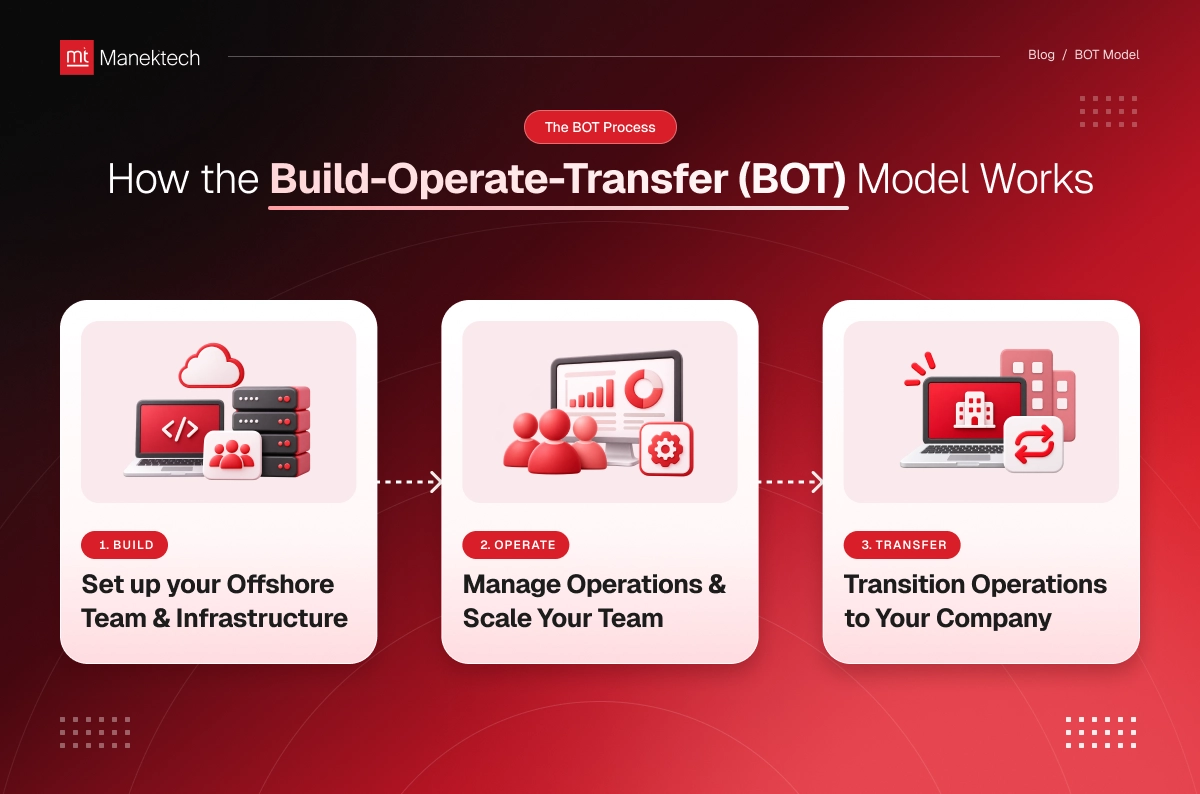
A BOT arrangement is generally structured around three stages: build, operate, and transfer. The responsibilities and activities within each phase depend on the client’s objectives, the service provider’s role, and the contractual agreement.
Build Phase
The build phase focuses on establishing the offshore operation and preparing it for business activities. This begins with defining the client’s requirements, determining the operating structure, and deciding whether the operation will function through an existing entity, a newly established entity, or another suitable arrangement.
The BOT provider may handle recruitment, office setup, infrastructure, equipment procurement, network connectivity, security arrangements, and other activities required to get the operation ready. This phase also involves addressing applicable employment, legal, and compliance requirements based on the chosen operating structure.
The objective is to establish a team and operational environment that can support the client’s business requirements and grow over time.
Operate Phase
Once the offshore operation is established, the BOT provider manages the agreed day-to-day operational responsibilities. These may include team coordination, recruitment support, HR administration, payroll, employee benefits, facilities, infrastructure management, and other activities covered under the agreement.
The client remains involved in setting business priorities, defining technical requirements, overseeing project delivery, and reviewing team performance. The level of involvement depends on how responsibilities are divided between the client and the provider.
The operate phase also involves maintaining quality standards, tracking progress, managing resources, and ensuring that the offshore team remains aligned with the client’s goals. Security, compliance, and risk management responsibilities should be clearly defined, including access controls, data handling procedures, audit requirements, and applicable contractual or regulatory obligations.
Regular communication, reporting, and performance reviews help both parties identify issues, address operational challenges, and prepare the center for its eventual transfer to the client.
Transfer Phase: Handing Over Operations to the Client
The transfer phase is where the client takes over the offshore operation established and managed by the BOT provider. This involves more than transferring the team. The client must be prepared to manage the people, technology, infrastructure, and day-to-day responsibilities without disrupting ongoing work.
The transition typically involves several activities:
- Employee Transition: Establish employment arrangements, reporting structures, management responsibilities, and retention plans for employees moving to the client’s operation, as applicable to the agreed structure.
- Knowledge Transfer and Documentation: Transfer technical knowledge, workflows, operational procedures, project documentation, internal processes, and other information required to manage the team and ongoing projects.
- Technology and Infrastructure Handover: Transfer or provide control of relevant source code repositories, cloud environments, software tools, hardware, licenses, systems, and access credentials, as defined in the agreement.
- Intellectual Property and Asset Transfer: Confirm the transfer or ownership of relevant intellectual property, business assets, documentation, and other resources covered by the BOT arrangement.
- Operational Responsibilities: Transition management duties, administrative processes, reporting, infrastructure responsibilities, and other operational activities from the provider to the client.
- Post-Transfer Support: If required, arrange continued support from the BOT provider to help address operational questions, technical issues, or transition-related challenges after the handover.
A well-planned transfer should have a defined timeline, clear responsibilities, proper documentation, and a structured knowledge-sharing process. Both parties should confirm that the client has the resources, access, and operational readiness to manage the offshore operation before the transfer is completed. These arrangements should be agreed upon from the beginning rather than left until the final stage.
How Much Does a BOT Model Cost in India?
The cost of setting up a Build-Operate-Transfer (BOT) operation in India depends on the size of the team, the infrastructure required, the location, and the level of support expected from the service provider. Some companies may need only a small software development team, while others may require an entire offshore center with office space, IT infrastructure, local management, and administrative support.
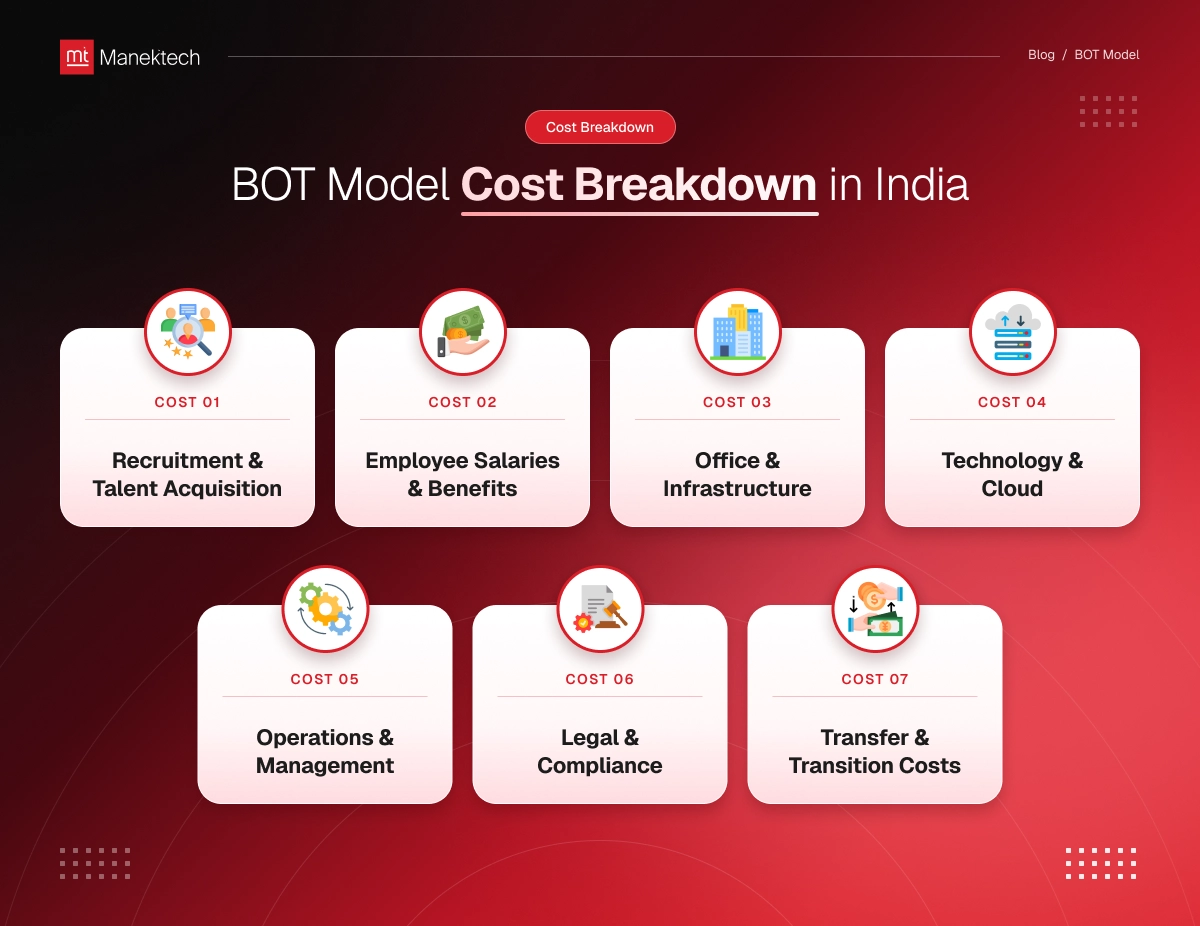
Since the BOT model involves both initial setup and ongoing operations, businesses should evaluate the total cost of the engagement rather than focusing only on the initial investment. The expenses generally fall into the following categories.
Cost Categories in a BOT Model
1. Initial Setup Costs
The build phase involves expenses related to establishing the offshore operation. Depending on the setup, these may include company registration, legal and consulting fees, office setup, security infrastructure, equipment procurement, and other initial arrangements. The cost will depend on whether the operation is established within an existing facility or requires a dedicated office and infrastructure.
2. Employee Hiring and Compensation
Recruitment is one of the major expenses in a BOT setup. Businesses need to account for salaries, employee benefits, recruitment costs, onboarding, training, and other employment-related expenses. The overall budget depends on the number of employees, their experience, technical skills, and the availability of talent in the chosen location.
3. Infrastructure and Technology Expenses
An offshore operation may require office space, workstations, networking equipment, internet connectivity, security systems, software licenses, cloud infrastructure, and development tools. These expenses can vary depending on the team’s size, technical requirements, security standards, and whether the client needs a dedicated facility or a shared infrastructure setup.
4. Operations and Management Costs
During the operate phase, the BOT provider may manage recruitment, payroll, HR administration, facilities, compliance, team coordination, and other operational responsibilities. Businesses should understand which services are included in the agreed pricing and which may be billed separately to avoid unexpected expenses during the engagement.
5. BOT Provider Fees
The service provider may charge setup fees, recruitment fees, management fees, administrative charges, or other service-related costs depending on the engagement structure. These charges should be clearly defined in the agreement, along with the responsibilities of both parties and any additional expenses that may arise during the build and operate phases.
6. Transfer and Transition Costs
The final transfer phase may involve legal and advisory fees, asset transfer expenses, employment transition costs, system migration, documentation, knowledge transfer, and other handover-related activities. These expenses depend on what is being transferred to the client and how the transition is structured.
Factors That Affect the Overall BOT Budget
The total cost of a BOT operation can vary considerably from one business to another. Before finalizing a budget, companies should consider the following factors:
- Team Size: A larger team requires more investment in recruitment, salaries, infrastructure, management, and ongoing operations.
- Location: Operating costs vary across Indian cities depending on office rentals, talent availability, salaries, infrastructure, and local business requirements.
- Skill Requirements: Hiring experienced professionals in specialized areas such as AI, cloud computing, cybersecurity, data engineering, or enterprise software may require a higher budget than hiring for general development roles.
- Infrastructure Requirements: Dedicated offices, advanced security systems, specialized hardware, and private cloud environments can increase setup and operating expenses.
- BOT Agreement Duration: The length of the agreement, pricing structure, and distribution of setup and operational expenses can affect the overall financial commitment.
- Transfer Scope: Transferring only the team and operational responsibilities may involve different costs from transferring a legal entity, office infrastructure, technology assets, contracts, and other business operations.
Before entering into a BOT agreement, companies should request a detailed cost breakdown from the service provider. This should clearly separate initial setup expenses, recurring operational costs, provider fees, and transfer-related expenses. Understanding these costs from the beginning helps businesses plan their investment, compare providers, and avoid unexpected expenses when they eventually take over the offshore operation.
Key Benefits of the BOT Model
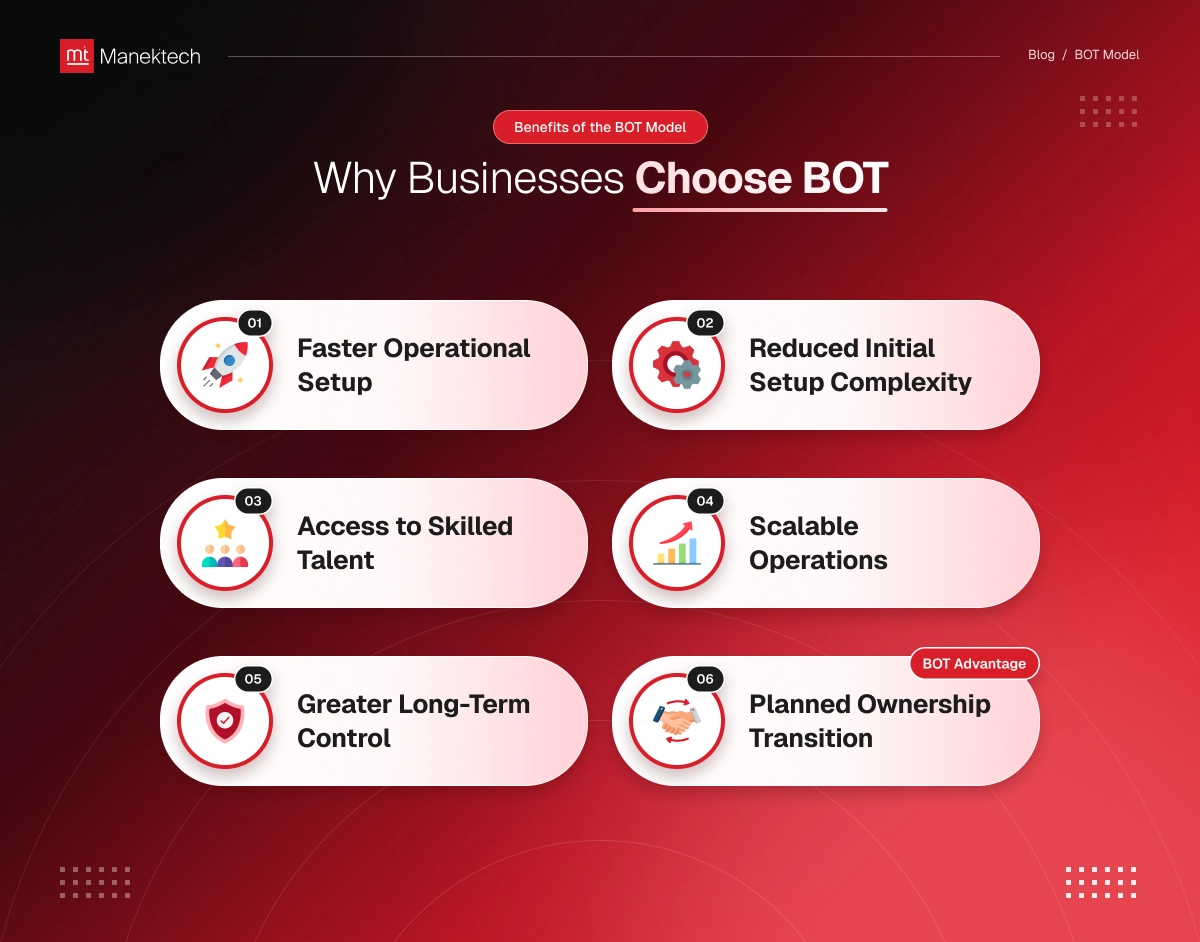
A Build-Operate-Transfer (BOT) model gives companies a way to establish an offshore operation without having to manage every aspect of setup and operations from the beginning. By working with an experienced local partner, businesses can simplify the initial setup, access talent, and gradually prepare to take over the operation. The key benefits include the following.
Faster Market Entry
Setting up an offshore operation involves recruitment, infrastructure, administrative processes, and local compliance requirements. With a BOT partner, companies can use the provider’s existing recruitment capabilities, local knowledge, infrastructure, and operational support to get started without building everything from scratch. This can simplify the setup process and help businesses establish their offshore presence sooner, depending on their requirements and the scope of the engagement.
Access to Local Expertise
Businesses entering India may not be familiar with local hiring practices, employment requirements, payroll, office management, and other operational responsibilities. A BOT partner with established local experience can help manage these activities and guide the company through the initial setup and operating stages. This allows the client to focus on its business objectives while the local operation is being established.
A Planned Path to Ownership
One of the main advantages of the BOT model is that it provides a defined path toward taking over the offshore operation. Unlike arrangements where the service provider continues to manage the team indefinitely, BOT is structured around an agreed transfer of operations to the client. This allows businesses to start with external support and prepare to take responsibility for the team, infrastructure, and operations over time, subject to the terms of the agreement.
Dedicated Team and Long-Term Business Alignment
A BOT model can help companies build a dedicated team that works on their products, processes, and long-term business objectives. Since the operation is intended to transition to the client, businesses can plan for continuity, develop internal knowledge, and establish working practices that align with their own organization. Team stability, however, depends on hiring decisions, employee engagement, management, retention practices, and the overall transition plan.
Risks and Challenges of the BOT Model
While the Build-Operate-Transfer (BOT) model helps businesses establish offshore operations without managing every setup activity themselves, it also comes with certain risks. Companies need to plan for these challenges from the beginning to avoid problems during operations or when taking over the center.
Dependency on the BOT Provider
During the initial stages, the company may rely heavily on the BOT provider for recruitment, team management, infrastructure, administrative tasks, and day-to-day operations. If the provider does not maintain proper documentation or knowledge-sharing practices, the client may face difficulties when taking over the operation. Clearly defined responsibilities and a gradual transition of knowledge can help reduce this dependency.
Employee Retention During the Transition
Retaining experienced employees is important for maintaining productivity and ensuring continuity of ongoing projects. Employees may have concerns about changes in management, employment arrangements, company policies, or their future roles after the transfer. Businesses should communicate the transition plan early, address employee concerns, and establish clear retention and employment arrangements before the handover.
Hidden Costs and Budget Changes
The initial budget may not cover every expense that arises during the build and operate phases. Additional recruitment, salary revisions, infrastructure upgrades, software licenses, compliance requirements, or transfer-related expenses can increase the overall investment. A detailed cost breakdown and clearly defined payment terms can help businesses manage these expenses more effectively.
Data Security and Intellectual Property Risks
An offshore operation may handle sensitive business information, customer data, source code, and internal systems. Without appropriate access controls, security policies, contractual safeguards, and monitoring, businesses may face data exposure or intellectual property risks. Security requirements, IP ownership, data handling responsibilities, and access rights should be established before operations begin and reviewed throughout the engagement.
Operational Disruptions During the Transfer
The transfer of employees, systems, infrastructure, and management responsibilities can create challenges if it is not planned properly. Delays in documentation, unclear ownership, incomplete knowledge transfer, or changes in team structure may affect ongoing projects. Both parties should prepare a transition plan well in advance, define the responsibilities involved, and ensure the client is ready to manage operations before the transfer is completed.
Difficulty Managing the Offshore Team
Although the BOT provider initially manages many operational responsibilities, the client still needs to maintain visibility into work progress, team performance, project priorities, and business objectives. Differences in communication, working hours, management expectations, or processes can create challenges. Establishing clear reporting structures, performance measures, communication practices, and regular reviews helps keep the offshore team aligned with the client’s goals.
Managing these risks requires clear responsibilities, regular communication, and proper planning throughout the BOT engagement. Businesses should not wait until the transfer phase to address employee retention, documentation, security, or operational readiness. These considerations should be built into the agreement and reviewed throughout the engagement to make the eventual transition smoother.
BOT Contract Checklist: What Should Businesses Clarify Before Signing?
Before entering into a Build-Operate-Transfer (BOT) agreement, businesses should clearly define how the offshore operation will be established, managed, and eventually transferred. A well-structured agreement helps both parties understand their responsibilities, manage costs, and avoid confusion during the transition.
Here are the key points to review before signing a BOT agreement:
- Scope of Work: Define the activities covered under the agreement, including team setup, recruitment, infrastructure, operational management, and any additional services the provider is expected to deliver.
- Team Structure and Hiring: Clarify the number of employees, required skill sets, hiring timelines, reporting structure, employment arrangements, and responsibilities for recruitment and retention.
- Setup and Operating Costs: Ask for a detailed breakdown of initial setup expenses, recurring costs, provider fees, salaries, infrastructure, administrative charges, and any additional expenses that may arise during the engagement.
- Management and Operational Responsibilities: Specify who will manage the team, oversee project delivery, handle HR and administration, maintain infrastructure, and manage day-to-day operations during the BOT period.
- Intellectual Property and Data Security: Clearly define ownership of source code, project deliverables, documentation, and other intellectual property. Include provisions for confidentiality, data protection, security requirements, and access to business systems.
- Performance Expectations: Establish measurable expectations for hiring, team performance, operational readiness, delivery quality, reporting, and other agreed responsibilities. Define how performance will be reviewed and how issues will be addressed.
- Transfer Conditions and Timeline: Document when and how the transfer will take place, what assets and responsibilities will be handed over, and what conditions must be met before the client takes control of the operation.
- Employee Transition and Retention: Clarify how employees will be handled during the transfer, including employment arrangements, communication, retention plans, and any responsibilities related to changes in employment.
- Exit, Extension, and Dispute Resolution: Define what happens if either party wants to terminate or extend the agreement, including notice periods, outstanding payments, transition support, dispute resolution, and responsibilities in case the transfer does not proceed as planned.
- Post-Transfer Support: If the provider is expected to support the client after the transfer, specify the duration, scope of assistance, fees, and responsibilities during this period.
Reviewing these terms before signing helps businesses understand what they are committing to and how the BOT arrangement will work throughout its lifecycle. The agreement should not only cover the setup and operating phases but also provide a clear path for transferring the operation to the client.
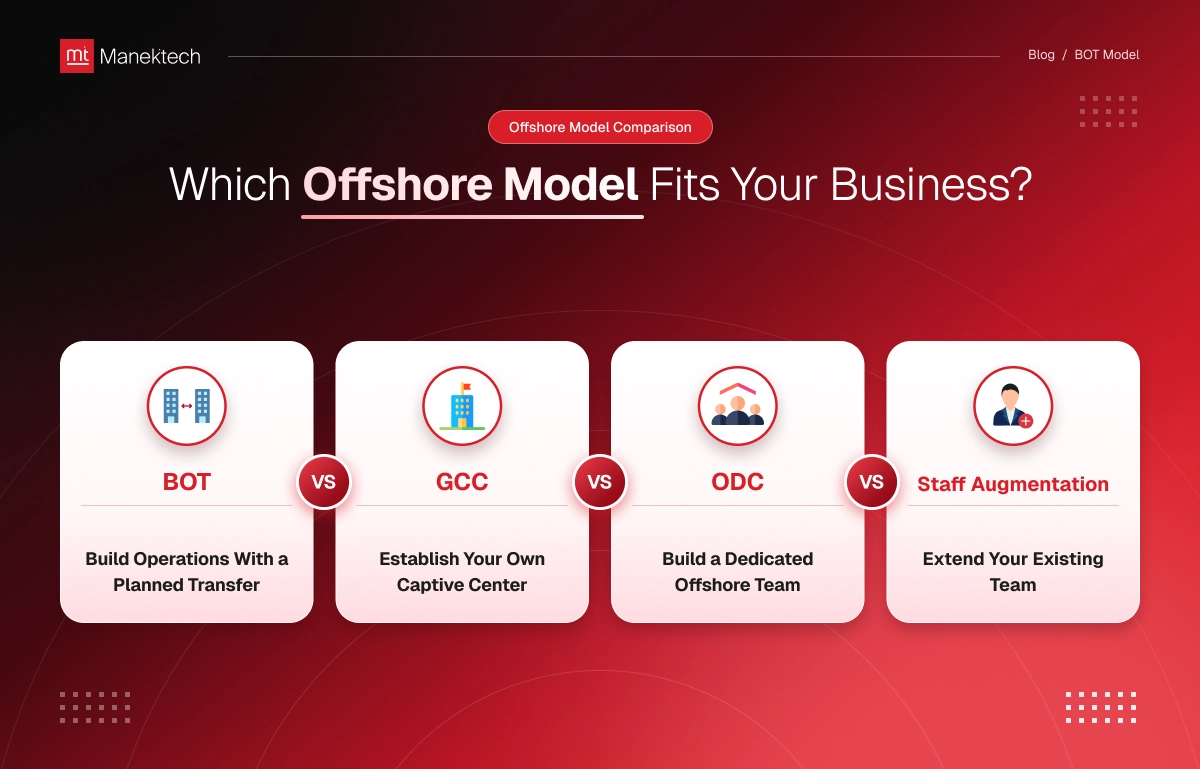
BOT vs. GCC vs. ODC vs. Staff Augmentation: What’s the Difference?
Businesses looking to expand their technology operations in India have several options. They can establish their own Global Capability Center (GCC), work with an Offshore Development Center (ODC), use the Build-Operate-Transfer (BOT) model, or hire offshore developers through staff augmentation.
Although all four models can help businesses access skilled talent in India, they differ in ownership, operational responsibilities, setup requirements, and long-term objectives.
Businesses evaluating offshore expansion can also compare offshore vs. onshore software development to understand the differences in team location, operational approach, and engagement considerations.
| Model | How It Works | Best Suited For |
|---|---|---|
| BOT (Build-Operate-Transfer) | A provider establishes and manages the offshore operation for an agreed period before transferring it to the client under predefined terms. | Companies planning to take ownership of an offshore operation but needing a partner to establish and manage it initially. |
| GCC (Global Capability Center) | A center established and controlled by the parent company to handle technology, engineering, business operations, research, or other strategic functions. | Businesses looking for a long-term presence, greater control, and direct ownership of offshore operations. |
| ODC (Offshore Development Center) | A dedicated offshore development team or center working on the client’s projects. The setup and management arrangement may vary depending on the engagement. | Companies needing a dedicated offshore team for ongoing product development, engineering, or technology operations. |
| Staff Augmentation | Offshore professionals join the client’s existing team to fill skill gaps or increase development capacity, while the client generally manages their day-to-day work. | Businesses needing additional developers, specialized skills, or flexible engineering capacity without establishing a separate center. |
Which Model Should You Choose?
The right model depends on how much control you want, how quickly you need to establish your offshore presence, and whether you plan to own and manage the operation in the long term.
- Choose BOT if you want to establish an offshore operation but need a partner to handle the initial setup, hiring, infrastructure, and operations before the agreed transfer.
- Choose GCC if you are ready to establish and directly manage your own offshore center as a long-term part of your business.
- Choose ODC if you need a dedicated offshore team or development center for ongoing work and prefer an arrangement that can be structured around your requirements.
- Choose Staff Augmentation if your existing team is in place but needs additional developers, technical specialists, or engineering capacity to meet project demands.
These models are not always mutually exclusive. A company may start with staff augmentation, expand into a dedicated ODC, and eventually establish its own GCC. Similarly, a BOT arrangement can serve as a transition toward a company-owned center.
The decision should be based on your hiring plans, operational requirements, budget, management capacity, and long-term business goals rather than cost alone.
When Should a Company Choose the BOT Model in India?
The BOT model is worth considering when a company wants to establish its own offshore operation in India but needs support with the initial setup, hiring, and management. It is particularly relevant for businesses planning to build a long-term engineering or technology team and take control of the operation in the future.
Companies may consider BOT in the following situations:
When You Plan to Build a Long-Term Offshore Operation
If you expect to expand your engineering, product development, or technology operations in India over the coming years, BOT can help establish the team and operating structure while preparing for a future transition to your own management.
When You Lack Local Setup and Management Experience
Companies entering India for the first time may not have the local recruitment network, infrastructure, administrative support, or experience required to establish an offshore operation. A BOT partner can help manage these activities during the initial stages.
When You Want to Take Over Operations Gradually
Some businesses prefer to begin with an external partner and take on management responsibilities as the team and operation become established. The BOT model provides a planned transition, allowing the company to prepare for the transfer of employees, processes, infrastructure, and responsibilities based on the agreement.
When You Need Support Establishing the Team and Infrastructure
Recruitment, office setup, technology infrastructure, administration, and operational management require time and resources. Companies that want to establish a dedicated offshore operation without coordinating every setup activity internally may benefit from a BOT arrangement.
When BOT May Not Be the Right Choice
BOT may not be necessary if you only need a few developers for a short-term project. In that case, staff augmentation may be a simpler option. If you need a dedicated offshore team but do not plan to take ownership of its operations, an ODC arrangement may be more suitable.
Businesses that already have a legal entity, local management, recruitment capabilities, and infrastructure in India may also be able to establish and manage their own GCC without using the BOT model.
Before choosing BOT, consider whether taking over the operation is genuinely part of your long-term plan. If not, another offshore engagement model may be more practical and easier to manage.
Conclusion
The Build-Operate-Transfer (BOT) model offers businesses a structured way to establish offshore operations in India with the support of a local partner. It can help companies build dedicated teams, establish infrastructure, manage initial operations, and prepare for long-term ownership without handling every setup activity independently.
However, the success of a BOT arrangement depends on more than establishing the offshore center. Businesses need to plan for operating costs, team management, intellectual property protection, employee retention, operational responsibilities, and the eventual transfer of the center. Clearly defined contractual terms and a well-planned transition are essential for maintaining continuity when the client takes over.
BOT may be a suitable option for companies planning to build and eventually manage their own offshore operation. Businesses that need a dedicated development team without future ownership plans may find an ODC or staff augmentation arrangement more practical.
If you are evaluating offshore expansion in India, ManekTech can help you understand the available engagement models and identify an approach aligned with your team requirements, operational needs, and long-term business goals.
Frequently Asked Questions About the BOT Model in India
The Build-Operate-Transfer (BOT) model is an arrangement in which a service provider establishes an operation, manages it for an agreed period, and subsequently transfers it to the client under predefined terms. In India, businesses commonly consider this approach when establishing offshore development teams or technology centers that they intend to manage independently in the future.
The BOT model generally works in three stages. During the build phase, the provider establishes the operation, including hiring, infrastructure, and other agreed setup activities. During the operate phase, the provider manages the operation and supports its growth. During the transfer phase, the operation is handed over to the client based on the agreed transfer conditions, including the relevant team, assets, processes, and responsibilities.
The cost of a BOT setup in India depends on team size, employee salaries, location, infrastructure, technology requirements, management services, and the scope of the transfer. Businesses should consider both initial setup expenses and recurring operating costs, along with provider fees and transition-related expenses. A detailed cost estimate should be prepared based on the company’s specific requirements.
There is no fixed duration for every BOT arrangement. The timeline depends on the size of the operation, hiring requirements, infrastructure, operating responsibilities, transfer conditions, and the client’s readiness to take over. The build, operate, and transfer timelines should be clearly defined in the agreement.
During the operate phase, the BOT provider generally handles the operational responsibilities agreed upon in the contract. These may include recruitment, HR administration, facilities, team coordination, and operational management. The client’s involvement in project priorities, technical decisions, delivery oversight, and reporting depends on the engagement structure and agreed responsibilities.
Employee transition arrangements depend on the legal structure of the operation and the terms agreed upon by both parties. The transfer may involve changes to employment arrangements, management, reporting, or the employing entity. These matters should be planned in advance, communicated clearly to employees, and reviewed with appropriate legal and HR professionals.
The transfer may include the agreed team and operational responsibilities, infrastructure, equipment, documentation, technology assets, software, contracts, processes, and other resources required to continue running the operation. The exact scope depends on the BOT structure and contract. Not every asset, employee, or agreement is automatically transferred.
BOT and ODC serve different business needs, so neither is automatically better. BOT is suitable for companies planning to establish and eventually take over an offshore operation with the support of a provider. An ODC is generally suitable for businesses that need a dedicated offshore development team or center, where the operating and management structure can vary. The right choice depends on whether future ownership or operational transfer is a business priority.
Once the transfer is complete, the client takes over the responsibilities defined in the agreement and manages the operation independently. This may include employee management, recruitment, infrastructure, administration, project delivery, and ongoing operating expenses. Some companies may continue working with the BOT provider for consulting, support, or other services after the transfer, if required.
Yes. Completing the transfer does not necessarily mean the business relationship must end. Depending on the agreement and the client’s requirements, the former BOT provider may continue offering recruitment support, HR and administrative services, technical assistance, consulting, or other operational support. These services can be defined separately based on the client’s needs after taking over the operation.
Related Blogs
Learn when to use AI and cloud staff augmentation versus in-house hiring. Compare costs, flexibility, technical skills, and long-term business needs.
19 Min ReadNov 18, 2026
Jayendu Vyas
VP of Sales at ManekTech
Learn how to set up an offshore development center in India. Explore ODC models, setup costs, hiring, benefits, challenges, and ODC vs. GCC.
15 Min ReadNov 13, 2026
Jayendu Vyas
VP of Sales at ManekTech