Get Free Trial Week Developer Access, Try Before You Hire. Click Here to Claim Now

How to Outsource Mobile App Development: A Complete Guide


Key Takeaways:
- There is a growing need for mobile apps in the competitive market; investing in a structured outsourcing model helps develop a functional, feature-rich mobile app.
- Outsourcing provides access to global talent without incurring additional costs or excessive management overhead.
- The process is handled by IT outsourcing companies that deliver suitable experts after analyzing your requirements and project scope.
- Choosing the most appropriate engagement model ensures cost control, scalability, and reduced errors while ensuring a skilled and trained development team.
- While choosing your outsourcing partner, make sure they have immense experience in working across industries.
Mobile applications are all over the internet, from healthcare, finance, education, and e-commerce to law, gaming, media, and the entertainment industry.
The mobile app development market size is estimated to reach $626.39 billion by 2030. These figures clearly indicate the popularity of mobile applications across industries.
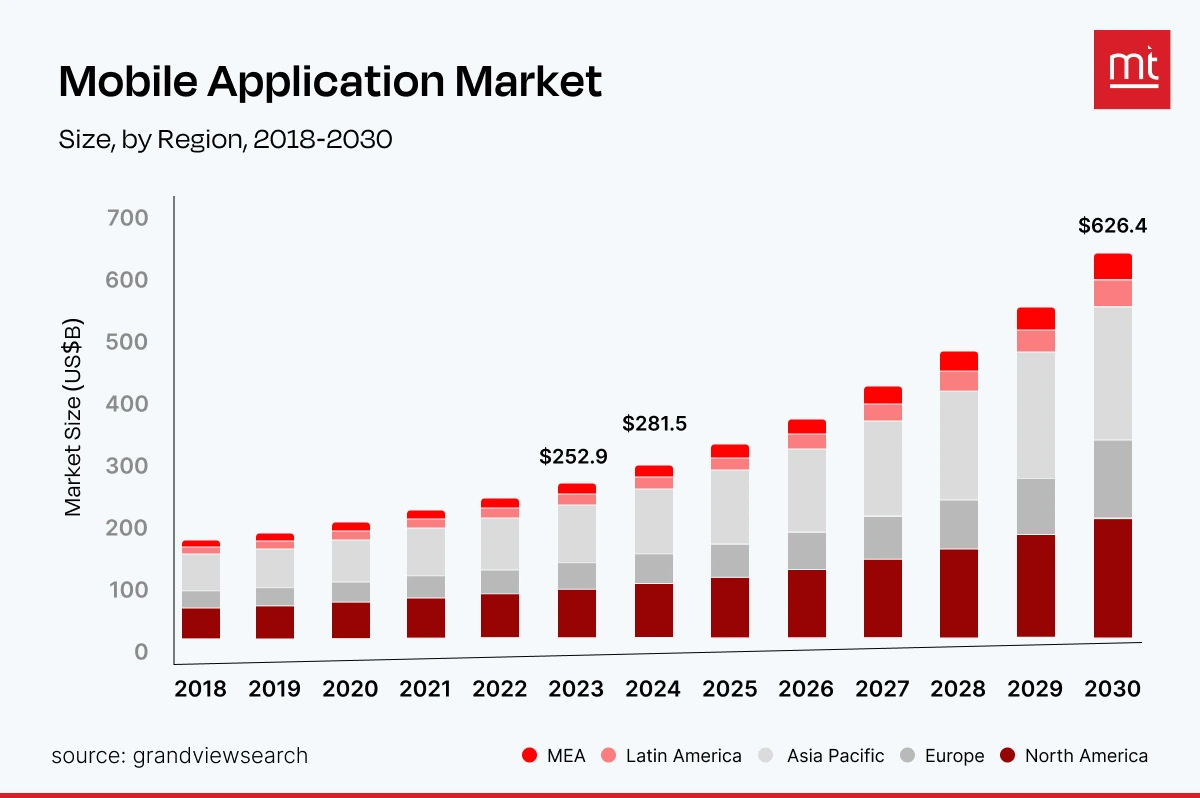
Mobile apps offer countless benefits to businesses by providing a user-friendly and mobile-compatible approach. They are easy to use and navigate, allowing even the most tech-challenged people to browse smoothly.
Today's tech-driven audience wants everything quick and easy. They don't wait to open a laptop every time they want to buy or browse something.
But how does a business effectively develop and maintain a high-end mobile app? This is where outsourcing mobile app development can help!
Maintaining and hiring an in-house team is expensive and time-consuming. A team requires careful hiring, onboarding, and constant management, which costs both money and time.
Various top brands and enterprises, especially the startups, are outsourcing their app development requirements for their cost-efficiency and quick turnaround.
However, the important question still lingers: Should you outsource mobile app development? How can a brand sustain this development approach?
All your questions are answered in this guide, which is designed to help you understand all the dimensions of outsourcing custom web app development services. Whether you own a small business or a large enterprise, we will explore how this service impacts the overall workflow.
What is Application Development Outsourcing?
When you hire an external or third-party team for your app development project, it is called application development outsourcing. The process is pretty simple if your goals and expectations are clearly set.
Let us have a glimpse of how outsourcing works in real projects.
For instance, this is what the overall outsourcing process looks like when developing an e-commerce app.
- You define your expectations
- Finalize the budget
- Provide all project-related requirements
- The outsourcing partner gathers a team for you.
- The outsourcing company hires, onboards, and trains the team.
- Once everything is finalized, the team is introduced to you.
People often wonder if outsourced and hybrid teams are the same. Here is a clear distinction between different app development approaches:
- In-house development: This refers to a full-fledged app development team that is hired by your company. These professionals are on your payroll, and everything is completely managed by your firm.
- Outsourcing companies: These are third-party agencies that provide skilled professionals on a project-basis. The outsourcing company handles everything from hiring and onboarding to training and documentation. Many businesses choose this model for various reasons to outsource web application development, including access to specialized expertise, faster project delivery, and lower operational costs.
- Hybrid teams: Hybrid teams are a combination of an in-house team and an outsourced one. For example, you can have a developer and coder as full-time employees, and you outsource a designer for that specific project.
Key Benefits of Outsourcing Mobile App Development
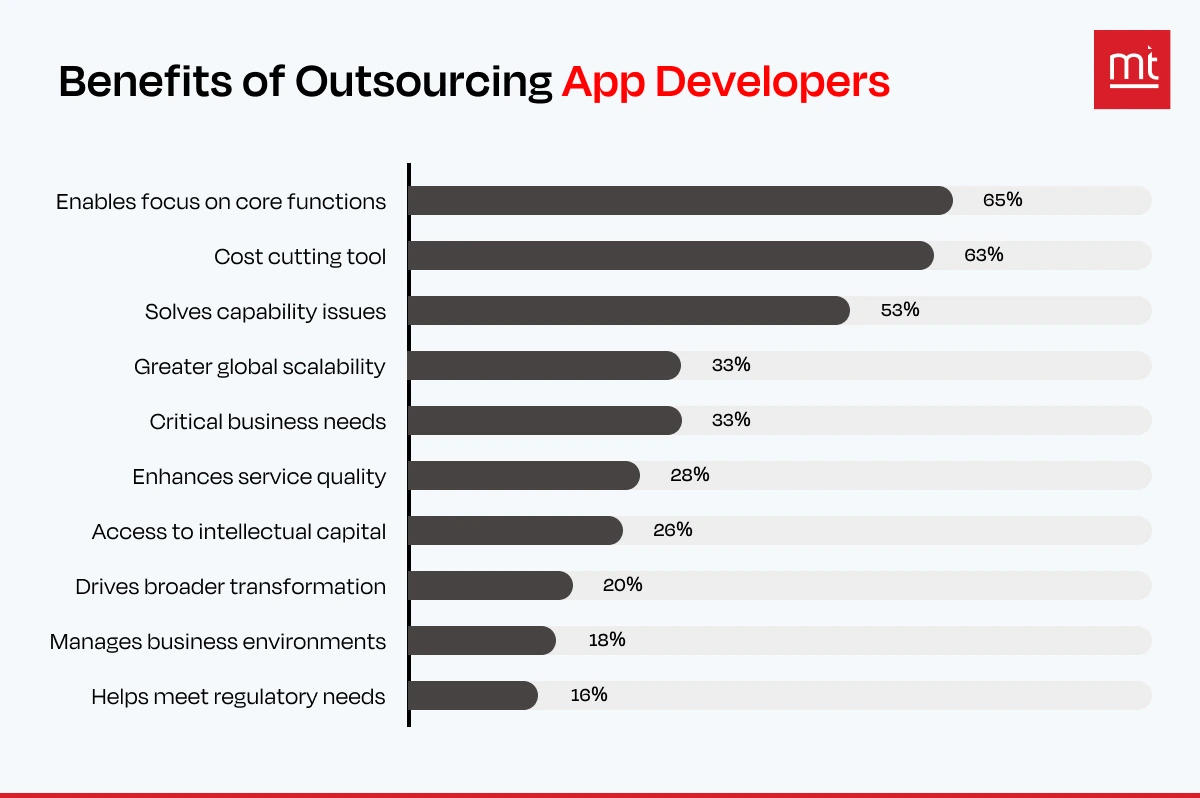
Outsourcing mobile app development has become a popular choice for businesses looking to build high-quality applications without the challenges of hiring and managing an in-house team. It helps companies reduce development costs, speed up project delivery, and access skilled professionals with specialized expertise.
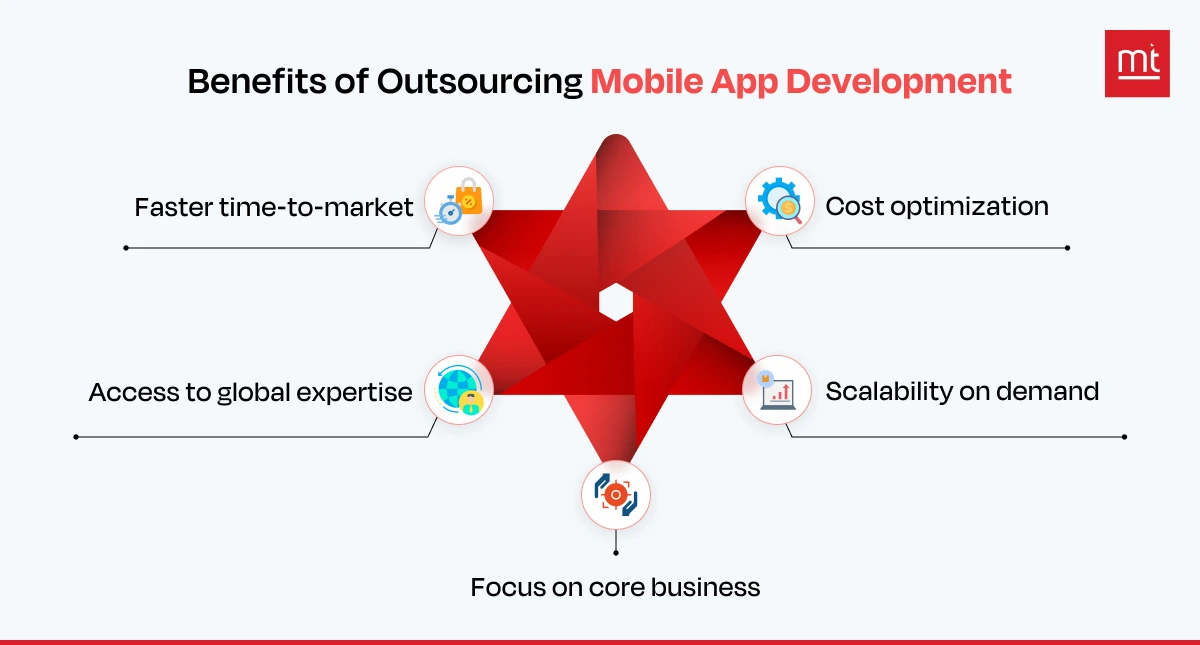
Here are some of the key benefits of outsourcing mobile app development:
- Faster time-to-market: These dedicated teams are highly skilled in multiple programming languages, front-end and back-end development, and other technical aspects. They deliver the project quickly, as they solely focus on a single project at a time.
- Cost optimization: Outsourcing can significantly reduce the cost of mobile app development compared to hiring a full in-house team. Since outsourced professionals work on a project or contract basis, businesses can avoid additional expenses such as recruitment, employee benefits, office space, and ongoing training while still gaining access to skilled development talent.
- Access to global expertise: Outsourced teams are trained to work remotely. Hence, you can hire the best talent from any part of the world without worrying about the time zone difference.
- Scalability on demand: One of the biggest advantages of mobile app development outsourcing is the ability to hire an offshore development team that can quickly adapt to changing project needs. Businesses can easily add or reduce resources without the challenges of traditional hiring.
- Focus on core business: With a dedicated team of outsourced experts, business owners and their teams can focus more on other core responsibilities while their development team handles everything from tech stack usage to app development and maintenance.
Step-by-Step Process of Mobile App Development Outsourcing
What does the process of app development outsourcing look like? Trusted and certified development teams follow a structured process where each stage is aligned to meet specific goals.
This ensures smooth onboarding and effective results as your outsourced talent is handed over to you in the minimum time.
Requirement gathering & idea validation
A team of outsourcing experts evaluates your project by understanding your key goals and long-term business objectives. The project length, budget, timelines, and other aspects are carefully considered.
Selecting an outsourcing model
An outsourcing model is finalized based on the information provided by the client. This can be offshore and on-shore models or per-project and fixed-term payment models.
Vendor evaluation
The selected team is thoroughly analyzed, tested, and evaluated on various aspects like expertise in different tech stacks, performance and work ethics, communication, availability, etc.
NDA & contract signing
After strong background checks and performance evaluation, the documentation process begins. A Non-disclosure agreement, along with the payroll document and contract terms, is signed.
Once everything is finalized, your outsourced app development team is ready to work!
UI/UX design phase
Now that the project has kick-started, it is time to get the work done. The app development work begins with finalizing a UI/UX design for your application. The hired professionals suggest the top ideas, and the best one is finalized by you.
For example, they will design a user-friendly interface for an e-commerce business so the buyers can effortlessly navigate through the app.
Development (Agile/Scrum)
The next step involves the core development process, where a proper Agile or Scrum framework is followed. The process is divided into different stages:
- Coding
- Front-end development
- Back-end development
- Database development
- Third-party integrations
- Custom feature incorporation
- Code reviews
Testing & QA
Your developed application is tested and checked on various parameters like bugs, errors, code issues, slow loading speed, and SEO performance.
The app is first released in phases, first to the 1% of users, then to 10%. Based on the findings, all the performance issues and errors are fixed to ensure a polished and high-performing app.
Deployment
Once all the fixes are done, the application is ready to be deployed. The fully developed app is launched on the servers and is monitored constantly.
Maintenance & support
This is the last phase of a well-established app development process where the app is monitored for several hours. Any error report is fixed through crash monitoring, and all the required upgrades are made.
Friendly Note: Launching the app is just the beginning. Make sure your application gets timely updates and maintenance.

Key Engagement Models in App Development Outsourcing
Selecting the right engagement model is one of the most important decisions in app development outsourcing. Each model offers different levels of flexibility, cost efficiency, and project control, making it essential to choose the one that best fits your business objectives and development needs.
Fixed Price Model
A fixed-price partnership model involves working on pre-defined terms for a specific project. The budget, requirements, app features, and all other aspects are pre-decided. The client agrees to pay a fixed amount for a fixed project. This engagement model offers limited flexibility and customization options.
Dedicated Development Team Model
In this engagement model, an IT outsourcing company provides a team of experts for long-term projects. Clients get higher flexibility, full control over the project, and customization options. All hiring and onboarding responsibilities are fulfilled by the outsourcing team, allowing the client to focus more on the business and worry less about hiring and managing a team.
Staff Augmentation Model
Staff Augmentation services help businesses fill the gap in their existing development teams. For example, your in-house app development team needs a QA expert. This professional will be in your direct management but a staff augmentation service provider will hire and onboard them.
Hybrid Engagement Model
A hybrid engagement model is often a blend of multiple engagement models to meet the project requirements. You can have a combination of different approaches, like a fixed-price model and staff augmentation. This model is usually adopted to save costs but requires extra management.
Model | Benefits | Downside |
Fixed Price Model | Fixed timelines, fixed budgets, pre-designed packages, and plans | Limited flexibility |
Dedicated Development Team Model | Skilled developers and experts, complete control over your project, better resources | Higher cost but beneficial in the long term |
Staff Augmentation Model | Cost-effective, quick onboarding | Requires you to manage the team |
Hybrid Engagement Model | A combination of internal and external resources | Can be confusing and requires extra management |
Why Professional Mobile App Development Companies Are Better Than Freelancers
Professional mobile app agencies are licensed entities operating in the market to deliver valuable outsourcing services. They function as a one-stop solution for all development needs.
Compared to freelancers, app development companies bring expertise and reliability to the table. They adhere to strict professional ethics and a structured process for desirable and cost-effective results.
A freelancer usually works on multiple projects simultaneously, but a dedicated team outsourced through app development companies stays committed to your project throughout the contract term.
- Full-stack team advantage (design + dev + QA + PM): With an app development agency, you can hire a complete team for your project. In a way, such companies act as a one-stop solution for all development requirements. On the other hand, you will have to consult separate freelancers for design, development, QA testing, and performance monitoring.
- Accountability & structured delivery: Freelancers function on their own terms, whereas the outsourced development team remains accountable to you. They follow your company's norms and work in harmony with your organizational structure.
- Scalability & resource backup: App development companies easily provide backup options in case things do not work out with the provided talent. Their experts are trained for scalability and versatility.
- Long-term support & maintenance: Freelancers often do not sign contractual agreements and NDAs. However, an app development company provides long-term support by providing experts on a per-project basis or for a duration desirable by your organization.
- Reduced project risk: With app development service providers, there is no risk of delays, skill gaps, or resource shortages. Unlike freelancers, they follow a structured and Agile approach for app development projects.
How to Select the Best Agency to Outsource Mobile App Development
Mobile app development is a popular service adopted by almost all business types. Countless app development companies are operating in the market, providing attractive pricing.
So, which one should you hire for your next project?
Follow the checklist below to ensure you partner with the best mobile app development outsourcing agency:
Technical expertise & tech stack
This is the most important thing to consider before finalizing an app development collaboration. You need to assess their technical knowledge and skills based on their expertise in different tech stacks.
- They should be proficient in different programming languages, especially Python, JavaScript, and HTML.
- They should have a clear understanding of different front-end and back-end frameworks.
- Also, analyze their expertise across various domains like UI/UX design, Android development, iOS development, and React native development.
Industry experience & portfolio
Before finalizing the agency for app development, analyze the quality they have delivered in their previous projects. They should have significant experience in your industry.
Along with the industry experience, their portfolio should contain different types of projects for multiple industries. This gives you a fair idea of their work diversity.
Communication & project management process
Effective communication stands as a crucial element in the outsourcing of mobile app development. The company needs to implement a well-structured communication process, provide regular updates on progress, and assign dedicated project managers to keep all stakeholders informed throughout the development cycle.
Assess the collaboration tools utilized, such as Jira, Slack, or Microsoft Teams. A transparent approach to project management guarantees enhanced visibility into milestones, quicker resolution of issues, fewer misunderstandings, and seamless coordination between your internal team and the outsourced development partner.
Agile methodology adoption
A dependable mobile app development service provider should adhere to Agile development methodologies to promote flexibility and ongoing improvement.
Agile allows development teams to break projects into manageable sprints, facilitating frequent testing, feedback gathering, and feature enhancements.
This methodology mitigates project risks, speeds up delivery timelines, and ensures that the final application meets the evolving requirements of the business.
You should hire a company that follows Agile practices and can swiftly respond to changing market demands while upholding high-quality standards and providing an improved user experience.
You may like reading: Advantages of Agile Methodology for Web Application Development
Security, NDA & IP protection
While hiring an app development outsourcing company, always prioritize your organization’s security.
Prioritizing data security is crucial since businesses often operate on confidential and sensitive data. The provider must adhere to industry-standard security protocols, which include:
- Secure coding practices
- Data encryption
- Access controls
- Compliance with applicable regulations.
Before disclosing project specifics, confirm their willingness to sign a Non-Disclosure Agreement to safeguard confidential business information.
Ensure that the contract explicitly outlines intellectual property ownership rights, guaranteeing that all source code, designs, and application assets are solely owned by your organization.
Post-launch support
The process of developing a responsive mobile app extends beyond the initial deployment. Continuous maintenance and support are vital to maintain optimal application performance, security, and compatibility with changing operating systems.
Evaluate the company's post-launch support offerings, which should include bug fixes, performance monitoring, security updates, feature enhancements, and technical support.
A reliable development partner should provide adaptable maintenance packages and Service Level Agreements to resolve issues swiftly. Robust post-launch support is essential for maximizing app longevity, enhancing user satisfaction, and safeguarding your investment
Client reviews & testimonials
This is the part that most people overlook. Client reviews and testimonials help you analyze the professionalism and work ethic of a company.
You can look for genuine reviews of the service provider on the internet, especially on Google, Clutch, Goodfirms, etc.
Here is a checklist of what to consider while scouring through the client reviews:
- Communication channel and frequency
- Technical knowledge and capabilities
- Project delivery timelines and punctuality
- Customer support
- Post-launch support and maintenance
What Happens If You Delay Outsourcing Mobile App Development?
Mobile apps are used by the majority of the world population. As per Statista, consumer spending on mobile apps reached a whopping $36.2 billion in 2024. With mobile phones being used by almost everyone in the world, companies are spending heavily on mobile apps and progressive web apps.
Timely investment in a mobile app development service is the right call for startups and businesses focusing on long-term growth. You have two options: outsource development services or hire an in-house team.
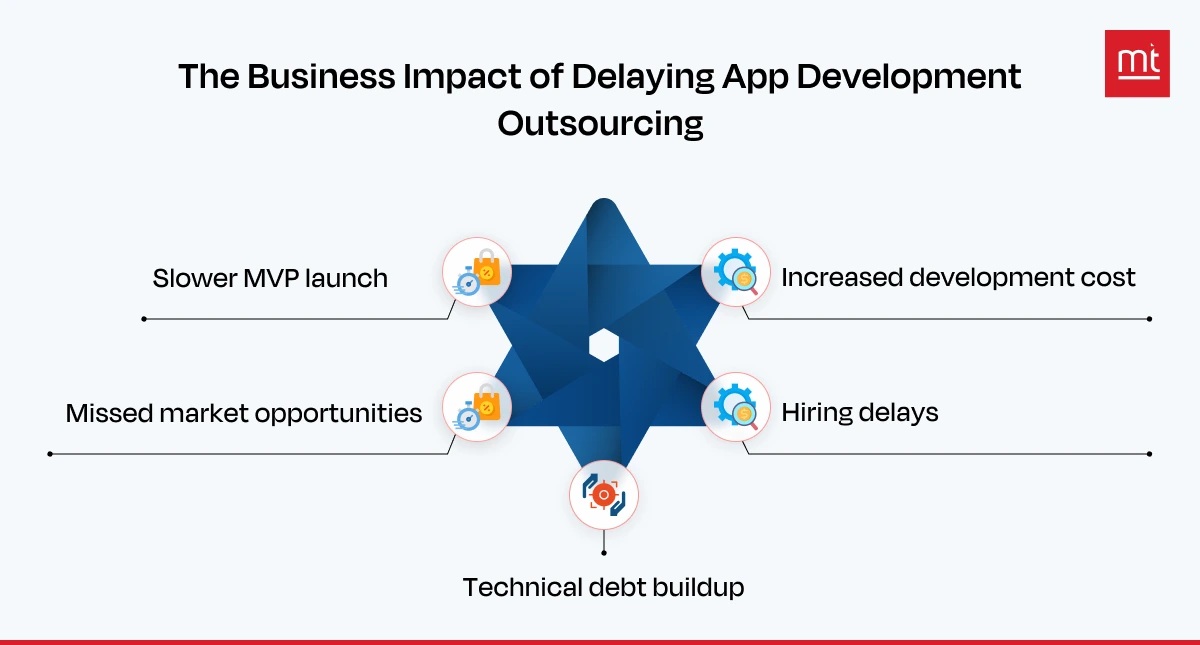
Outsourcing means higher throughput in minimum time, plus such teams do not require excessive investment and round-the-clock monitoring. Let us see in detail how delaying the outsourced app development affects your business:
Slower MVP launch
Outsourcing provides talented and ethical professionals who are trained to complete the project within the given timelines. Not hiring these experts means prolonging the launch date of your application.
This ultimately leads to missed business opportunities and even a loss of your user base that expects a smooth browsing experience, and in the case of an e-commerce business, a shopping experience.
Increased development cost
An in-house team would require heavy investment for app development, which will automatically increase the overall project budget. From gathering resources to training the team with new tools and frameworks, the cost becomes significantly unbearable for startups.
However, an outsourced app development team costs you much less because a skilled team of professionals is specifically selected for your project. That is why delaying this service can cost you a good amount.
Missed market opportunities
With delayed app development, businesses can miss out on key market opportunities. In industries that move at lightning speed, being late to launch can mean losing customers to competitors who beat you to the punch.
An in-house team might take longer to gain the necessary skills, establish workflows, and hit those important development milestones.
On the other hand, outsourcing can speed up the development process by bringing in seasoned professionals who can jump right in. Getting to market faster means businesses can take advantage of new trends, gather customer feedback more quickly, and build a stronger edge over the competition.
Hiring delays
Outsourcing means quick hiring of the most talented professionals. Agencies with experience and a good reputation ensure onboarding within 48-72 hours. Comparatively, in-house hiring can stretch to weeks with the interviewing, shortlisting, onboarding, documentation, and training processes.
Not only does this delay the start of development, but it also increases the risk of losing top candidates to competing employers.
Technical debt buildup
When companies depend on small teams that lack experience, technical debt can start to pile up. Pressing deadlines, a shortage of technical expertise, and insufficient code reviews often lead to hasty decisions in development that can hurt the application's long-term performance.
As this technical debt increases, it makes future updates, integrations, and scaling efforts not only more complicated but also more expensive.
On the other hand, outsourcing partners come equipped with specialized skills and proven development practices. They adhere to industry standards, perform regular code reviews, and design scalable architectures right from the start.
This approach helps keep technical debt in check, enhances code quality, and ensures that the application stays stable, secure, and easier to manage over time.
Cost of Outsourcing Mobile App Development
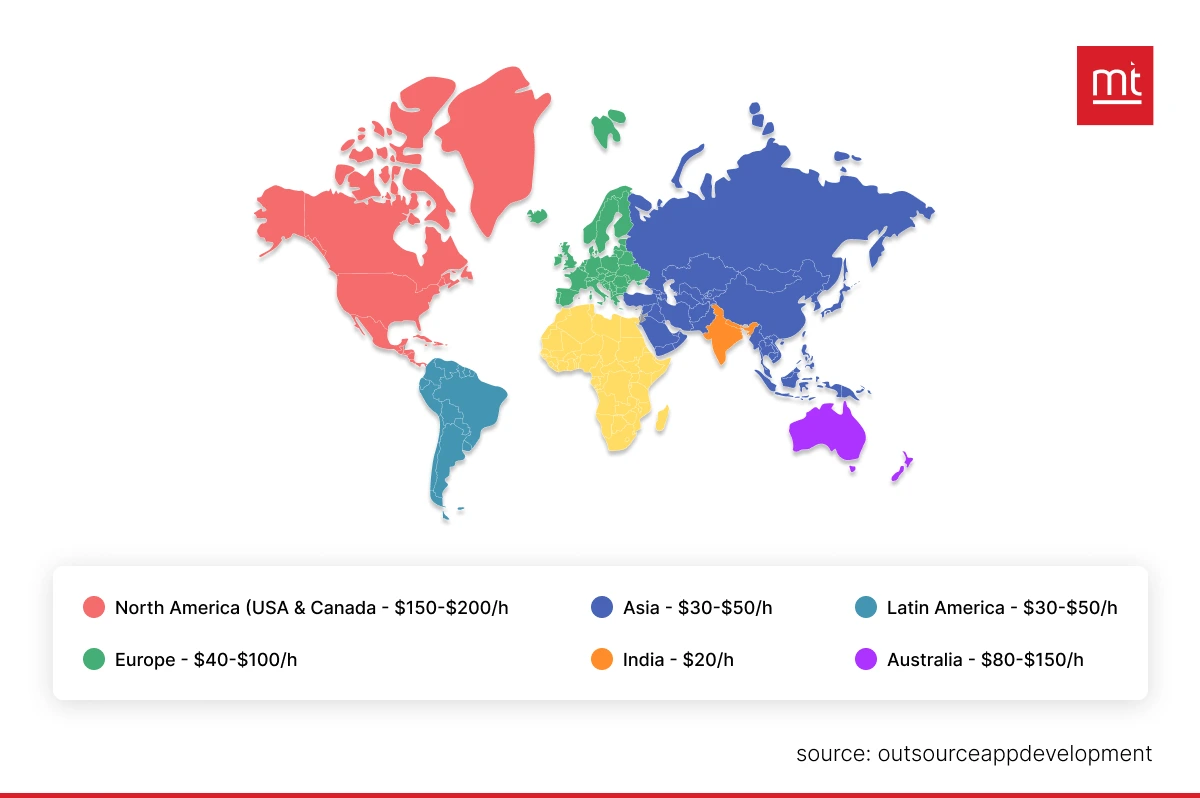
When you outsource app development, the costs may vary based on countless factors. From the size of the team to project complexity and tech expertise requirements, all these factors together determine the actual cost of outsourcing mobile app development.
As per Clutch, the estimated cost ranges from $10,000 to $49,999 for simple apps, and this price increases for enterprise-level complex apps.
Let us see how the app development costs are finalized:
Cost based on complexity:
Basic apps
Basic apps are built with straightforward functionality and a limited set of features. They usually include things like user registration, simple navigation, static content, basic forms, and minimal backend needs. Since they require a lesser development time, these apps are the cheapest.
Medium complexity apps
Medium-complexity apps come with more advanced features, such as real-time notifications, payment gateway integration, social media logins, geolocation services, user dashboards, and API integrations.
These apps need a stronger backend infrastructure and more development effort. Businesses often opt for this level when they’re looking for a scalable solution that offers better user engagement and functionality.
Enterprise apps
Enterprise applications are highly sophisticated solutions tailored for large organizations with intricate business needs. They typically incorporate advanced security features, cloud infrastructure, AI capabilities, data analytics, third-party system integrations, role-based access controls, and the ability to support thousands of users at once.
Developing enterprise apps requires thorough planning, extensive development, rigorous testing, and ongoing maintenance, making them the most resource-heavy and costly type of app development project.
Key cost factors
Features
The features you expect on your app play a key role in determining the final cost of development. Multi-device compatibility, SEO enhancement, custom navigation, and other such features increase the overall development costs.
Technology stack
The team’s expertise in different technologies is yet another factor that heavily impacts the development pricing. Trained and skilled professionals often come at higher costs as they possess multiple expertise levels and years of experience.
Developer location
Whether you want a developer from your region or from a different country affects the budget. You may like the work of a developer from South Asia, and your business is based in Virginia. The time difference will add to the budget.
Timeline
Projects with tight deadlines are often expensive. A tight schedule would mean the team will be working outside working hours, often completing difficult tasks in a limited time. That is going to affect your overall app development costs.
Here is a visual presentation of the estimated costs associated with outsourcing app development based on various regions:
Common Challenges in Outsourcing and How to Overcome Them
App development outsourcing is a beneficial service, but it comes with its own set of challenges. If you are not careful, the partnership can lead to communication gaps, project delays, frequent errors, and low-performing apps.
The good news is that these challenges can be addressed and avoided with the assistance of a trusted and reliable outsourcing development company.
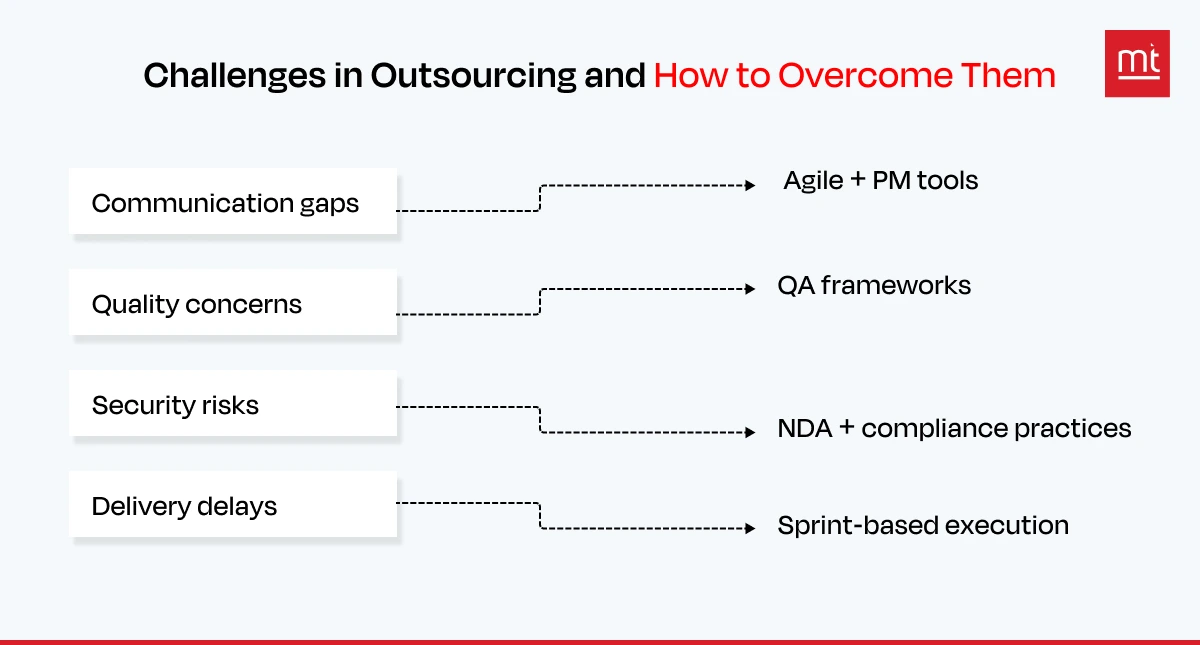
Let us look at the most common challenges and their solutions:
Communication gaps → Agile + PM tools
Communication often tops the list of worries when it comes to outsourcing app development, especially when teams are spread across different countries or time zones. Misunderstandings about project requirements, deadlines, or feature specifications can lead to expensive revisions and delays.
Reliable outsourcing partners overcome this challenge by adopting Agile development processes and cutting-edge development practices. They are adept in the trending tools and frameworks, making communication swift, especially in cross-functional teams.
Quality concerns → QA frameworks
To tackle this risk, top outsourcing firms put in place thorough Quality Assurance frameworks throughout the development journey. They carry out a mix of automated testing, manual testing, performance testing, security testing, and code reviews at various stages.
For example, before launching an e-commerce app, the QA team meticulously tests the checkout processes, payment gateways, product searches, and mobile responsiveness to guarantee a seamless user experience. This proactive strategy helps catch and fix issues before they can affect the end users.
Security risks → NDA + compliance practices
Sharing sensitive business information with an outside team can understandably spark worries about data security and protecting intellectual property. Sectors like healthcare, fintech, and eCommerce are especially at risk since they deal with a lot of confidential customer data.
To tackle these issues, professional outsourcing firms often sign Non-Disclosure Agreements, enforce strict access controls, and adhere to compliance standards specific to their industries.
Delivery delays → Sprint-based execution
Missed deadlines can really throw a wrench in the works when it comes to business growth, marketing strategies, and launching new products. Delivery delays often pop up because of poor planning, shifting requirements, lack of resources, or just plain inefficient project management.
But experienced outsourcing companies have found a way to tackle this issue with sprint-based execution models. Instead of dragging things out for months to get a complete product, they break development down into smaller, manageable milestones or sprints, each one showing tangible progress.
Latest Trends in Application Development Outsourcing (2026)
Application development outsourcing is an evolving service shaped by the newest technologies like AI, cutting-edge frameworks, automation, and more.
An outsourcing partner is equipped with the expertise to adapt to the fresh market and industry trends, ensuring quality development.
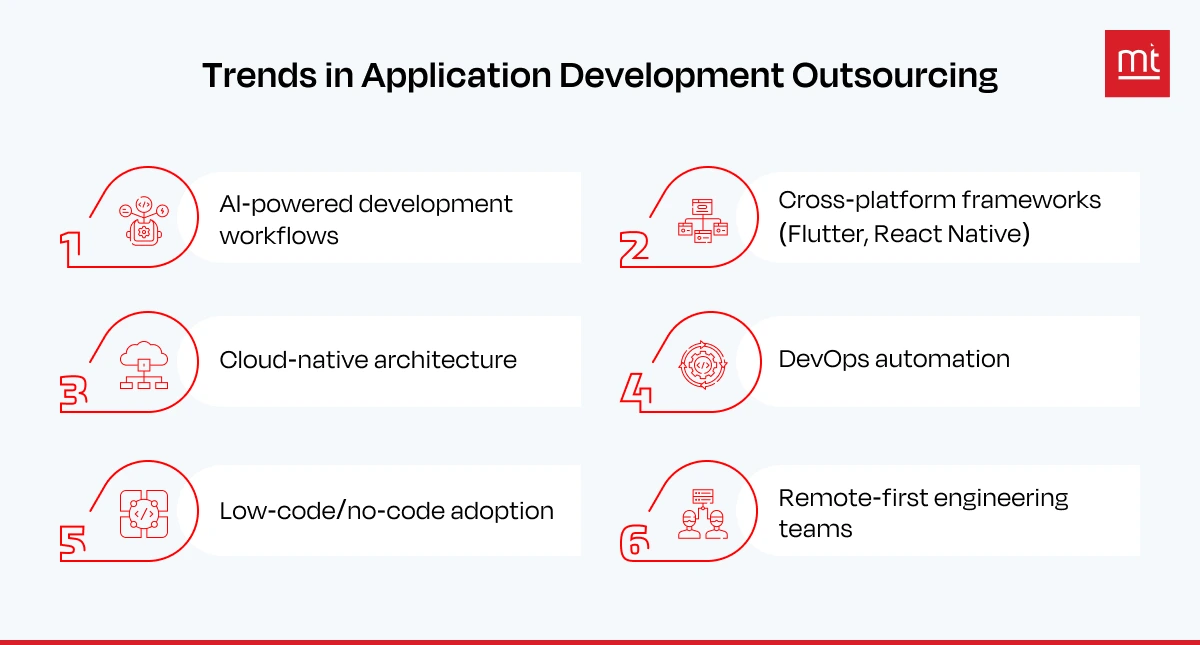
Let us look at the latest trends in this realm:
AI-powered development workflows
Artificial Intelligence is being used in all industries, and app development is part of this revolution. We now have tools to automatically generate code, which is a lifesaver for emergencies and deadline-driven projects.
Cross-platform frameworks (Flutter, React Native)
In order to reach a wider audience, the application should be developed for multiple platforms, including mobile apps, tablets, and even browsers. Hence, developers now utilize cross-platform frameworks like Flutter, React, and Native to meet these requirements.
Cloud-native architecture
Modern applications are being crafted with cloud-native architectures that tap into powerful cloud platforms like AWS and Google Cloud. This method not only allows applications to scale up or down automatically based on user demand but also boosts reliability and performance.
DevOps automation
DevOps has really become a game-changer in the world of software development. It automates the processes of code integration, testing, deployment, and monitoring. It allows development teams to roll out frequent updates without any errors.
Low-code/no-code adoption
Low-code and no-code platforms empower users with a tech background to build functional apps using simple drag-and-drop features and ready-made components. While they might not take the place of custom development for more complex projects, they shine when it comes to internal business tools, automating workflows, and quickly prototyping ideas.
Remote-first engineering teams
We live in a post-pandemic world where remote working is normalized. Remote-first teams save time, resources, and money. This approach allows businesses to hire highly skilled app developers from different regions while reducing operational costs.
Modern collaboration tools, cloud-based workflows, and agile methodologies make it easier than ever for distributed teams to work together efficiently and deliver successful software projects.
Industries That Benefit Most from Mobile App Development Outsourcing
The mobile app development market is expected to grow at a rate of 14.3% from 2024 to 2030.
Gaming
As per a report by Grand View Research, the majority of the mobile app market share is dominated by the Gaming industry. Mobile game users are scattered across the world, and the demand is very high.
Gaming companies often outsource development to access experienced game developers, UI/UX designers, animators, and quality assurance specialists. This allows them to build engaging gaming experiences, launch updates faster, and support multiple platforms without maintaining large in-house teams.
Healthcare
Healthcare management apps, patient record management apps, and door-step medicine delivery apps (also known as telemedicine apps) are some of the common usages of this advanced technology in the Healthcare sector.
Outsourcing helps healthcare organizations develop secure and compliant applications while reducing development costs.
Fintech
The fintech sector is all about mobile apps that make digital banking, online payments, investment management, insurance services, and personal finance tracking a breeze. Since these apps need top-notch security, compliance with regulations, and a smooth user experience, many companies choose to partner with specialized teams that know the ins and outs of financial technology.
Mobile app development experts utilize industry-best practices to keep Fintech apps secure and initiate successful transactions.
This strategy not only speeds up product launches but also ensures that transactions are secure and performance is solid.
E-commerce
Mobile applications have become essential for modern e-commerce businesses looking to deliver personalized shopping experiences. Features such as product recommendations, secure payment gateways, loyalty programs, and real-time order tracking require specialized development expertise.
Outsourcing app development helps startups as well as large enterprises reach these milestones with perfection. E-commerce brands can quickly implement innovative features, improve customer engagement, and scale their platforms during peak shopping seasons without increasing internal overhead.
Having the support of a reliable app development outsourcing company not only reduces technical workload but also helps e-commerce brands reach the right audience using tech innovations.
Logistics
The logistics and transportation industry is embracing mobile apps to make fleet management, route planning, shipment tracking, warehouse operations, and delivery processes more efficient. These processes require real-time tracking and live monitoring, which can be delivered by high-end apps.
Outsourcing mobile app projects helps logistics companies create feature-packed applications that include GPS tracking, real-time analytics, and automated notifications. This not only boosts operational efficiency but also helps cut down on delivery delays, giving customers better visibility throughout the supply chain.
Education (EdTech)
Both schools and EdTech firms are pouring resources into mobile applications to enhance online learning, facilitate virtual classrooms, promote skill development, and engage students with impactful learning activities.
This trend became more popular after the COVID pandemic introduced the format of online learning.
Outsourcing app development enables organizations to create scalable learning platforms with features such as live video streaming, interactive quizzes, progress tracking, and AI-powered learning recommendations. These apps also initiate processes like online grading, AR-infused teaching, and other creative methods of learning.
This allows educational providers to reach learners across different geographical locations effectively while enhancing the quality of education.
Travel & Hospitality
The travel and hospitality sector heavily depends on mobile apps for its entire functioning, from booking hotels and flights to managing itineraries, offering travel tips, and providing customer support.
Travel agents and booking platforms utilize apps for enhanced customer experience and also manage their in-house operations.
With the help of the right outsourcing partner, travel companies can create user-friendly apps that feature real-time booking, location services, digital payment options, and support in multiple languages. These enhancements not only improve the customer experience but also help travel businesses stay competitive in a fast-changing market.
On-Demand Services
On-demand services include food delivery apps, grocery delivery, telemedicine, home repairs, home-based salon services, and more. To meet these demands of customers, mobile apps require complex features like real-time tracking, payment processing, matching customers with providers, and sending push notifications.
One can find countless such apps in today’s time, signalling the popularity of on-demand services. On-demand service providers can outsource skilled teams that can efficiently build and maintain these advanced applications, leading to quicker growth and happier customers.
ManekTech: Your Trusted Outsource App Development Service Provider
Outsourcing mobile app development services can be a logical decision for businesses wanting to work with the best global talent at reasonable costs. It not only offers quality but also avoids roadblocks like lack of talent, higher operational costs, and team mismanagement.
Businesses can unlock these benefits with the right IT outsourcing company like Manektech, which successfully meets your mobile app needs.
We have a proven track record of designing and developing 2500+ projects for a plethora of industries. From building MusiFy: an AI-enabled music generator and editing app to serving the e-commerce sector with a custom Gourmet Goodies Gift app and an on-demand Grocery App.
Our work does not end here; we have also developed apps for Stock Trading, Supply Chain Management, Resort Booking, Mental Health Wellness, and the list goes on. Our portfolio spans from covering industries like Travel & Tourism, Music & Entertainment, FinTech, Healthcare, E-commerce, On-demand Delivery, and more.
We deliver custom solutions specifically tailored to meet your business needs with the help of our 450+ skilled professionals. From writing clean code to ensuring the app delivers a user-friendly experience, we leverage the power of advanced technologies.
With over 14 years of experience in mobile app development, we have emerged as the top choice of businesses aiming for excellence. Whether you need an MVP, an enterprise-grade application, or a dedicated development team, we provide tailored solutions that best suit your business goals.

FAQs
Q.1 What is mobile app development outsourcing?
The process of hiring a dedicated team of development experts from a third party is called app development outsourcing. This model brings trained experts from different parts of the world to work for you.
Q.2 Why should companies outsource app development?
Outsourcing boosts productivity by ensuring skilled professionals work on a project. It also reduces hiring costs and management time, as all these tasks are fulfilled by the outsourcing service provider.
Q.3 How much does outsourcing mobile app development cost?
The actual cost depends on project details, like the complexity, urgency, app type, integrations, and additional features. Development cost can range from $10,000 to as high as $50,000+.
Q.4 Which is the best outsourcing model?
All outsourcing models have their benefits, but a dedicated development team model works best as it takes away your responsibility of managing and onboarding a team.
Q.5 How do I choose a mobile app development outsourcing company?
Before hiring an app development outsourcing company, assess their previous work, tech expertise, work ethics, and experience in different industries. Checking the company’s reviews and customer ratings also gives a fair idea of its work.

Nikhil Solanki
Mobile Lead
Nikhil Solanki has 10+ years of experience in App Development and currently works as the Mobile Lead at ManekTech. He is an experienced Mobile lead with a demonstrated history of working in Mobile's information technology and services industry.


Subscribe to Our Newsletter!
Join us to stay updated with our latest blog updates, marketing tips, service tips, trends, news and announcements!