
Project Overview
AI-Powered Employee Attendance Tracking App is an intelligent workforce management tool created to assist companies in managing their employees’ attendance and work schedules. This application combines employee check-ins, attendance management, location verification, and reporting in one single place. This application was built for a US-based corporate client with the help of a dedicated development team at Manektech and includes several features, such as AI-powered face recognition, liveness detection, QR code scanning, and GPS tagging that facilitate the process of attendance tracking and make it more accurate and time-efficient. With its offline attendance feature, employees can check in even in places where there is no access to the internet, and all data will be synchronized once the connection is available again. Furthermore, the application also offers HR and payroll integrations, a real-time attendance dashboard, and automated reports.
Project Objectives
- Use AI-based attendance tracking to automate employee check-in and check-out processes.
- Increase the accuracy of attendance with facial recognition and liveness detection.
- Facilitate attendance management for office, remote, hybrid, and field employees.
- Offer location verification through GPS and QR codes.
- Ensure offline attendance tracking with automatic data synchronization.
- Integrate attendance data into HR, identity management, and payroll systems.
- Help schedule shifts, report attendance, and monitor employees.
- Keep employee data safe through secure data processing and consent-driven workflows.
Let's Shape Your Project Together
Have an idea, a challenge, or a new project in mind? Our team is here to help.
Business Challenges
1. Incorrect Attendance Records
The client used manual recording, spreadsheets, and local software solutions to track the attendance of employees. The process resulted in inaccurate records, missed check-ins, wrong work hour calculations, and even buddy punching. An accurate employee attendance tracking system was needed to solve the problem.
2. Complicated Remote & Field Employee Attendance Verification
As employees worked from various offices, home offices, and field sites, checking their attendance became quite problematic. Conventional attendance systems were unable to prove that employees checked in at certain places and provide a unified view of workforce activity to managers.
3. Payroll Calculation Mistakes & Manual HR Work
As a result of the mistakes in attendance tracking, the HR team had to devote much time to correct timesheets, calculate work hours, and resolve salary issues. The client needed an app with integrated attendance reporting and a payroll system.
4. Biometric Safety & Attendance Fraud
The introduction of facial recognition brought about many problems concerning the privacy of employees, the protection of their biometric data, and verification reliability. The app had to be able to differentiate real users from photos and videos and manage employee information in a secure way.
5. Flaky Internet Connections
Field-based workers found themselves in places with poor or no connectivity in some instances. There was a threat of the loss of check-ins and/or delayed attendance details due to not having an offline capability for taking attendance.
6. Challenging Human Resources and Payroll Systems Integration
Connecting the attendance software with current systems used by enterprises like ADP, Workday, and Okta demanded a lot of integration thinking. The system needed to be able to connect with attendance details and manage identities without disturbing human resources and payroll processes.
Our Solutions
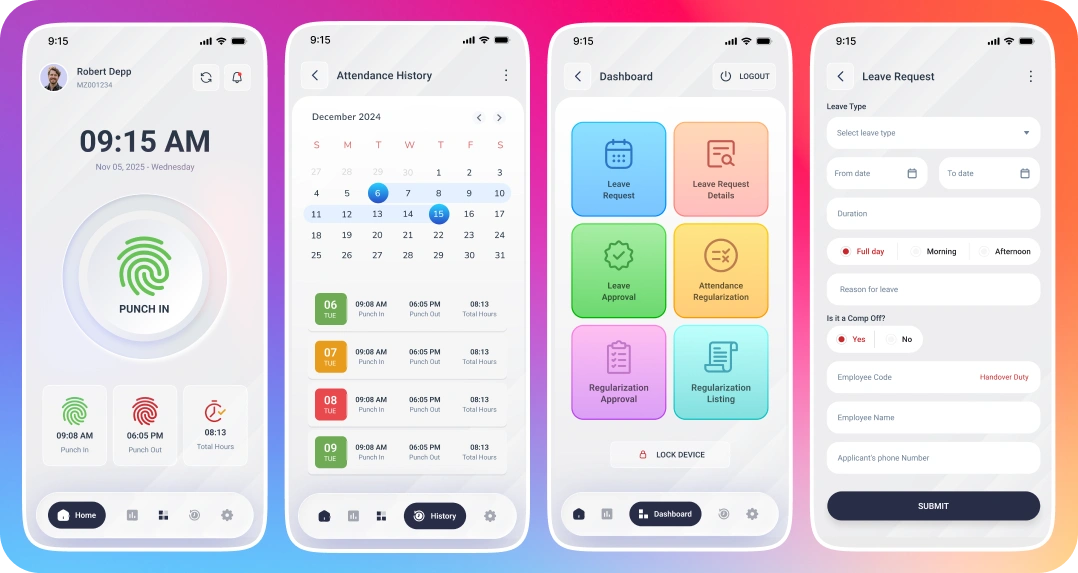
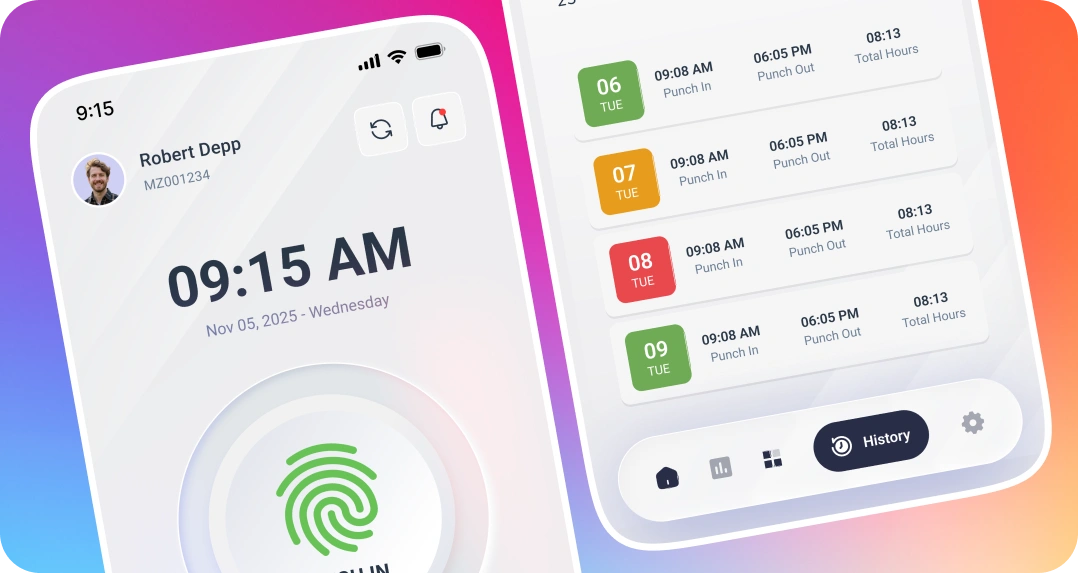
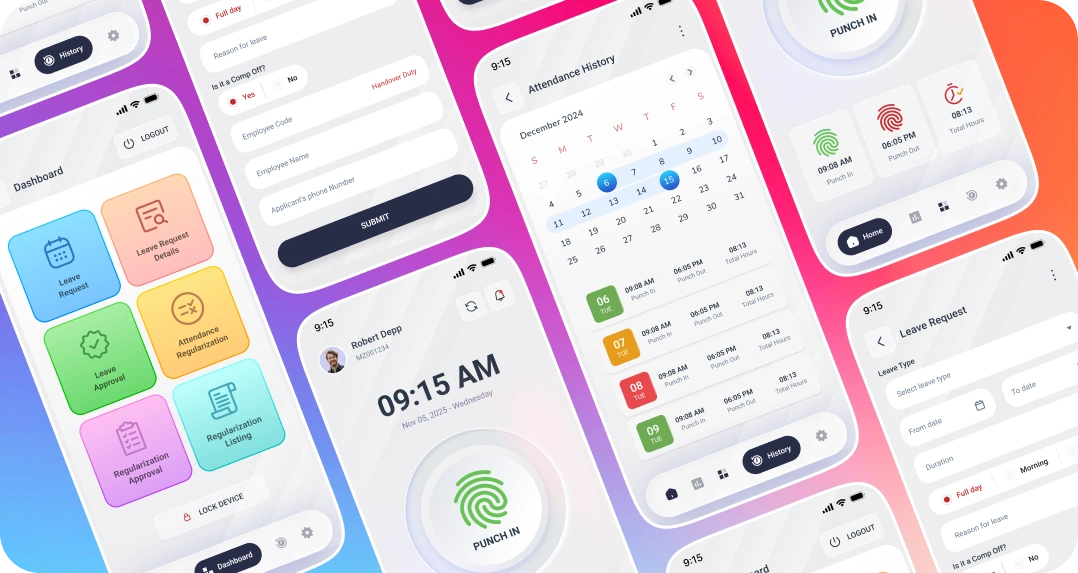
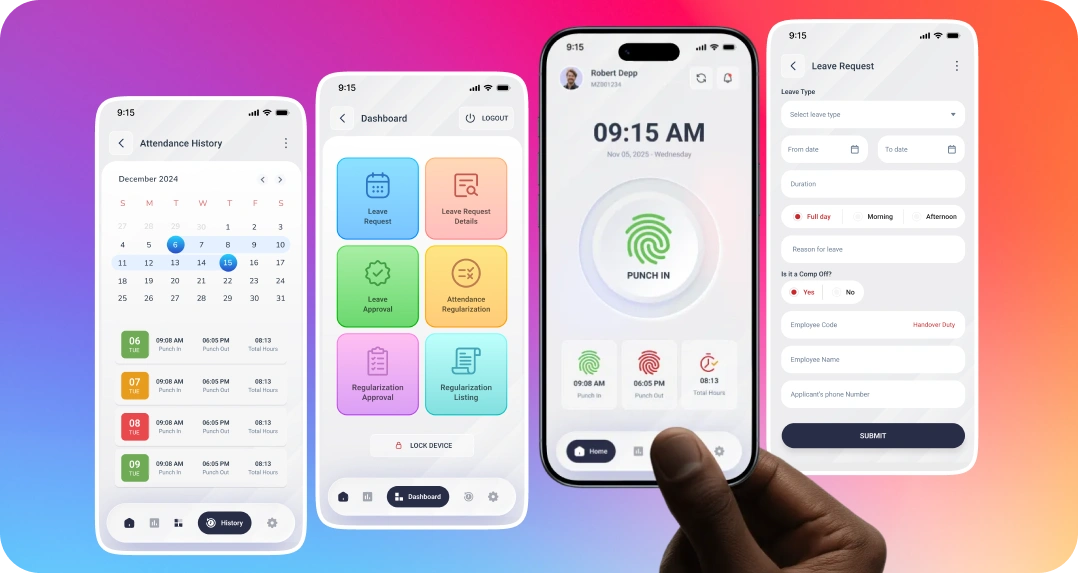
As a top Flutter app development company USA, we suggested developing a digital attendance tracking system that automates the entire check-in process to manage employee attendance for office, hybrid, and field employees. The proposed solution was built to operate on Android and iOS devices and allow managers and HR specialists to control attendance centrally. Intelligent verification will help eliminate any fraudulent check-ins, GPS and QR codes will assist in location-aware attendance tracking, and automatic synchronization will keep the records updated when a connection becomes available again. Our solution also features reporting tools, shift scheduling capabilities, secure handling of employee data, as well as integration with HR and payroll systems to minimize manual labor and facilitate workforce management. AI-Powered Face Recognition & Liveness Detection Face recognition based on AI algorithms is used to help employees mark their attendance using the camera of their mobile device. Liveness detection is introduced as an extra verification step aimed at eliminating any presentation attacks using photos and videos. The solution accounts for various lighting and camera conditions, face angles, and other factors necessary to provide a practical user experience for mobile attendance marking. Proper consent and biometric data protection are essential components of the solution. Flexible Check-In & Location Verification Our app allows several attendance options to be used, including face scanning, scanning a QR code, location verification based on GPS, badge scanning, or approved attendance by the manager in case of necessity. It ensures that companies can adapt their solutions to a different environment whether it is an entrance in an office or a job site where there is no option of using a certain check-in method. Offline Attendance & Synchronization For this reason, we included offline attendance feature to allow employees to record their attendance even when there is no Internet access. Data will be saved locally and then synced when the connection is restored. Automated HR & Payroll Integration It allows integration with various systems such as ADP, Workday, and Okta to automate related attendance, payroll, and identity management procedures. It can help HR teams in automating data exchanges to avoid repetitive work and simplify work hour calculation. Real-Time Workforce Monitoring & Reporting We created an attendance dashboard that lets managers see how their employees attend work and if there are any latecomers or absentees. HR teams can create attendance reports, analyze attendance patterns, and export data for payroll preparation. Key Benefits
- Enable attendance tracking automation for different workplace setups.
- Enhance attendance verification using AI facial recognition and liveness detection.
- Cater to employees working in offices, hybrid, remote, and field settings.
- Minimize the need for manual correction of timesheets and HR activities.
- Gain better visibility into your workforce via attendance dashboards.
- Capture attendance information even when there is no internet connectivity.
- Make attendance reporting and payroll processing easy.
- Enable integration with HR, payroll, and identity management systems in enterprises.
- Ensure that employee data is secure through encryption and consent-driven processes.
- Build a strong base for smarter workforce management.
Key Features
Technology
| Mobile App Development | React Native, Flutter |
| Frontend / Web Interface | React, Next.js |
| Backend | Node.js, Express.js, TypeScript |
| Database | PostgreSQL, Redis |
| AI & Machine Learning | TensorFlow, TensorFlow Lite, Face-Embedding Models |
| Cloud Infrastructure | AWS EKS, AWS S3, AWS RDS, AWS IAM |
| Infrastructure as Code | Terraform |
| CI/CD | GitHub Actions |
| Push Notifications | Firebase Cloud Messaging, APNs |
| Analytics & Reporting | Metabase, Tableau Connector |
| Identity & Access Management | OAuth 2.0, Okta Integration |
| Security | TLS, AES-256 Encryption |
| HR & Payroll Integrations | ADP, Workday |
Business Results
90%
Improved Attendance Accuracy
The project reported a significant improvement in attendance accuracy following the move away from manual spreadsheets, supported by automated check-ins and additional verification methods.
70%
Faster Employee Check-Ins
QR code and GPS-based attendance workflows helped employees record their attendance more quickly, reducing the time required for routine check-in and check-out activities.
40%
Reduction in Time Theft
AI-based verification and location-aware check-ins helped reduce attendance abuse, including attempts to record attendance on behalf of other employees.
80%
Less Manual HR Work
Automated attendance reporting and integrated workflows reduced repetitive administrative tasks, giving HR teams more time to focus on employee support and workforce planning.
Product Gallery
Planning a Similar Mobile Application Project?
Whether you’re building from scratch, modernizing an existing application, or expanding your engineering team, our experts are ready to help.
- 450+ Engineers
- 14+ Years
- Flexible Engagement
- US Business-Hour Collaboration
Frequently Asked Questions
An AI-powered employee attendance tracking app is a software solution for workforce management that automates employee check-ins and check-outs with the help of various technologies, including face recognition, liveness detection, GPS, and QR codes.
The use of AI face recognition ensures identification of an employee during check-in. In combination with liveness detection, it helps detect possible attempts to check in using photographs or video instead of a person.
Yes. The app provides the function of offline attendance that will allow checking-in even when there is no Internet connection.
Yes. The tool can be used for office-based, hybrid, remote, and field workers. GPS tagging, QR code scanning, and other attendance verification options are available to enable companies to track attendance in various work conditions.
The solution can be integrated with enterprise systems like ADP, Workday, and Okta for identity and access management. Such integrations may help reduce payroll errors due to data exchange between the system and other HR and payroll tools.
By automating attendance recording, unifying work hours documentation, and integrating with HR and payroll systems, the tool can help avoid manual data input and timesheet discrepancies. HR specialists can use attendance reports to eliminate any discrepancies.