


How Much Does a Shopify Store Development Cost? A Complete Guide for App Owners

Key Takeaways:
Shopify is one of the most popular e-commerce platforms today, which is already used by big brands. If you are a startup founder, e-commerce manager, or app owner, understanding its costs and factors behind it is crucial. In this blog, you’ll learn about the factors that affect store development costs and how pricing differs between templates and custom stores. We explain everything from monthly plans to transaction fees, helping you plan your budget wisely.
Introduction
Shopify is one of the most dominant e-commerce platforms these days due to its simplicity and scalability. Do you know there are currently 5.54 million active stores, which means globally 27% of e-commerce stores are on Shopify. No doubt, Shopify also offers some free trials and provides incredible flexibility. But that same flexibility can add extra costs if you don’t know about the costs and factors affecting it.
If you are new and starting with a Shopify store and thinking about h ow much does a Shopify store costs , you must first explore professional themes, productivity apps, transaction fees, marketing tools, and development work to customize your store’s functionality. In this article, we will discuss about the Shopify costs, templates, customizations, transaction fees, and more to plan your budget from day one and launch a successful store.
What Factors Affect the Cost of Building a Shopify Store?
The cost of running a Shopify store will depend on certain factors based on your choices. Here are some, let’s explore it.
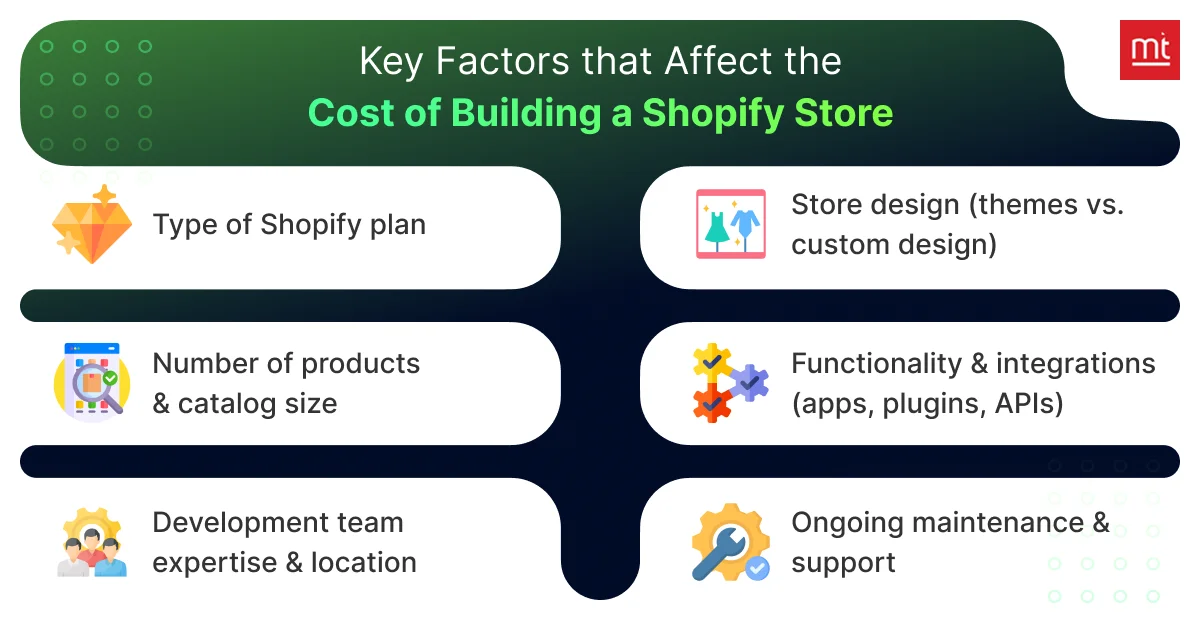
1. Type of Shopify Plan
Shopify do come with a free trial, but later on it has monthly and yearly charges. Basic plans are more affordable but have limited tools, while advanced or Plus plans cost more and include better analytics, lower transaction fees, and enterprise features.
2. Store Design (Themes vs Custom Design)
There are two options: if you have a custom Shopify developer available, you can use free themes and customize it wherever needed. But if you want a completely unique look and functionality for your brand, then it needs a custom design.
3. Number of Products & Catalog Size
The more products you sell, the more complex your store becomes. Large catalogs require better organization, data imports, and product filtering options, all adding to design and development time. This is indirectly connected to transaction charges.
4. Functionality & Integrations
Adding extra features like loyalty programs, chat support, or shipping tools requires third-party apps or custom integrations. Free apps are budget-friendly, but paid ones add monthly costs.
5. Development Team Expertise & Location
Hiring an experienced Shopify development company offers better results but costs more. Rates also vary by region, as teams in North America or Europe charge higher than developers in India or Asia.
6. Ongoing Maintenance & Support
Your Shopify store needs regular updates, security checks, and performance monitoring to stay reliable. Maintenance costs include bug fixes, new feature additions, and app updates.
Breaking Down The Shopify Store Development Costs
Starting with a Shopify store includes so many things, and everything comes with some charges. Shopify Store Costs depend on subscription plans, theme costs, customization, type of development, payment gateway, integrations, and the level of support it needs.
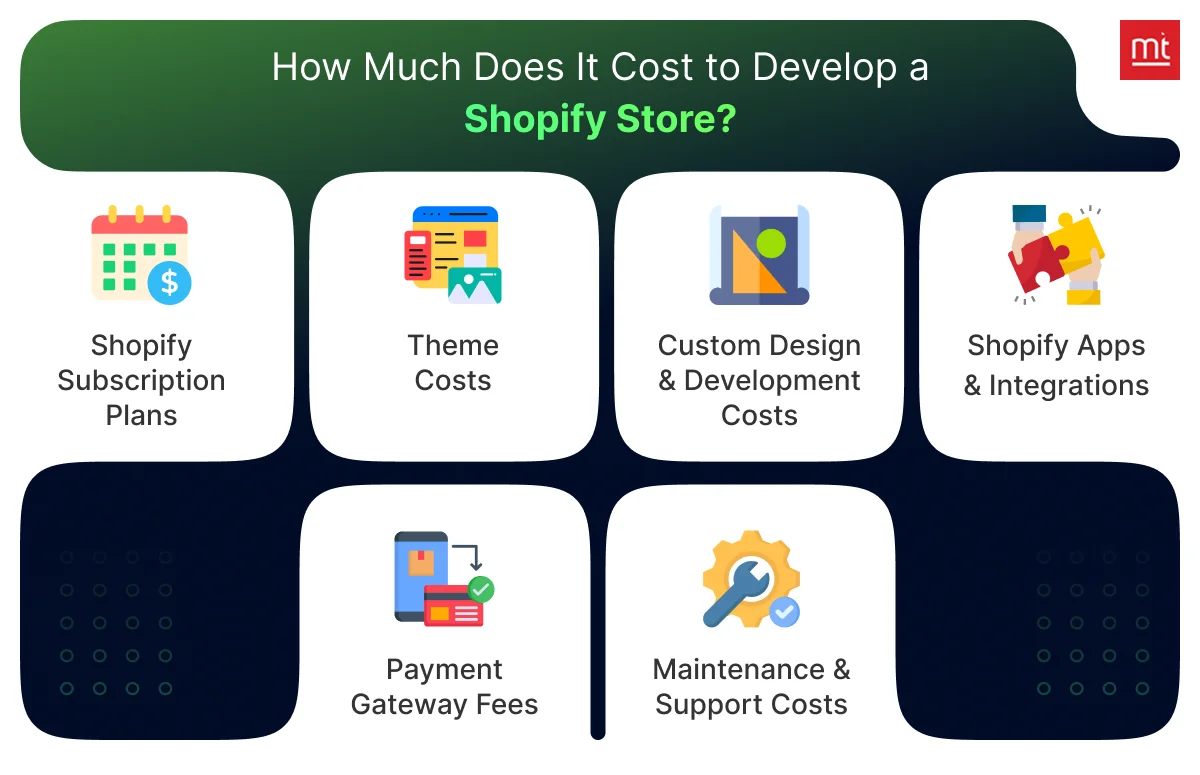
Let’s go through all of them below.
1. Shopify Subscription Plans
Shopify offers four main types of subscription plans, and you can choose according to your business size and the needs of your store.
- Basic Shopify : The Basic Shopify plan starts from $39/month and is best for new stores. It has all the essential features to start selling online, including a website, blog, and basic reports.
- Shopify Grow : It starts with $105 per month and comes with more staff accounts, better reporting, and lower transaction fees than the basic plan.
- Advanced Shopify : The advanced Shopify plan starts with $399/month and is best for growing businesses. It provides advanced reports, third-party calculated shipping rates, and lower transaction fees for higher-volume businesses.
- Shopify Plus : Shopify Plus is for enterprise-level, big brands that want full customization, deal with a high number of sales, need scalable features, and continuous dedicated support. It starts with $2,300/month.
2. Theme Costs
Shopify currently has more than 800 themes, which are responsive and can be customized according to business needs. It has lots of free themes as well as paid ones. Free themes have enough features and functionalities to start selling and accepting payment, but if you want advanced customization, better design, and additional features, then opt for paid themes.
Free themes are good for testing or small stores, while go for paid themes if you are a well-established business and want a professional appearance and unique layout.
3. Custom Design And Development Costs
Sometimes, pre-built themes don’t fit your goals or business requirements, then you might need to hire Shopify Developers to create custom layouts, features, and interactive elements as per your brand identity.
Simple customizations like color changes or section tweaks cost $500-$2,000. But building custom features, unique checkout experiences, or completely bespoke designs might require hiring an experienced Shopify development company.
4. Shopify Apps And Integrations
Apps and integrations are important to add extra functionality to your Shopify store. Shopify’s app store has thousands of free apps covering basics like email marketing, social media integration, SEO tools, and customer reviews. They’re excellent starting points, but often have limited features or display “powered by” branding.
Premium apps can start from $5-$300/month each. If you want advanced functionality like abandoned cart recovery, inventory management, loyalty programs, advanced analytics, and marketing automation. Then you must consider the cost of apps and integrations according to your customers.
5. Payment Gateway Fees
Shopify charges a transaction fee on the number of orders. Shopify’s built-in payment system costs 2.9% + 30¢ per transaction if you choose the basic plan. For the advanced plan, the charges are 2.4% + 30¢ with no extra fees. If you use third-party gateways like PayPal or Stripe, there’s an additional 0.5–2% fee on top of their regular rates. These fees may look small, but they can add up and affect your store’s profits over time.
6. Maintenance and Support Costs
Your store needs ongoing attention after launch. This adds extra maintenance and support costs. Basic maintenance includes theme updates, app management, security monitoring, and content updates. So you can expect around $50-$200 monthly if you are outsourcing to an eCommerce Development Company.
Always hire a Shopify developer for continuous optimization, troubleshooting, performance monitoring, and feature additions.
Estimated Cost Ranges for Shopify Store Development
If you want an answer for how much does it cost to start a shopify store, it depends on the size of the business and the goals you are trying to achieve. We can categorize it into three types: small business, medium, and enterprise-level stores. Let’s explore them to get more clarity.
1. Small Business/Startup Store
If you are a startup or a small business, you must assume the cost of Shopify store development within $500 to $5,000. This includes simple layouts, basic product catalogs, and standard payment options. It can grow gradually, depending on the additional features you add.
2. Mid-size Store With Customizations
A medium-sized store also requires some level of customization. You can use pre-built themes, but you need to hire a Shopify developer to customize and add suitable functionality. A medium-sized Shopify store will need custom themes, integrations with third-party tools, and good reporting. Hence, you can expect development costs around $5,000 to $20,000, depending on complexity.
3. Enterprise-level Shopify Plus Store
If you are an enterprise or high-volume business, use Shopify Plus to handle large traffic, complex workflows, and multiple sales channels. This kind of development requires fully custom themes, advanced apps, ERP integrations, and priority support. Cost can start around $20,000 and can go higher depending on features and customizations.
To handle big business smoothly, Shopify Plus is a great choice as it offers scalability, security, and a premium shopping experience.
How to Reduce Shopify Development Costs?
The cost to start a Shopify store is different for every business. But you can reduce the development cost by using some smart practices. Here are some:
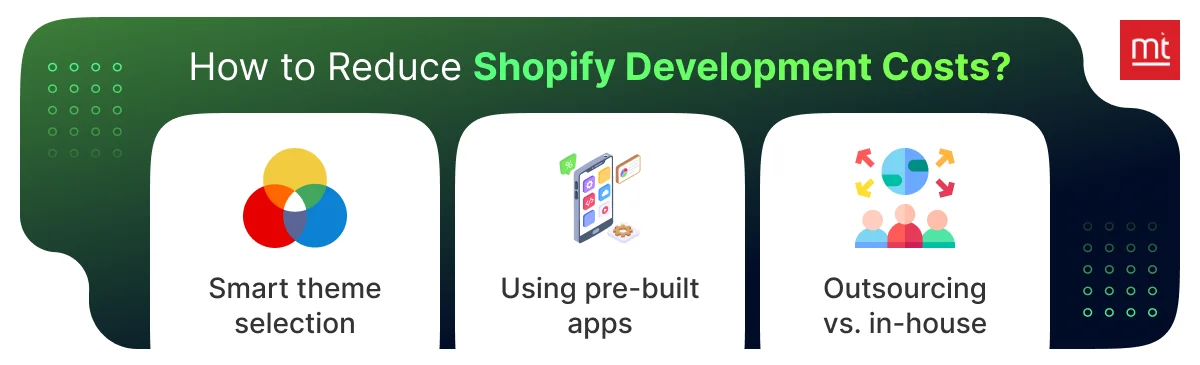
1. Smart Theme Selection
Themes are the basic building blocks of the Shopify store, as everything is connected with the theme and operates through the theme. Your features, functionality, and design are connected to the theme. Shopify offers many free and affordable themes that look great and are easy to customize.
By picking a ready-to-use theme, you can save both time and developer costs. You can always modify colors, fonts, and layouts later as your store grows. So start simple, launch fast, and upgrade design elements only when your sales start making a profit.
2. Using Pre-built Apps
Instead of spending on feature development, you can use pre-built apps for marketing, inventory, payments, and more. The built-in apps are easy to install and use. This will save you hours of custom coding. You can always try free plans or low monthly fees and then pay for it after testing your store features.
This will keep your initial development budget low without compromising functionality.
3. Outsourcing vs In-house
This depends on your business size. If you are just starting up, you can hire an outsourcing Shopify agency to set a good base and start running your store. You can choose flexible pricing models like fixed or hourly rates, depending on your project size. This approach is perfect for startups and small businesses looking for professional results.
Why Choose ManekTech for a Shopify Store Development Project?
Manektech has been the top eCommerce Development Company, serving thousands of clients in creating successful Shopify stores. With over 14 plus years of experience, we are experts in customizing themes, performing complex integrations, and designing your store according to your business objectives.
Our goal is simple: to create Shopify stores that look great, load fast, and convert visitors into customers. From setup to scaling, we take care of everything so you can focus on growing your business with confidence.
If you need help with how to grow your business with a Shopify store , our experienced consultant can also guide you from scratch to make things work within your budget and achieve goals.
Shopify Store Development Cost: Wrap-Up
Understanding your Shopify store costs is the first step toward smart business planning. By reading the above blog, you must have got an idea about how much does it cost to start a Shopify store. It all starts with the basic choices you make for your Shopify store. What you can do is pick a theme that aligns with your business, use pre-built apps to cut costs, and decide early whether to outsource or develop in-house.
It’s always better to start small with free themes and apps and test them. If this works great, you can always customize it and modify it to align with your store goals. Lastly, focus on building a smooth, fast, and user-friendly store. With the right approach, your Shopify store can grow steadily without stretching your budget.
Frequently Asked Questions
No, Shopify is not actually cheaper as it has fixed monthly plans and needs built-in hosting. WooCommerce can be affordable initially, but it needs separate hosting, plugins, and maintenance. Wix is best for small sites, but the charges can increase with advanced features.
Yes, we can create a basic and good functional store within your budget. You just need to finalize the pre-built themes, required features, customization, and other requirements needed for your store.
Custom stores are more expensive because it need more investment. It requires more coding, a unique design, custom functionality, and a specialized development process according to the brand. While template stores are fast and affordable because they are made from ready-made themes, and most of the functionality and features are already included in it.
Yes, a Shopify store is worth it for small businesses it is easy to start, manage, and requires less technical skills. Any small business can get started with ready-made themes, accept payments, and grow the functionality as the business grows.
No. Shopify does not take 30% of your sales. Transaction fees depend on your plan and the payment method you use. It only takes a specific percentage of amount from the sales of your store.
Yes majority of big brands are already using Shopify Plus because of its capability to provide advanced functionality, accept multiple currencies, handle high traffic, inventory, and scalability.
More articles on the topic
An app's user base using Firebase Analytics, a free and unlimited analytics solution. You'll be able to learn who your users are and how they interact with your app.
7 Min ReadFeb 27, 24

Nikhil Solanki
Mobile Lead at ManekTech
Data Visualization technologies provide us with a proliferation of insights into the data obtained. Google and Microsoft, for instance, gather and utilize Big Data to shape the future of their commercial operations.
4 Min ReadFeb 29, 24
Ruchir Pandya
Delivery Head of Web at ManekTech