Get Free Trial Week Developer Access, Try Before You Hire. Click Here to Claim Now

How to De-Risk Software Development Outsourcing?


Key Takeaways
- Reduce failures in software development outsourcing with structured contracts, clear governance, and measurable delivery controls.
- Cut delays and cost overruns by enforcing milestone payments, SLAs, and sprint-based progress validation.
- De-risk execution through vendor evaluation, pilot engagements, and defined communication frameworks.
- Avoid vague contracts, weak IP clauses, and poor documentation that trigger rework and compliance issues.
- Choose experienced partners, define scope early, and validate with a short trial before long-term commitment.
The global software development outsourcing market is fast-evolving, with estimates showing it will cross $1 trillion by 2030. Growing startups and enterprises are continuously investing in external development teams to move the needle faster, scale quickly and control costs. Despite all efforts, most projects run into the same issues like delayed timelines, budget overruns and end products that don't match the vision.
Most often failures don’t happen because you haven’t onboarded the right talent. It occurs when you select the wrong vendor or enter into vague contracts with them.
With remote work being normalized since 2020, the outsourcing landscape has also changed dramatically. In 2026, AI-assisted development with stricter regulations and cross-border security has added more opportunities along with risks.
At ManekTech, we have seen these shifts first-hand across 500+ projects. That’s why we have prepared this guide that breaks down the risks that matter most and offers practical strategies to mitigate them when hiring dedicated software developers.
What 'De-Risking' Actually Means in Software Outsourcing?
De-risking software development outsourcing means identifying risks related to delivery, communication, legal and talent acquisition and safeguarding them before the project starts. With the growth in the software development outsourcing landscape, the risks have also potentially increased.
According to Gartner, the global IT services spending is likely to exceed $1.7 trillion, backed by software development, AI and digital transformation. To understand how these risks appear in real software development projects, we have divided them into predictable categories.
According to Industry Insights: How Software Outsourcing Risk Has Evolved
Outsourcing risks look very different today from what they were just a few years ago when remote work was normalized.
- Before 2020, outsourcing risks meant operational issues like delivery delays or communication gaps. However, in 2026, it is slightly strategic involving AI code governance, strict global data privacy regulations and cross-border compliance responsibilities.
- Hybrid outsourcing models are continuously rising. In this model an onshore project manager coordinates with the offshore development teams. This is considered a safe structure for large projects
- According to NASSCOM data, India’s unrivaled talent pool has given it a competitive edge in the sourcing market. It currently has a 58% share in the outsourcing market with a 6Mn technology workforce.
From our observation, experience and data-backed insights, we believe that companies that succeed in outsourcing aren’t doing it for cost-savings alone; they have structured partnerships founded on clear governance and transparent communication.
What Are the Four Software Outsourcing Risk Categories Every CTO Should Know?
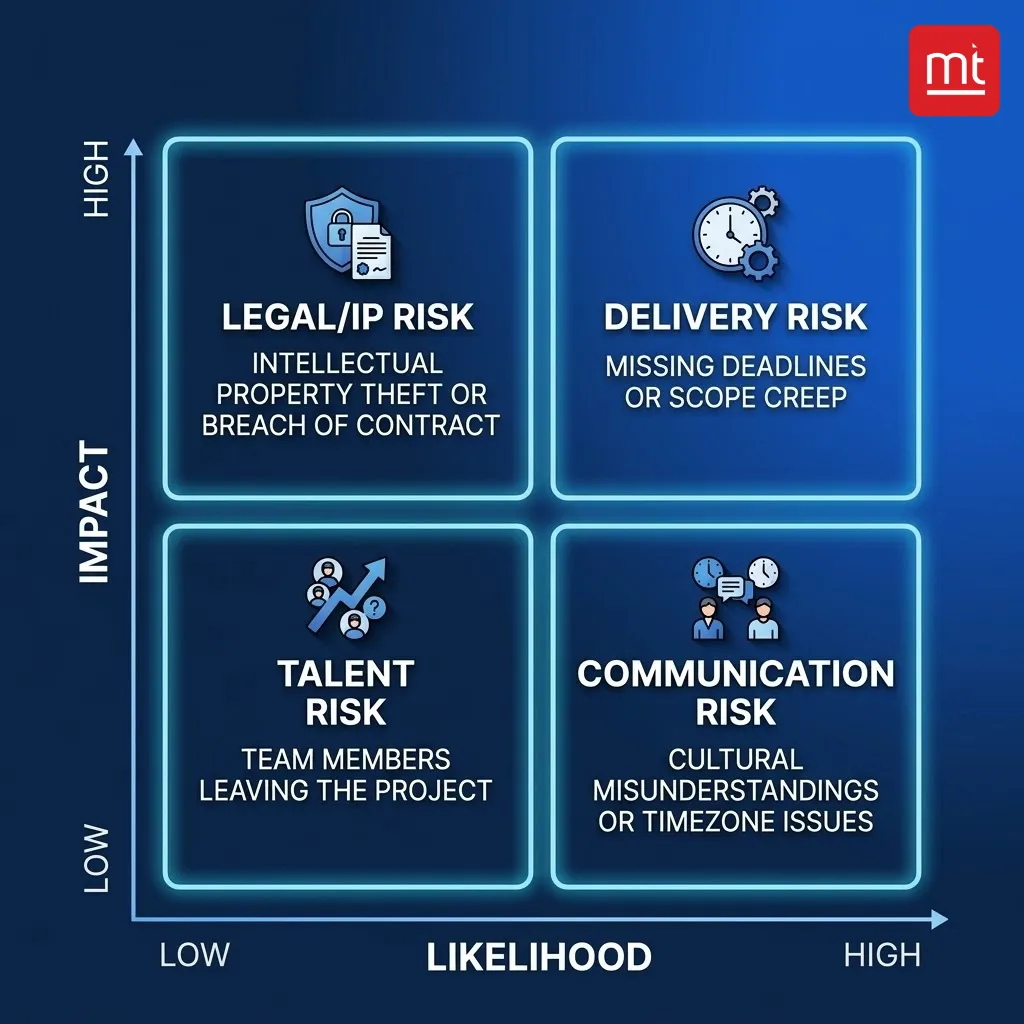
Here is an at-a-glance view into the different risk categories every CTO should know.
Risk Category | What Can Go Wrong | De-Risk Strategy |
Delivery Risks | Missed deadlines, poor scope definition, Quality gaps, rushed releases and technical debt | Sprint planning checkpoints, milestone-based contracts, defined acceptance criterion. |
Communication Risk | Unclear documentation, fragmented conversations, IP ownership disputes, and misunderstood requirements | Dedicated project managers, async-first communication, shared documentation |
Legal and IP Risk | IP and code ownership disputes, unclear product assets, data leaks and non-compliance | Airtight NDAs, clear IP assignment, compliance with regulations |
Talent Risk | Developer churn mid-project, skill gaps, knowledge transfer | Redundant teams, document codebases, code repositories. |
Delivery Risk
When your outsourcing partner misses the deadline or releases features that fall short of expectations, the root cause is a weak project structure. In the absence of clear milestones, defined acceptance criteria and frequent sprint reviews, these small delays accumulate, escalating into missed releases or scope creep.
Communication Risk
While distributed teams offer flexibility and access to global talent, they rely on clear and structured communication. Time-zone differences combined with fragmented conversations and poor documentation can cause misunderstandings. This can cause the partner to lose context, which results in communication gaps, triggering rework and technical debt.
Legal and IP Risk
There are legal considerations to be included when you enter a cross-border development partnership. You must define the IP ownership, data protection responsibilities and regulatory compliance to be followed at the start, else you will face compliance risks.
Talent Risks
The success of your project depends on your dedicated software developer’s expertise and the stability of the team delivering the project. If you experience a high developer churn, undocumented architecture decisions and knowledge available with a single person, you may find it difficult to scale the project.
What Are the Hidden Costs Nobody Talks About?
Let’s take a look at the hidden costs you should know of while estimating the budget for the project.
Hidden Cost | What It Looks Like in Projects | Impact |
Rework Costs | Unclear or incomplete requirements that were established midway | More development cycles are added and product release is delayed |
Bus Factor Risk | Only one developer knows how critical systems work | Knowledge loss when the team member leaves |
Opportunity Costs | Delivery issues cause delayed releases | Loses market share or delays the revenue generation |
Outsourcing risks impact more than just the budget; they make you lose opportunities and delay releases.
Consider a SaaS startup that wants to launch a particular feature before a major industry event. In case of outsourcing delays, they may have to push back the release by two or more months. In this case, they lost development time; they also lost early customers, media attention and market momentum that could have garnered maximum results.
What Are the Key Considerations When Choosing an Outsourcing Partner?
The choice of software development outsourcing partner will decide if the project moves forth smoothly or with struggles and delays. You must evaluate the vendors on their technical ability, communication and security practices along with cost.
A 7-Point Checklist for Evaluating Outsourcing Partners
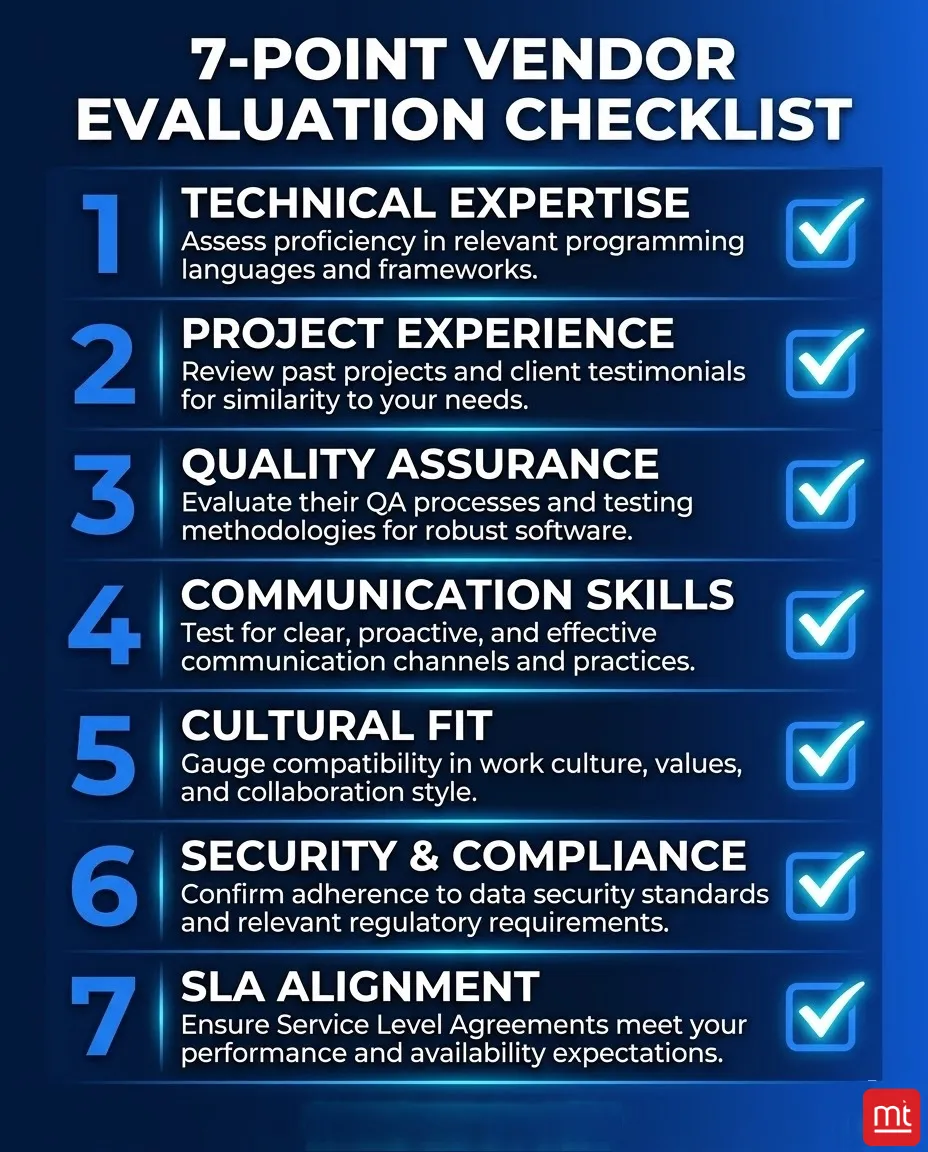
- Technical Depth: Know if your potential vendor is well-versed with your chosen tech stack. Whether you plan to use cloud platforms or AI frameworks, they should possess the requisite expertise as it will impact speed, architecture decisions and product stability.
- Portfolio Fit: A strong outsourcing partner would have developed a product that is similar to you in terms of industry, complexity and architecture. Their relevant experience can reduce onboarding time and help them anticipate challenges without slowing development.
- Communication Infrastructure: Along with a dedicated project manager, the potential partner should maintain overlapping hours and follow transparent reporting cycles like sprint reviews and progress reports for structured communication.
- Security Posture: As they handle proprietary code and sensitive data, they should follow strong security protocols like ISO-aligned processes and GDPR-aware data handling.
- Scalability: As your project scope expands, the outsourcing partner should be able to scale the team without compromising productivity or quality. They should have access to a broader talent pool.
- Cultural Alignment: The trusted partner would emphasize transparency, accountability and proactive communication. This helps them integrate with internal stakeholders while maintaining strong partnerships.
- Transparency Mechanisms: The reliable vendor will offer visibility into development progress. They have tools like live dashboards and shared repositories that help stakeholders understand project status and priorities.
Learn how we at ManekTech handle these principles in practice with our flexible engagement model.
What Red Flags Appear in Initial Conversations?
Early conversations with potential vendors are very crucial especially when you aim to de-risk software development outsourcing. These conversations help understand how the vendor operates and reveals warning signals.
Here are some of the red flags to watch out for to de-risk outsourcing.
- Vague answers to questions on scope changes is a red flag. An experienced team would always explain their process regarding handling changing requests or evolving requirements.
- If there is no clear escalation path for when things go wrong, it can become a risk. Every outsourcing partner should be able to explain how problems are escalated and resolved.
- If they resist working on a paid pilot or discovery phase, it shows their inexperience. Professional vendors would always agree to validating collaboration before commitment.
- If they over promise before understanding the project, it indicates they haven’t understood the project complexity.
Why India Continues to Lead in Software Outsourcing Quality
India’s tech sector employs about 4.5Mn professionals, making it one of the largest English-speaking developer communities globally. With this large talent pool, it is easier to find specialized skills across tech stacks for your project.
Apart from the talent pool, it also supports cost efficiency and fast delivery. Indian outsourcing companies estimate 60-70% software development cost savings than their Western counterparts. With overlapping hours and time zone differences, you can enable continuous project momentum.
India’s mature outsourcing ecosystem that has embraced agile delivery frameworks and a strong quality assurance practice is also a strong reason for India to lead the software outsourcing quality.
What a Trial Engagement Tells You About Your Developer to De-Risk Outsourcing?
Even with the most in-depth interviews, you won’t know how a development team performs in real-world conditions. That’s why a small pilot engagement is important before you hire dedicated software developers
At ManekTech, we offer a 40-hour free developer trial that allows you to experience our team’s capabilities before committing to an engagement model. You can get insights into our dedicated developer’s communication habits, development discipline and responsiveness.
A brief real-world collaboration reveals a lot about your partner’s capability than proposals, interviews and presentations can.
How to Structure Contracts, SLAs, and Milestones to De-Risk Your Outsourcing for Your Business?
With contracts, service level agreements and milestone-based delivery, you create the guardrails needed to ensure your project is aligned with the vision. It helps maintain transparency throughout your project lifecycle.
The Anatomy of a De-Risked Outsourcing Contract
Using a well-structured outsourcing contract, you can protect intellectual property, clarify responsibility and define how engagement evolves. The contract should specify the legal and operational frameworks to safeguard the engagement.
Contract Element | Why It Matters | Risk Reduction Benefit |
IP Ownership Clause | Confirms all code and deliverables belong to client | Prevents ownership disputes in future |
Work-for-Hire Language | Confirms legal rights over assets | Offers full product control to client |
Source Code Escrow | Code is securely stored with third-party access rights | Protects product in case partnership ends |
Data Protection Addendum | Defines how to store and process sensitive data | Full compliance with GDPR and India’s DPDP Act |
Termination Clauses | Termination for cause and convenience | Complete flexibility when engagement needs to end |
Change Request Process | Defines how scope changes are assessed and approved | Prevents uncontrolled cost escalation. |
Define how your requirements should evolve with a structured change request process using contracts as projects continuously evolve and you need to scope adjustments.
Writing SLAs That Have Teeth
Service level agreements can convert your expectations into measurable commitments. Strong SLAs can define performance metrics that help you track consistency.
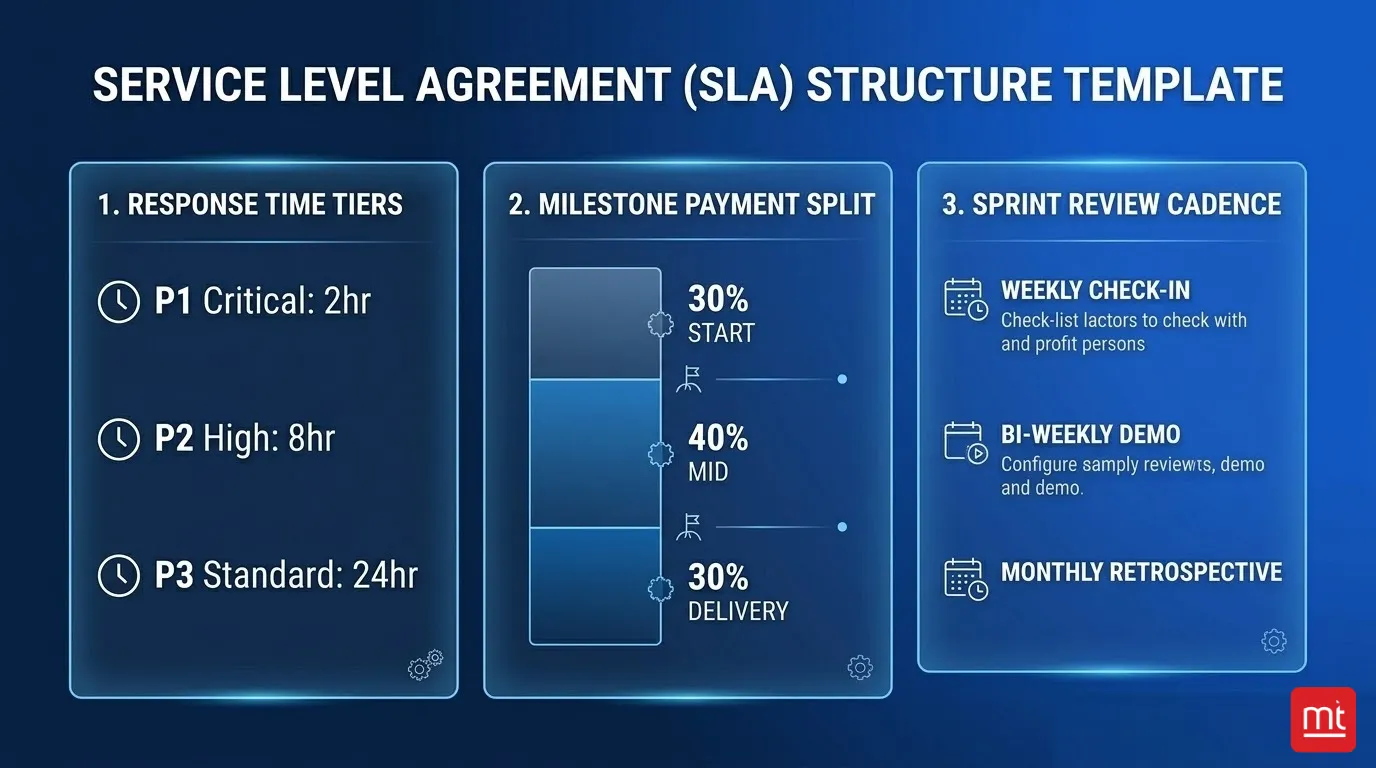
SLA Category | Example Metric | Why It Matters |
Response Time SLA | P1 (priority one) issue responses within defined hours | This ensures critical issues are addressed immediately |
Availability Commitment | System uptime targets for hosted service | This helps define the product’s reliability to users |
Code Standards | Test coverage threshold and linting rules | Offers long-term maintenance |
Reporting SLA | Weekly progress reports with sprint reviews | Stakeholders are informed and aligned |
Escalation Response | Timeframe for resolving project blockers | Prevents delayed delivery issues |
As per industry best practices, SLAs without predefined remedies are aspirations. You should ensure SLA clauses include consequences such as service credits, contract reviews and escalation triggers.
Milestone-Based Payments: The Safest Way to Pay
Payment structures can influence the outsourcing risk. That’s why most organizations combine time-and-material pricing with fixed-price milestones for clear deliverables.
Milestone Phase | Purpose | Payment Logic |
Discovery | Requirements analysis, architecture planning | Initial payment |
Alpha | Functional prototype | Payment after feature validation |
Beta | Feature-complete product for testing | Payment tied to testing |
Launch | Production-ready product for release | Payment after final development milestone attained |
Post-launch Support | Stabilization and performance optimization | Maintenance or support |
In this structure, payments are tied to verified progress instead of time spent to protect clients from incomplete deliverables. In case of international engagements, companies use escrow or secure payment gateways to add another financial protection layer.
The Sprint Review Rhythm That Prevents Surprise Failures
Even the most detailed contracts and SLAs cannot replace delivery visibility. That’s why modern development teams rely on structured sprint cycles with regular reviews.
Sprint Practice | Purpose | Benefit |
Two-week Sprint Cycle | Short development iterations | Enables rapid feedback with course correction |
Sprint Demo | A demo of all completed features | Defines progress against expectations |
Definition of Done | Shared criteria for what’s called complete | Prevents releasing partial or incomplete product |
Retrospective Meeting | Team reflection to improve workflow | Strong collaboration with efficient team |
In an agile workflow, each sprint ends with a demo and acceptance review, letting stakeholders validate the completed features before proceeding with development. This reduces gaps in the project.
Definition of Done when clearly documented ensures consistency. An organization that ensures structured sprint reviews and milestone visibility will report fewer scope issues and enjoy a faster feedback cycle.
Leveraging Indian Outsourcing for Cost-Efficiency Without Compromising Quality
Is outsourcing to India worth it? Isn’t this the single most important question you try to answer when exploring global software development outsourcing?
The single word answer is yes. It is worth every bit of your investment if you structure the partnership well.
India has spent decades to create the most mature outsourcing ecosystem globally that combines large-scale engineering talent with proven delivery. Most organizations don’t choose India because it offers cost advantages. They choose because the country blends technical expertise with scalable teams and global delivery experience to offer reliable products.
Using clear evaluation frameworks for your outsourcing decisions can help you embrace the strengths of the country and accelerate product development without compromising quality.
The India IT Advantage by the Numbers
Metric | India’s Position (2025-26) |
IT export revenue | ~$246Bn annually (NASSCOM) |
Developer talent pool | 5.4 Mn, English speaking tech professionals |
Cost vs US/UK rates | 60-70% savings |
Top tech cities | Bangalore, Hyderabad, Pune, Ahmedabad, |
Global outsourcing rank | #1 in A.T Kearney Global Services Location Index |
These numbers indicate why India dominates the global software outsourcing market. Being home to one of the largest dedicated software developer communities globally, you can access specialists across technologies, including AI and cloud from this country.
What Does Outsourcing to India Actually Cost?
You must understand the real cost of outsourcing before committing to a partnership. Pricing advantage in India isn’t another headline number; it actually translates into a tangible budget relief across the entire product development lifecycle.
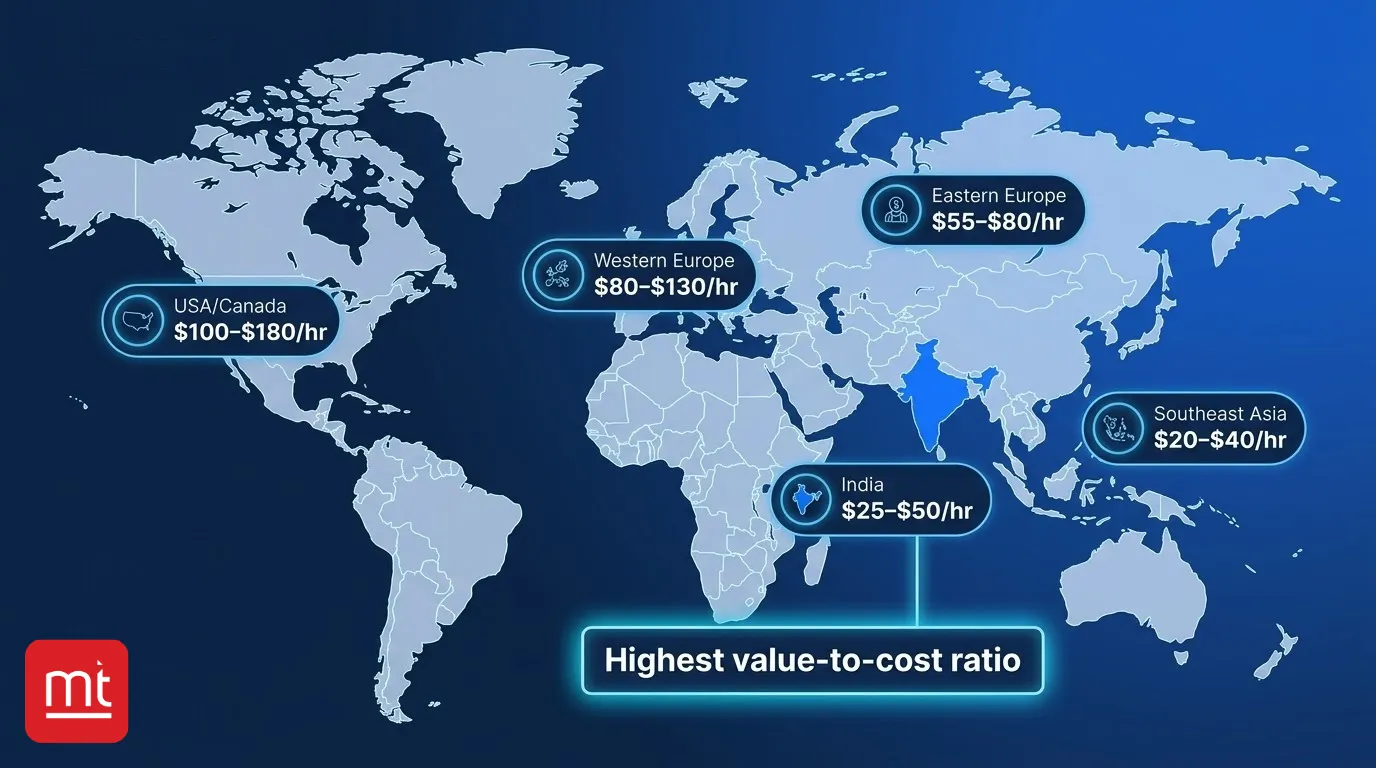
Here’s a glimpse into the hourly rate ranges for 2025-26 across regions
Role | India | US | UK | EU |
Junior Developer | $15 to $25 | $80 to $110 | $70 to $95 | $60 to $85 |
Mid-level Developer | $25 to $45 | $110 to $150 | $95 to $130 | $85 to $120 |
Senior Developer or Architect | $45 to $75 | $150 to $200+ | $130 to $180 | $120 to $160 |
QA Engineer | $15 to $30 | $70 to $110 | $60 to $95 | $55 to $85 |
Project Manager | $25 to $45 | $100 to $140 | $90 to $125 | $80 to $115 |
Rates may vary according to the technology stack, engagement model and vendor tier.
The hourly rates translate to $2,500 to $6000 per month per developer for a dedicated developer hiring model. It is higher in US and UK regions, nearing $12,000 to $20,000 per month per developer. The cost of living, salary, benefits and overhead will influence the costs in different regions.
The difference in costs isn’t a reflection of poor quality. Rather, it comes from structural economic factors. A lower cost of living in the Indian tech cities signals competitive salaries that can attract top talent. At the same time, the maturity of the Indian outsourcing ecosystem has created a large pipeline of talented and trained engineers without inflating the pricing.
As a growing business or a startup, this means you can hire a dedicated developer for a full-cycle product team at the cost of hiring a mid-level engineer in the US. That’s not just marginal efficiency but a strategic lever that helps you scale faster.
Quality Is Not a Trade-Off: It's a Standard
Low cost doesn’t mean low quality, and Indian tech companies continuously prove that. By operating under well-defined quality frameworks that global enterprises trust, they ensure quality at the cost they are offering.
Most top software development companies maintain CMMI maturity levels and ISO certifications while following a structured quality assurance process. Moreover, the country boasts a huge talent pool as million engineers graduate each year.
At ManekTech, we ensure quality is reinforced using multiple layers of engineering governance. From internal code reviews to automated testing pipelines, each aspect has been defined to maintain code quality and transparency throughout the development cycle.
Communication and Culture: Closing the Gap
One of the biggest challenges early on used to be time-zone differences. However, with modern collaboration practices, the work culture has changed and frictions have reduced. Most reputed outsourcing companies use structured communication models, agile methodologies and overlapping work hours to ensure seamless coordination.
As most developers are proficient in English language, the collaboration is easier, making India the best outsourcing destination. Moreover, the developers and project managers have vast experience working with the global clients, allowing them to follow international development standards with ease.
Our development team also uses the overlap working model to support collaboration. In this process, we align dedicated hours with US or UK business schedules. Using this approach, we are able to conduct product discussions, sprint reviews and critical decisions in real-time.
Case Study: How We Helped a California-based Company De-Risk Software Outsourcing?
A mid-sized SaaS development company based out of California was facing a scaling challenge. Their roadmap needed rapid feature expansion to maintain the momentum but, their internal engineering team couldn’t grow quickly to match their needs.
The company was looking to scale their development capacity across all functions in two months to maintain the product’s stability. That’s where we stepped in to help them. We onboarded eight engineers in a span of three weeks, starting the collaboration with a short trial and structured sprint planning.
Our team integrated with the client’s internal product management and began following the same agile workflow. Within a few months, the roadmap was back on schedule allowing the company to launch new features successfully.
They were able to achieve 98% sprint velocity and delivered the product 40% below the estimated budget.
What Makes a Software Outsourcing Partner Truly Reliable in 2026?
By now you are aware what makes a successful outsourcing partnership. It is rarely about cost or location. The success of your partnership depends on how well your partner works, manages risks and communicates with your team throughout the project’s lifecycle.
The Traits That Separate Good Partners from Great Ones
Here are all the behavioural signals that reveal if your partner is truly reliable or not.
- Strong partners would spend time asking thoughtful questions regarding your product roadmap, architecture and constraints in the early conversations. They would use these insights to make delivery promises
- A reliable team would follow a structured workflow that ensures organized and predictable project flow, from onboarding stage to sprint planning and escalation.
- Experienced partners are likely to pinpoint potential delays, technical risks and requirement gaps in the early stages itself along with regular reporting.
- They would have built solutions similar to your requirements or worked in your industry and handled the technical complexities, making them experienced enough to anticipate challenges and make better decisions.
According to Our Clients: What Builds Long-Term Outsourcing Confidence
Many of our clients have hinted at similar qualities while describing what made our partnership sustainable over time.
“ManekTech has consistently delivered high-quality releases, maintaining sprint velocity even during complex development phases. Their engineering discipline with commitment to timelines has helped our team launch features faster and with confidence. “
“Communication from their team has always been clear and structured. Whether it was a weekly update, quick response or discussions, the collaboration felt like we were having conversations with an internal team member.”
We were impressed by the technical depth of the engineers we interviewed while scaling the project. They understood our architecture needs, proposed improvements and even scaling requirements immediately. They were ready to support product growth in every way.”
How ManekTech Promises to De-Risk Software Development Outsourcing
Our goal at ManekTech is to make outsourcing simple, predictable, transparent and easy for your team. We have refined our engagement approach based on insights from our clients to help you evaluate our abilities and gain full visibility throughout the project.
- Free 40-hour developer trial: This will help you review real code and our collaboration style before you commit to the team for the long-term.
- Flexible engagement models: You can choose from dedicated teams, staff augmentation and project-based development, depending on your needs.
- Structured communication cadence: Access weekly reports, sprint reviews and live project dashboards to gain complete visibility into the project progress.
- Transparent pricing models: They are designed to avoid unexpected costs and unclear billing during the project for transparent cost management.
- In-built legal protection: NDAs and clear IP ownership clauses are included at the start of the project.
Explore our approach and how it works in detail here: Engagement Models
Ready to Outsource Without the Risk? Here's Your Next Step
Outsourcing software development doesn’t have to be a leap of faith. Using the right preparation approach, clear contracts, measurable milestones and structured communication, you can use it to scale your product efficiently while maintaining quality and timelines.
The key is to choose a partner that values transparency, asks the right questions and works with you as an extension of your team rather than a vendor.
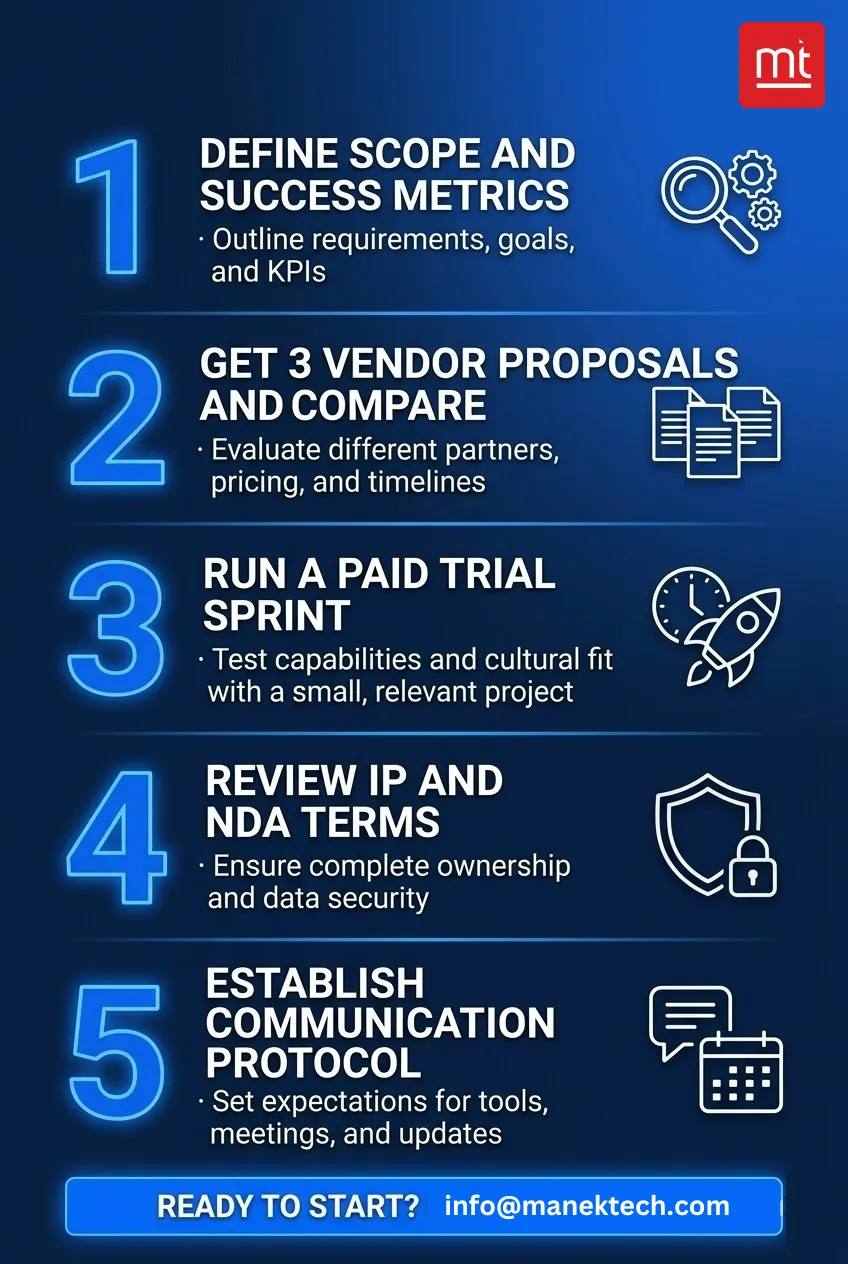
Before you commit to any engagement, you should validate the basics. Start by clearly defining the scope, verify IP protection, include structured sprint reviews and use a short pilot project to experience the collaboration before committing to it. With these simple steps, you can reduce risks and increase confidence in your partnerships.
Schedule a free consultation with our team at ManekTech, a leading software development company to explore how this approach works. We would be happy to discuss your project and answer questions that would help you take the first step in the right direction.

Ruchir Pandya
Delivery Head of Web
Ruchir Pandya is a seasoned software and business professional with over 15 years of experience in IT, Software Development, and operations. As the overseer of the Open-Source Web department (PHP Department), he takes charge of development and operations.

Subscribe to Our Newsletter!
Join us to stay updated with our latest blog updates, marketing tips, service tips, trends, news and announcements!