


Top Reasons Middle East Startups Hire Indian Full-Stack Developers

Key Takeaways:
- Hiring locally in the Middle East is slow and expensive due to talent shortages.
- Look at how hiring in India can save your startup up to 80% compared to US or European rates.
- Real-world examples of how Middle East businesses used offshore teams and kept budgets under control.
- See how flexible engagement models help control budgets and reduce risk.
- Find out when offshore development makes the most sense for MVPs, scaling, and growth stages.
Did you know that around 45 to 58% of companies in key Middle Eastern markets report difficulty finding specialized technical talent in 2025-2026, making roles like full-stack developers hard to hire?
The global IT outsourcing market is expected to cross $634 billion by 2026, and India contributes nearly one-fifth of the global software outsourcing market. It is found that Saudi Arabia is highly investing in AI and digital transformation due to Vision 2030. The Kuwait ICT market is also expected to reach $39.83 billion by 2028.
But here’s the challenge: Over half of employers in the region report serious technical skill shortages, especially in full-stack, cloud, and emerging tech roles. This gap is one of the biggest reasons startups are choosing Indian full-stack developers.
This guide explains exactly why Middle East startups (from Dubai to Riyadh to Kuwait City) are choosing Indian full-stack developers, what these developers deliver, and how to successfully integrate them into your product roadmap.
What Full-Stack Developers can do: Frontend + Backend Mastery?
Before exploring why Middle East startups hire full-stack developers India, it’s essential to understand what full-stack developers actually deliver.
Full-stack developers are the all-rounder developers who build complete applications from the UX/UI (frontend) and connect them with the server logic and databases to make the backend functionality.
Frontend expertise includes designing and developing responsive user interfaces, in addition to HTML5, CSS3, and JavaScript, with modern frameworks including React, Vue.js, and Angular. Full-stack designers have a deep understanding of responsive design, accessibility, and user experience.
Experience with backend development includes server-side development in Node.js, Python, Java, C#, PHP, and Ruby. They handle authentication, business logic, payment processing, and data manipulation, the infrastructure that is invisible to users but indispensable for operations.
In addition to frontend and backend, full-stack developers are skilled at several specialized domains as well, like:
- Database management: Both SQL databases (PostgreSQL, MySQL) and NoSQL systems (MongoDB, Redis). They build schemas, improve queries, and use caching to ensure that applications are able to process user data.
- API development and integration : Creating RESTful and GraphQL APIs for seamless communication between frontend and backend, plus integrating third-party services like payment gateways and cloud storage.
- Cloud services: Deploying and managing applications on AWS, Azure, and Google Cloud, including serverless computing architectures.
- DevOps and automation : Using Docker, Kubernetes, Git, and CI/CD pipelines to streamline development and deployment.
Hence, rather than managing separate frontend and backend teams with potential communication gaps, full-stack developers can create a complete end-to-end product for you with design and back-end architecture.
For startups, this is a huge advantage because hiring just one full-stack developer can help you build an entire app/software from a feature from idea to launch.
The Cost Advantage: India vs Local Middle East Hiring
Cost is the first reason why Middle East startups hire Indian developers, but there are many more reasons to hire remote developers India. Let’s understand those in more detail.
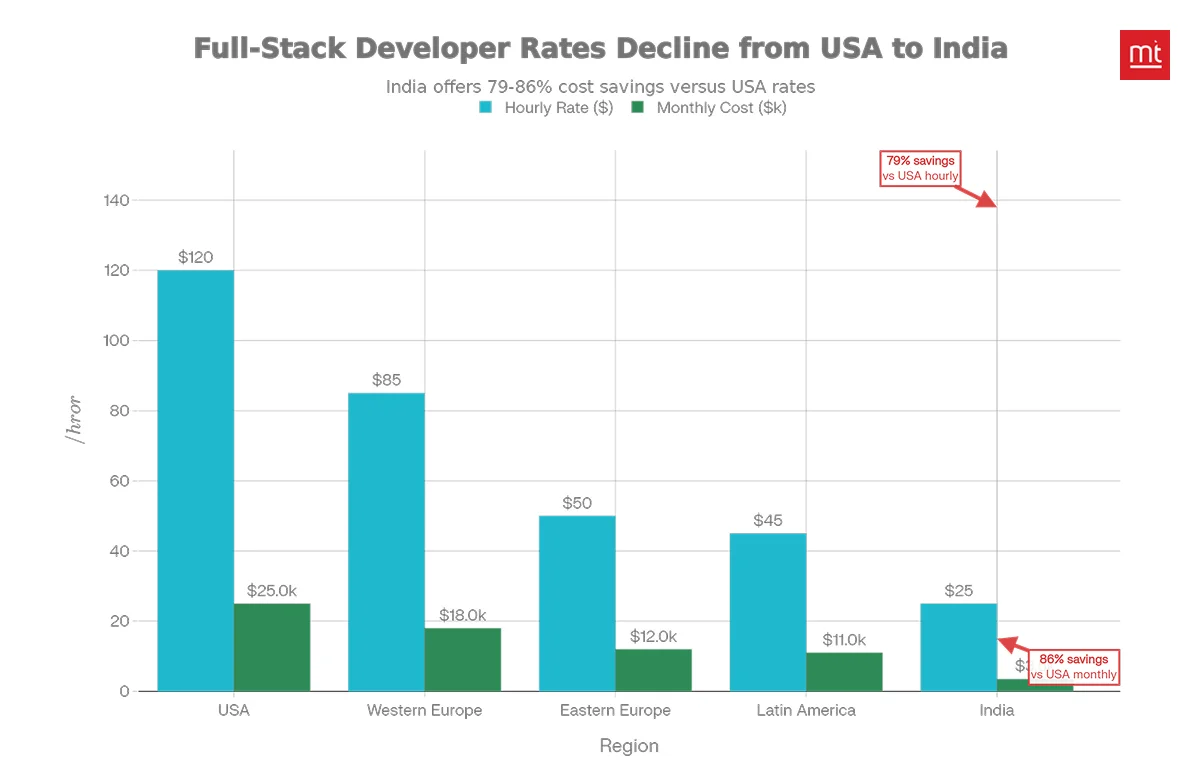
There is a huge difference in the hourly rate of developers in different regions.
A full-stack developer in the USA typically costs $80 to 160 per hour. In Western Europe, developer rates range from $60 to 200/hour. If we come to Indian full-stack developers, the rates are between $20 to 60/hour. Plus, if you are fine with hiring entry-level developer, it may start from $10 to $25, depending on the skillset, technical expertise and other requirements.
At ManekTech , you can hire full-stack developer starting at $22 per hour which can also be customized according to your needs and technical expertise. Though the final cost to hire full-stack developers India depends on the engagement model i.e hourly, monthly, part-time and more.
| Region | Monthly Agency/Contract Cost | Key Tech Hubs | Comparison |
|---|---|---|---|
| USA | $12,800 to $25,600+ | San Francisco, NY, Austin | Baseline |
| Western Europe | $9,600 to $19,200 | London, Berlin, Amsterdam | 30% cheaper than USA |
| Eastern Europe | $5,600 to $11,200 | Poland, Romania, Ukraine | 60% cheaper than USA |
| India | $3,500 to $6,400 | Bengaluru, Pune, Hyderabad | 85% cheaper than USA |
| ManekTech | $2,500/month | Ahmedabad, India | 90% savings vs USA |
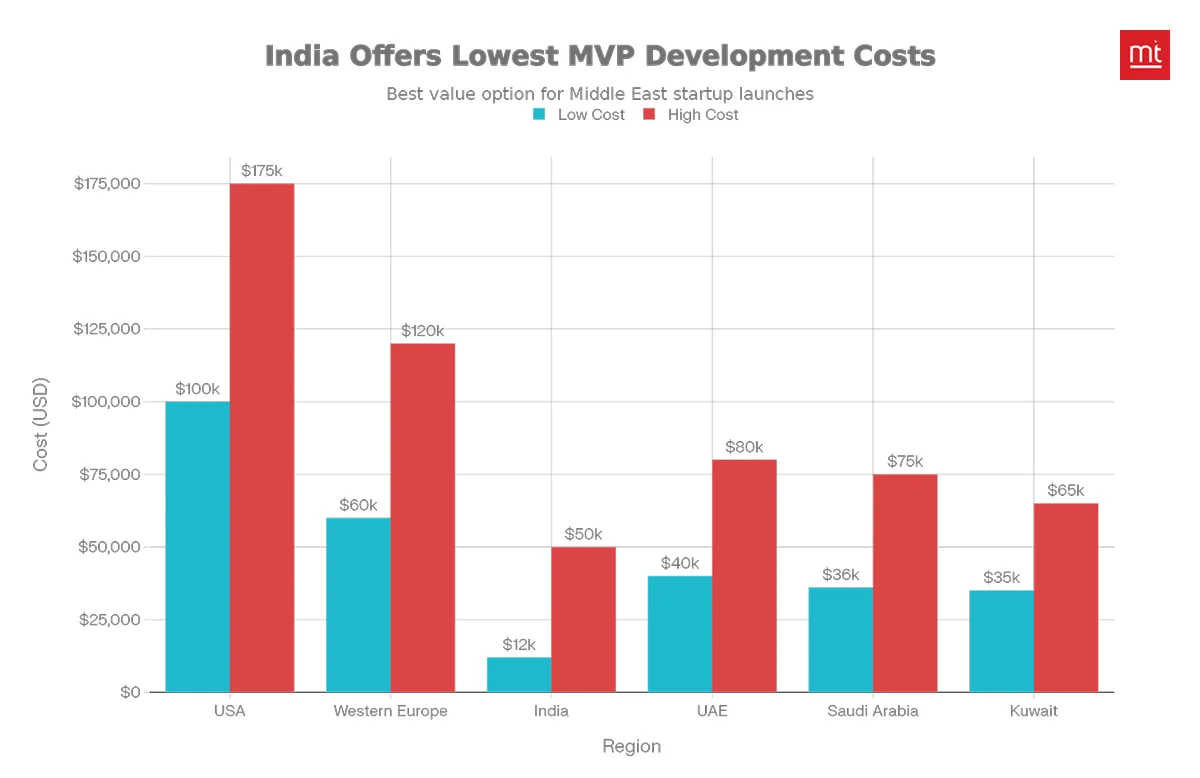
The cost will fluctuate accordingly if you develop MVP first and then scale it to full development.
| Location | Cost Range | Average |
|---|---|---|
| USA | $100,000 to $175,000 | $137,500 |
| Western Europe | $60,000 to $120,000 | $90,000 |
| India | $12,000 to $50,000 | $31,000 |
| UAE (Local) | $40,000 to $80,000 | $60,000 |
| Saudi Arabia (Local) | $36,000 to $75,000 | $55,500 |
| Kuwait (Local) | $35,000 to $65,000 | $50,000 |
Let’s understand the practical example to get more clear idea.
A fintech startup needed five full-stack developers to build their product. Hiring an in-house full-stack developer would have cost ₹60 LPA (about $7,200/month per developer) plus ₹15 LPA with other overhead and benefits, totaling ₹75 LPA annually. By outsourcing their project, they hired the same five developers at ₹2,500/month each ($30,000/year total per developer. Hence, they were able to cut over 50% of development cost and achieve reliable and high-quality development work.
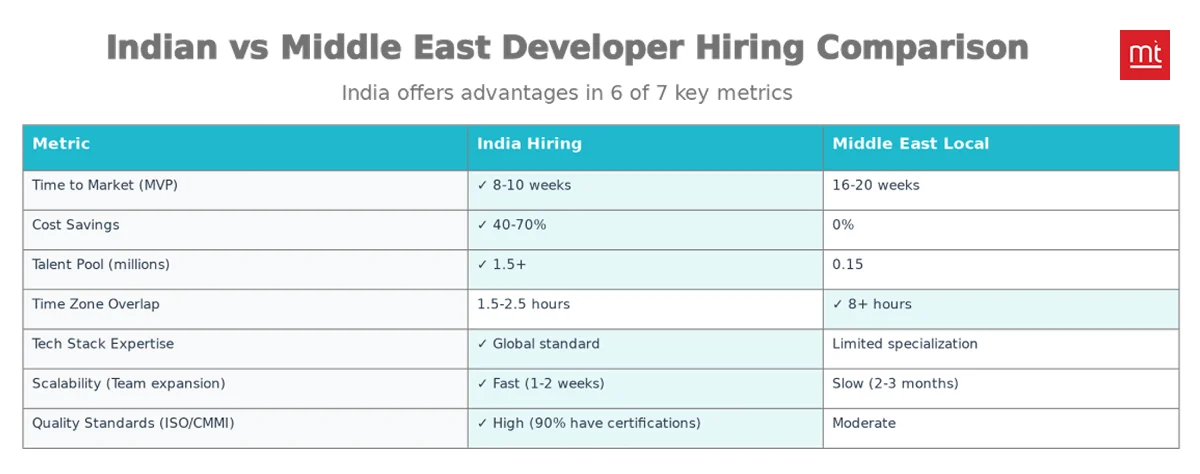
Indian developers already work with global companies, including Fortune 500 firms, and follow the same engineering standards as developers in the US or Europe. The real difference comes from the cost of living, taxes, and talent availability. India produces more than 1.5 million tech graduates every year, which keeps hiring costs reasonable. On the other hand, the Middle East and Western countries face a shortage of skilled developers, which naturally pushes salaries higher.
For startups in the UAE, this creates a smart opportunity. By hiring Indian developers, they can save 40–70% of their development budget and use that money for other growth factors like marketing, user acquisition, or extending their runway.
MVP to Scaling: Flexibility Across Growth Stages
Beyond cost, Indian full-stack developers offer a lot of flexibility, like creating an MVP and then growing the product according to the demand and align properly with the business goals. This is what matters most for startups.
Phase 1: MVP Development (Weeks 1 to 10)
You first need to prove your business model works with real users. You need iteration more than perfection an fine-tune the whole coding and concept. A full-stack developer can develop an end-to-end things like frontend, backend, database, and API without needing any specialists to coordinate.
Timeline to market: 8 to 10 weeks compared with 16 to 20 weeks for traditional hiring cycles, which comprise recruitment, onboarding, and initial productivity ramp-up.
A case study from the UAE: For instance, a healthcare platform required 6 weeks to deploy an appointment-booking MVP in order to meet investor demo requirements. Two Indian full-stack developers from a dedicated team model produced a production ready web and mobile app with payment gateways and SMS notifications in time and 50 per cent under budget.
Phase 2: Growth & Feature Expansion (Weeks 10 to 26)
Once your MVP is working and you start collecting seed funding, you will need more developers to develop further things. If you hire fullstack developer India, assume the timeline of 6 months to properly implement every feature, functionality, integration and other stuff.
This can be solved in the dedicated team model. The application process of adding developers takes 1 to 2 weeks, whereas local applications take 2 to 3 months. You can hire offshore developers India without taking on more load who are the best fit for your project.
If your sprint needs 4 developers and the next sprint only needs 3, you can always scale up and as you need the experts without conflict.
Phase 3: Continuous Development (6+ Months)
At this stage, you are not validating, your development is under progress and you will need to optimize things as you get clarity. You need consistent feature delivery, bug fixes, and technical debt paydown. The “follow-the-sun” workflow becomes a genuine asset as your Middle East team logs off for the day, Indian developers will easily continue working on things where the other developers left.
This just needs the proper coordination and planning with transparency.
Access to Global Tech Expertise: Cloud, APIs, Databases
The Middle East is facing a serious skills shortage in the areas that matter most today. Around 42% of tech roles in AI, cloud, and platform engineering across the GCC remain unfilled because the right talent is hard to find.
At the same time, India has a strong pool of developers working in Global Capability Centers, where skills like AI, cloud, and modern platforms are already common and well-developed.
Indian developers working in competitive tech markets like Bangalore, Hyderabad, and Pune are continuously upskilling in:
- Cloud platforms: AWS, Azure, Google Cloud, serverless architecture.
- Microservices and APIs: RESTful and GraphQL development at scale.
- Database optimization: SQL and NoSQL performance tuning for millions of users.
- AI/ML integration: 42% skill gap in GCC AI roles, but Indian developers increasingly bridge this.
- DevOps automation: Docker, Kubernetes, CI/CD pipelines for rapid iteration.
If we compare the Middle East market, it already lacks expertise in this kind of technology, like AI/ML, cloud services and many other advanced tech stacks.
A local developer with basic web fundamentals is easily available, but if you need to handle a product to handle 100,000 concurrent users, optimize database queries for millisecond performance, or work with the architecture of a microservices platform, this will require a high-level technical expertise which is either unavailable locally or more expensive in that country.
Speed & Continuous Support: From Concept to Launch
Startup success purely depends on the speed of development and how well the changes are iterated according to the users.
Indian full-stack developers are comfortable working with the traditional timeline in multiple ways:
Faster hiring: Rather than posting a job, conducting interviews, negotiating offers, and onboarding over 2 to 3 months, your development will start within 48 hours once you finalize the developer. At ManekTech, we can help you hire the best full-stack developer within 48 business hours or before that. You can easily connect via Slack or Teams and schedule a call to get started with the development at your earliest.
Streamlined processes: Offshore development are mature enough to handle multiple other operations and sync the development with internal teams.
They use agile methodologies (Scrum, Kanban) that reduce friction and clarify priorities. Rather than managing other project ambiguity, you can expect structured sprints, clear sprint goals, and weekly demos to see noticeable progress.
Real-time iteration: India and Middle East have only a difference of 1.5 to 2.5 hours hence, these time gaps are easily manageable and a good overlap in working hours.
You can easily conduct daily meetings and coordinate related to project discussion as compared to other foreign countries like North America.
This is the real case study:
KFC needed to develop and launch seven mobile food delivery apps across key Middle East markets in the UAE, Saudi Arabia, Kuwait, Egypt, Qatar, Bahrain, and Oman within a year. They use to depend on food delivery aggregators to reach their customers but the problem was 90% of orders keep on coming from that aggregator app.
Plus, KFC’s own app was getting poor reviews because of bad user experience. It made cthe ustomer experience and bonding weak.
This was the solution they implemented to make ordering easier:
They developed multiple options right on the home screen: Delivery, Self-Pickup, Drive-Thru, Dine-In, and Carhop.
They also added QR code functionality for contactless ordering.
The app also included advanced analytics for the KFC team, where they could track app performance and identify areas that needed improvement.
The Results:
- About a 22% increase in conversion rates on the new apps.
- Apps maintained an average rating of 4.5/5 on App Store and Play Store.
- Over 50% of orders now flow directly through KFC’s own apps, reducing dependency on third-party aggregators.
Talent Availability & Scalability Advantage
India has over 15000 IT development companies and 5 million developers. Among those, 65% of companies are currently active.
India hosts over 1,800 Global Capability Centres (GCCs), making it one of the largest GCC ecosystems in the world. Reports also says that in 2026, around 120 new GCCs will open in India and create about 40,000 new tech roles in modern digital fields.
For UAE and Middle East startups, this means easy access to skilled developers and the ability to scale teams quickly, whether adding one developer for a sprint or building a larger team.
Engagement Models: How to Hire Indian Full-Stack Developers?
You can hire full-stack developers India with various engagement models. Each approach from freelancers to dedicated offshore teams, affects cost, control, and speed.
Lets have a look at the different engagement models to get the most out of the partnerships.
Model 1: Hourly Rate (Time & Material)
Cost : The common hourly rate of Indian developers is $20 to 60/hour.
Commitment : Project-based; no long-term obligation.
Best for : Flexibility, proof-of-concept, agile projects with evolving scope.
With hourly billing, you pay for time worked. It’s ideal for MVPs where requirements evolve based on user feedback. A typical week involves 40 hours of development where you have the freedom to scale features, pause sprints and adjust your cost accordingly.
Model 2: Monthly Dedicated Team
This model is where you hire a dedicated developer team for a monthly basis. It is best for ongoing development and long-term projects.
This model works for predictable workloads and projects where you want to focus on velocity rather than tracking hours. Monthly cost is usually affordable than hourly because you’re committing to consistent work.
Model 3: Fixed-Price Project
When the project scope and every detail are clear, then this model works perfectly. For example, if you want to build a payment gateway integration module or implement two-factor authentication, you can hire software development company at a fixed price and get the job done without overspending.
Model 4: Staff Augmentation (Hybrid)
If you have local engineers in Dubai or Riyadh, you can extend your team by hiring an expert from India where your project lacks in terms of skills or other technical knowledge. Staff augment or hybrid model is flexible and can be scaled according to need, whether the requirement is fixed or changing.
You might need to give agency margin up to 5 to 15% depending on the agency.
ManekTech: Your Trusted Full-Stack Development Partner
ManekTech specializes in connecting Middle East startups with Indian full-stack developers.
Here’s why:
Transparent Pricing
- We offer competitive rates than other companies in the market, that is $22/hour.
- We offer a 40-hour risk-free evaluation period as a trial for every new client.
- 48-hour startup: Begin development within 2 business days.
- No hidden fees; transparent milestone-based billing and 100% NDA.
Quality & Expertise
- Full-stack expertise across all modern tech stacks: React, Node js, Python, AWS, Azure .
- API development, microservices architecture, DevOps automation.
- Experience with Middle East startups (fintech, healthtech, e-commerce, edtech).
- Portfolio demonstrates MVP-to-scaling journey with case studies.
Engagement Flexibility
- Multiple models: hourly, part-time and full-time.
- Scale easily from one developer to 450 team.
- Transparent resource allocation with real-time tracking.
- Daily standups, weekly demos, and sprint retrospectives.
Client Success Metrics
- We have an average proven record of MVP delivery: 8 to 10 weeks
- You save up to 30 to 50% cost when you hire remote developers India from Manektech.
- 96% Client retention rate.
- We are experts in up to 50+ modern frameworks and platforms.
Top App Development Alternatives & Comparison
From local hires to other offshore regions, each choice you make will have its own advantage. Let’s explore the top alternatives and see how they compare.
| Criteria | Indian Offshore | Local ME | Eastern Europe | USA Agencies |
|---|---|---|---|---|
| Hourly Rate | $20 to $60 | $60 to $120 | $40 to $80 | $100 to $200 |
| MVP Timeline | 8 to 10 weeks | 16 to 20 weeks | 10 to 12 weeks | 16 to 24 weeks |
| Talent Pool | 1.5M+ engineers | 150K engineers | 200K engineers | 500K engineers |
| Time Zone | 1.5 to 2.5 hrs overlap | Same | 4 to 6 hrs overlap | 8 to 12 hrs behind |
| Tech Specialization | All global stacks | Limited | Cloud & enterprise | Full spectrum |
| Scalability | Fast (1 to 2 weeks) | Slow (2 to 4 weeks) | Moderate (2 to 3 weeks) | Very slow (6 to 8 weeks) |
| Quality Standards | CMMI Level 3 | Variable | ISO 9001 | Enterprise-grade |
| Best For | Cost-conscious MVPs | Premium local presence | Quality + cost balance | Enterprise complexity |
Local UAE/Saudi/Kuwait hiring offers the advantage of in-person collaboration and alignment with local regulations. But the cost can be significantly higher.
Eastern European developers offer better cost than USA, a strong engineering culture, and a moderate time zone overlap with Europe. However, again, they are expensive as compared to the depth of India.
USA and Western agencies are optimal for highly complex projects, enterprise integration, or when deep timezone overlap and same-language collaboration are critical business requirements.
BallPark App Development Packages & Implementation Timeline
If you are looking to buy any development packages from well-known Indian companies, here is a rough estimation of the development packages.
The Startup MVP Builder Package Can Range From Up to $8,000
- Timeline: 4 to 8 weeks
- Team: 1 to 2 full-stack developers
- Deliverables: Single-platform MVP (web or mobile), production-ready
- Core features: 5 to 8 features, basic responsive UI/UX, payment integration, authentication
- Support: Weekly standups, async communication via Slack/email
- Ideal for: Pre-seed startups validating business hypotheses before fundraising
- ROI: Validate concept and secure seed funding within 3 to 4 months total
Growth Stage Product under $30,000
- Timeline: 3 to 6 months
- Team: 2 to 4 developers (full-stack + QA specialist)
- Deliverables: Multi-platform (web + mobile), production-grade infrastructure
- Advanced features: 15 features, sophisticated UI/UX, third-party integrations (payments, SMS, push notifications), cloud hosting (AWS/Azure)
- Support: Daily standups, video calls, dedicated project manager
- Ideal for: Seed-stage startups scaling beyond MVP, approaching Series A
- ROI: Launch market-ready product 30 to 40% faster than traditional hiring, extend runway with cost savings
Enterprise Scale Solution Needs TO Get Custom Pricing
- Timeline: 6 to 12+ months
- Team: 5+ developers (full-stack, DevOps, QA lead, solution architect)
- Deliverables: Enterprise-grade platform, microservices architecture, 99.9% uptime SLA
- Advanced features: Complex analytics, real-time dashboards, AI/ML components, multi-tenant infrastructure, advanced security (encryption, audit trails)
- Support: 24/7 monitoring, round-the-clock support, quarterly business reviews
- Ideal for: Series A+ companies, complex integrations, regulated industries (fintech, healthcare)
- ROI: Proven delivery track record with Fortune 500 enterprises, enterprise-grade quality at 50% cost savings.
Note: Above are just ballpark estimates. If you want to know the accurate pricings, get in touch for your app idea to reality or free consulting.
Success Stories & Impact Metrics
Here are some of the success stories we developed for our clients. Have a look at it.
Case Study 1: UAE Payment App
One UAE fintech firm with a traditional payment system struggled with low engagement and outdated features. They needed a better way to compete in the fast-moving digital payments business. ManekTech developed an AI-powered digital wallet app with new features including AI-driven spending insights, multi-currency support, fraud detection and seamless payment gateway integration. The app also had a simple user interface with biometric login, rewards, and budgeting features. Now their users registered for new accounts increased by 40%, fraud transactions fell by 70% and revenue from loyalty programs and fees increased by 25%; this boosted user activity and business growth.
Case Study 2: Saudi Arabia HealthTech
One of the largest hospitals wanted a platform that made medical services more accessible and manageable. They encountered problems like difficult appointment scheduling, service tracking, and transparent payment. ManekTech developed a web-based healthcare management system that centralized important features like patient dashboards, service and appointment management, payment tracking, and feedback tools. This solution improved transparency, simplified administrative processes and made access to healthcare services easier for users. Patients and staff could efficiently manage bookings, payment, and services, improving overall patient experience through a more efficient system and process.
Case Study 3: Kuwait FinTech Platform
A financial services company wanted a powerful share-trading platform that could serve both beginners and seasoned investors with fast, secure, and intuitive tools. Their challenge was building an app that delivers real-time market data, handles large transaction volumes, and offers deep insights, all while ensuring top-tier security. ManekTech delivered a feature-rich share market app with real-time price updates, advanced analytics, secure transactions, customizable watchlists, alerts, and scalable architecture. After launch, users enjoyed a smooth trading experience and reliable performance, helping the client grow its user base and strengthen its position in the competitive fintech trading market.
Implementation Roadmap: From Consultation to Launch
Here are the detailed steps from consultation to launch for development projects.
Week 1: Discovery & Planning
This first week is all about getting clarity before any code is written. The startup and development partner discuss the idea, business goals, timeline, and budget to avoid surprises later. Together, they decide what the MVP should include, usually 5 to 8 must-have features that solve the core problem. Technical needs like the preferred tech stack, third-party integrations, and hosting setup are documented. At the same time, an initial consultation call helps the partner start matching the right developers to the project.
Week 2: Team Setup & Onboarding
Once the plan is clear, the right developers are assigned based on the required skills. Communication rules are set early daily standups for quick updates, weekly demos to show progress, and tools like Slack for everyday questions. The team gets access to code repositories, cloud infrastructure, and project management tools such as GitHub, AWS, and Jira. This week also includes sprint planning, where clear goals and success metrics are defined so everyone knows what needs to be delivered in the next two weeks.
Week 3 to 4: Development Sprint 1
Designers create the “face” of the app that is the frontend so it looks good and works on mobile. Meanwhile, engineers build the “brain” (the backend) to handle data and logic. You’ll have short daily check-ins to make sure no one is stuck. At the end of the second week, the team will show you a “demo” of what they built. This is your chance to see the progress early and give feedback while things are easy to change.
Week 5 to 6: Development Sprint 2
In this sprint, the focus shifts to deeper functionality. Payment gateways and third-party APIs are integrated, making the product more real and usable. Backend performance is improved through better queries and caching, while the frontend is refined based on feedback from the previous sprint. Daily standups and weekly demos continue, keeping everyone aligned. By the end of this phase, the product usually feels complete from a feature perspective and is ready to be tested and polished before launch.
Week 7 to 8: MVP Refinement & Launch Prep
At this step, the team focuses on refining the MVP and launching it once everything is working nicely. User acceptance testing helps identify bugs and usability issues, which are fixed based on priority. It is the test for users to see whether they will adapt to using the app. Performance is optimized so the app loads fast and responds smoothly. Security checks ensure that authentication and data handling are safe. The team prepares deployment infrastructure, monitoring tools, and backups. Once everything is ready, the product is launched into production and closely monitored to catch any issues early.
Week 9+: Post-Launch
This is the step after launching, where you learn and watch how real users behave. You’ll use analytics to see which features people love and where they get confused. And the QA and testing team fixes any immediate issues to keep the system healthy. From here, you enter a “growth mode” where you use actual user feedback to plan the next big features. You can either keep a full team to grow fast or move to a smaller maintenance team to keep costs low.
Conclusion
The Middle East startup ecosystem is at an inflection point. The capital resources are immense, but talent is limited. Founders who solve the talent problem faster and make it work through international markets strategically gain advantages in speed to market and capital efficiency.
Hiring Indian full-stack developers is not a move in the wrong direction; it’s a strategic decision. Because you gain access to 1.5 million people, you launch your MVP 50 percent faster and you save 30 to 40% off the cost of development. The time zone is manageable. Plus, you get the same quality of work with trial periods and other benefits to mitigate the risk.
In 2026, the businesses in the Middle East are not waiting for local talent to come along or spending capital on expensive local hiring. They are building lean, distributed teams by working with indian developers.
Contact ManekTech for a free consultation. Get a customized proposal for your project, understand the composition of the team and assess fit risk-free.
Alternatively, start with our 40-hour trial . See our developers at work, learn how we work, and make a wise decision before signing up for a monthly team.
FAQs: Addressing Common Startup Concerns
No, the time difference between India and most GCC countries is only 1.5 to 2.5 hours, hence there will be no difficulty working at this time difference as the meetings can other sessions can easily be done at any time of the day. But if you choose to work with North American teams, you will face coordination issue as there is over 9 to 12 hours difference.
Yes, Indian developers are already working in competitive markets like Bangalore and Hyderabad. Hence, they can easily maintain the same quality standards as Western counterparts.
No matter what type of specialized skills your project needs, India has the best talent pool available with expertise in different technologies. You can easily find the budget-friendly developer depending on your needs.
When you work with freelancers, there are chances they may leave in mid of the project. But when you hire offshore developers India like Manektech, you get a guaranteed contract. We sign an NDA and promise to complete the project we onboarded. If you need a replacement of developer, we provide that too.
Yes, even after MVP delivery, our dedicated team model offers ongoing support and development in case of feature expansion, scaling, and integrations. You can upgrade your current model from project-based sprints to continuous product development sprints.
If you want to protect intellectual property:
- Work with reputable offshore partners (especially those with enterprise clients) that routinely handle IP agreements.
- Do an agreement that you own all code, designs, and IP created. The developer has no claim post-engagement. This is standard practice and non-negotiable.
More articles on the topic
An app's user base using Firebase Analytics, a free and unlimited analytics solution. You'll be able to learn who your users are and how they interact with your app.
7 Min ReadFeb 27, 24

Nikhil Solanki
Mobile Lead at Manek Tech
Data Visualization technologies provide us with a proliferation of insights into the data obtained. Google and Microsoft, for instance, gather and utilize Big Data to shape the future of their commercial operations.
4 Min ReadFeb 29, 24
Ruchir Pandya
Delivery Head of Web at Manek Tech