


Top 100+ Web App Ideas That Could Change The World In 2026

Key Takeaways:
Are you looking for the trending and profitable web app ideas for your startup in 2026? You’re in the right place.
Building a successful web application, the first step is having a strong web application idea. However, many startups and entrepreneurs often struggle to find clear answers to questions such as:
- How do you discover innovative web app ideas?
- How do you validate and finalize the right web application idea?
- How can you effectively brainstorm web app concepts?
- How can you make web application ideas into reality?
- How can you patent a web application idea?
- How do you take the first step toward building a web app?
If you’ve been asking yourself the same questions, you have nothing to worry about, our this “100+ Best Web App Ideas for startups in 2026” article also has some great web application ideas that haven’t been done yet. If you’re a new startup or an aspiring entrepreneur, you can look into these great web app ideas take accomplishment in the enterprise web solutions space.
Also Check out our article if you’re looking for more top 100+ mobile app ideas.
Introduction:
Don’t confuse web applications and mobile applications. Native or cross-platform apps are downloadable from the App Stores.
On the other hand, web applications can run on the web or mobile server. You don’t need to download them on your mobile devices. You can use a web app from your desktop, tablet, or mobile phone. Web apps offer users a streamlined and seamless experience and are relatively easier to develop than mobile apps.
If you are a startup, web application creation can be promising. Mobile app development might cost you a fortune and also takes a lot of time and resources.
On the other hand, web app evolution does not hurt your pocket. Also, a web app’s app-to-market time is shorter than mobile app evolution. All you need is innovative web app ideas that you can explore.
📊 Key Points: Web App Market Statistics & Summary
Here are the most important web application statistics for the top web app ideas for 2026. These figures highlight growth, adoption trends, and the expanding business opportunity in web apps worldwide.
Web App Market Growth & Value
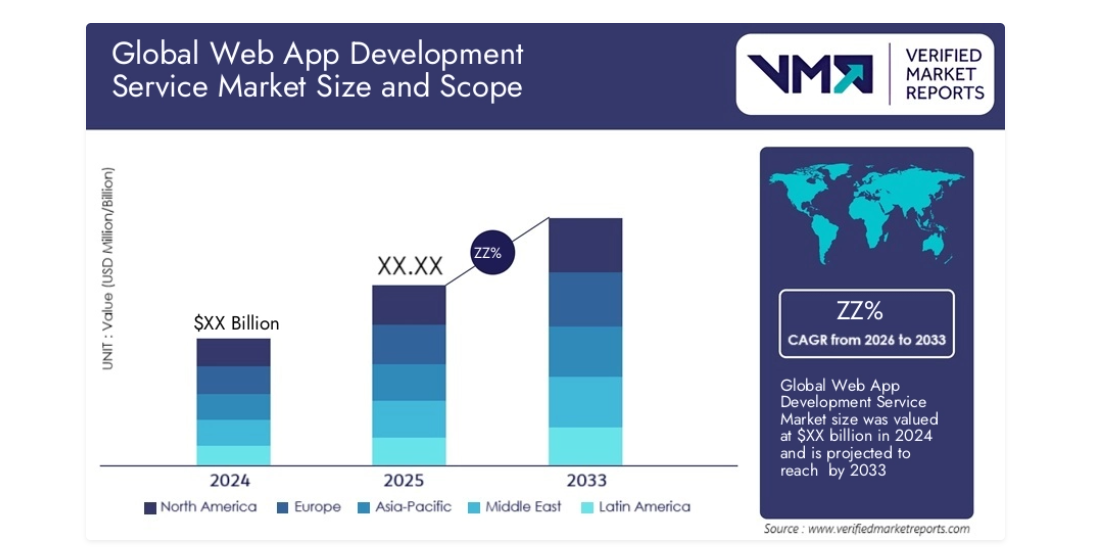
The global Web App Development Service Market was valued at USD 118.81 billion in 2024 and is projected to grow significantly to around USD 295.41 billion by 2033, with a CAGR of ~13.47% over the forecast period.
The broader web and web app market is expanding steadily, with projections suggesting continued growth through 2034 driven by rising digital adoption across industries.
📈 Progressive Web Apps (PWAs) — A Key Web App Segment
The Progressive Web Apps market — a major web app category — was valued at around USD 2.08 billion in 2024 and is expected to expand rapidly to USD 21.24 billion by 2033, reflecting a CAGR of ~29.9%.
PWAs combine the reach of websites with the performance of native apps, offering offline functionality and fast loading, making them ideal for modern web-based solutions.
🌍 Web App Adoption & Trends
Cloud-based web applications and serverless architectures continue to rise in demand, with cloud solutions representing the majority of web development deployments.
Mobile device users increasingly rely on web apps for daily tasks, with mobile-first web app design becoming a standard approach.
📊 Web Performance Market Support
The global Web Performance Market — an indicator of investment in web app optimization and scalability — was valued at USD 6,147.2 million in 2024, expected to reach USD 10,509.5 million by 2030 (CAGR ~9.4%).
What is a Web App?
A web app is a new trend, but gaining immense popularity across the globe. Web apps are like websites but can be used on smartphones like apps, giving a similar experience to using an app.
Users can access web applications from anywhere with a web browser. It is the most cost-efficient solution that can offer the best native app-like experience to your users.
Also, you don’t need more resources to maintain and upgrade web apps. Further, they allow superior scalability possibilities as well. However, you cannot operate web applications if you are offline. You will need an active internet connection to use a web app.
You only need to hire a reputed web development service provider. However, getting a promising web app idea is what you need. You need to research a bit before finalising the idea. Research your competitors, target audience, and others before making up your mind.
Advantages of Web Apps
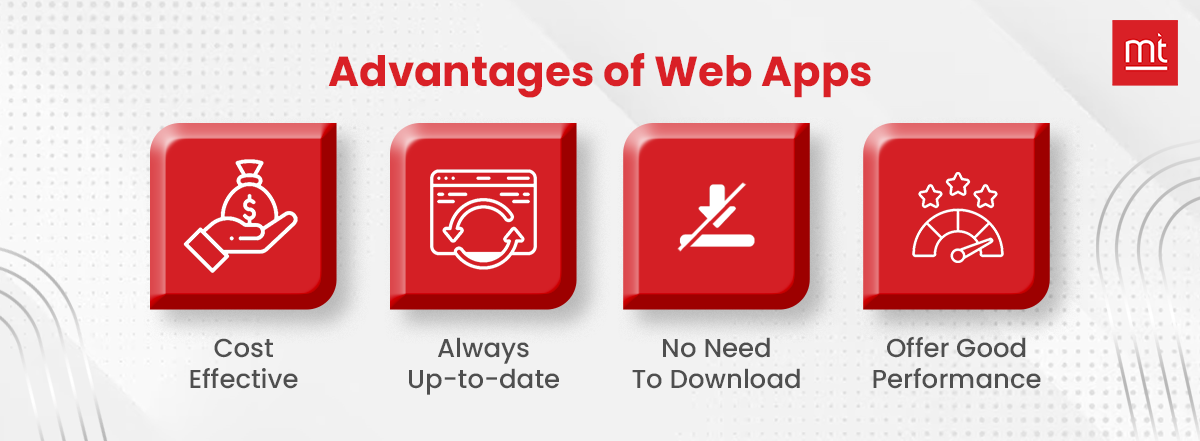
1. Web Apps Are Cost-effective
Developing a web app will help your pockets. Web app creation is similar to website creation.
You must create links between the URL and the app, which requires almost no time. Also, customising the app is relatively simpler compared to mobile apps. Overall, you will need fewer resources to develop a web app.
2. Web Apps Are Always Up-to-date
Mobile apps require constant upgrades. However, it is different with web apps. The web app automatically updates when it updates the linked website. Users will always have an updated web app to use.
3. No Need to Download
You don’t have to download the app to your smartphone like mobile apps. You can use the web app from your web browser by adding the URL. Furthermore, you can also add a home screen icon to your smartphone.
4. Web Apps Offer Good Performance
Web apps offer a seamless performance to users. They run on various operating systems while providing optimum performance.
Disadvantages of Web Apps
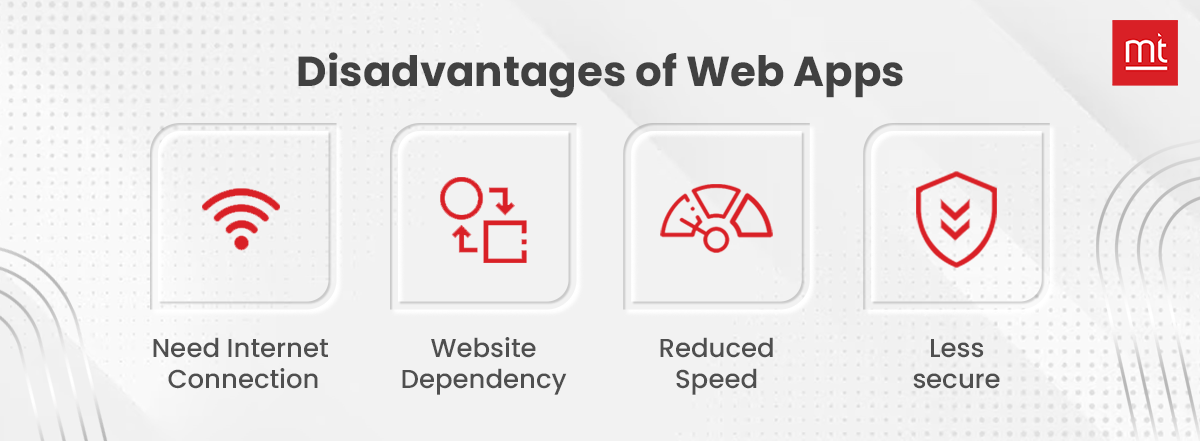
1. You Need an Active Internet Connection
Native and hybrid mobile apps allow users to access some functions offline. It is different from web apps. You have to be online to use web apps.
2. Website Dependency
A web app depends on a web browser. Though this is a benefit, it limits the web apps in case a website falls or faces some errors. In case of issues with the website, a web app will not function.
3. Reduced Speed
A local server hosts a web app, and it limits the speed and performance. Furthermore, a web browser links web apps, causing the app size to increase and further decreasing the speed.
4. Less Secure
Regarding security, mobile apps are far better than web apps. Though SSL enforcement might help prevent cyber attacks, web apps have many security vulnerabilities.
What are the Types of Web Applications?
There are a total of six types of web applications that a web development company can design for you. Let’s check them one by one.
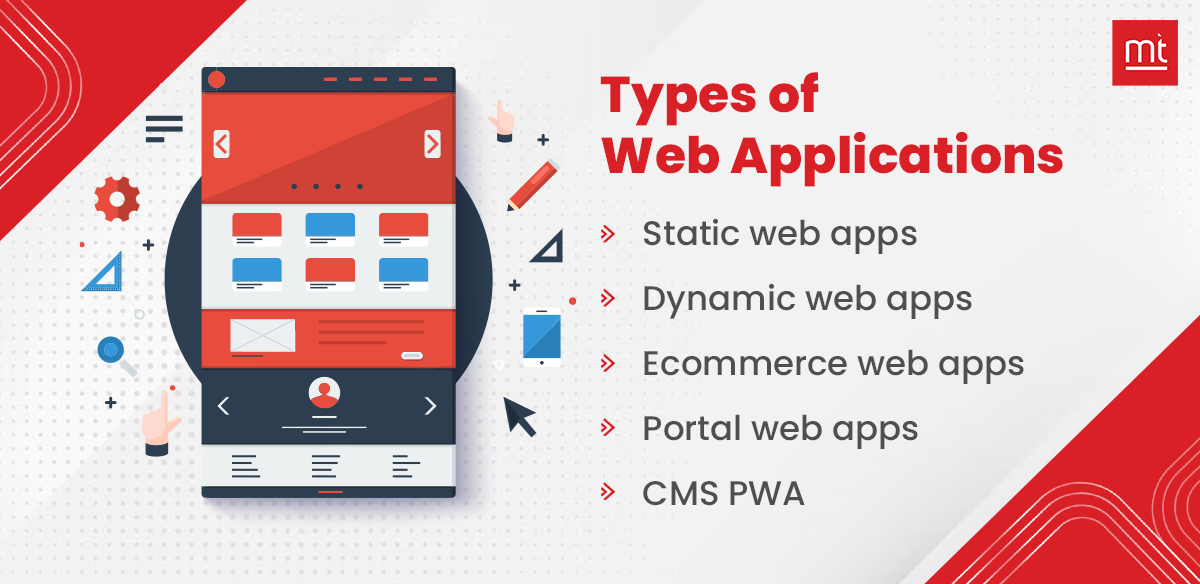
1. Static Web Apps
Static web apps are developed with HTML and CSS. You can add GIFs and videos to the app as well. The main concern is the updation of the app. To update a static web app, you have to download the entire HTML code and work on it.
2. Dynamic Web Apps
Dynamic web apps are apps that need updates regularly. These apps allow users to update the content easily. Dynamic apps handle data and pages quickly and in real-time.
3. Ecommerce Web Apps
Do you want to sell something online? You can create an ecommerce web app for your business. Most web apps are ecommerce apps that allow companies to offer their customers a mobile app-like user experience. You can create categories, add various functionalities, integrate third-party payment gateways, and do much more with your app.
4. Portal Web Apps
Portal web apps allow users to fetch information from diverse categories through a home page. When a user creates a search query, the portal app brings news from relevant sources and presents it to the user.
5. CMS Web Apps
Users can easily add, delete, manage, and modify digital content with a CMS web app.
6. PWA Web Apps
Progressive web apps resemble websites that users can access through a web browser and provide a valuable experience. You can add native-like functionalities inPWAs, such as push notifications and offline functionalities.
How to Monetize Web Apps?
There are various ways you can monetize your web app. Monetizing the web app is crucial as you can cover your costs and generate revenue. Furthermore, different monetization strategies encourage your customers to continue using the app.
Here is a list of ways to monetize the app:
#1. Advertising
You can allow displaying ads on your web app. You can display various ads on an app, such as display ads, native ads, video ads, and others. Keep in mind the proper ad placement to gain maximum results.
#2. Freemium
You can allow users to use the app’s basic version for free. Users must pay for access to use additional advanced features or functionalities. Some businesses offer a limited free version, and some offer a free version for a trial period.
#3. Subscription-based Model
Here, the app will charge users a specific amount weekly, monthly, or yearly for usage. Most web apps in the entertainment or news categories opt for this monetization model.
#4. In-App Purchases
Here, users can buy things within the web app. You can purchase goods or services, premium content, or other services.
#5. Pay Per Use
If you want to use a specific product or service, pay and use it. You must pay for a product every time you wish to use it.
#6. Sponsorship
Users can approach other brands or businesses for financial support in exchange for their brand’s promotion on the web app. It improves the app’s user base and increases brand visibility online.
Read More: Mobile App Ideas That Could Change the World in 2024
When to Go for Web App Development?
Should you go for a mobile app or web app for your business? Well, the answer is tricky. There are various scenarios you need to think of before concluding. Let’s check out when you should think of web app creation.
Entrepreneurs with Budget Constraints
Most entrepreneurs with the best web app ideas have budget constraints. They are in the phase of their business where they need more financial resources for mobile app creation. Developing a web app can be a feasible solution.
When You Want to Launch the App Immediately
Mobile app development is time-consuming. On the other hand, you can develop a web app in just no time. Just hire the best web development service provider, and they will create a dynamic, scalable, and customer-centric web app in just no time. If you want to launch your app quickly, go for web app creation.
When you Want to Target on a Large Scale
Web apps offer cross-platform compatibility. Web apps work on almost all devices, operating systems, and browsers. You can target nearly everyone with a web app.
Best 10 Web App Ideas for Entrepreneurs to Explore in 2025
Do you want to explore the best web app ideas for startups? Let’s discuss the top ten ideas that can be successful.
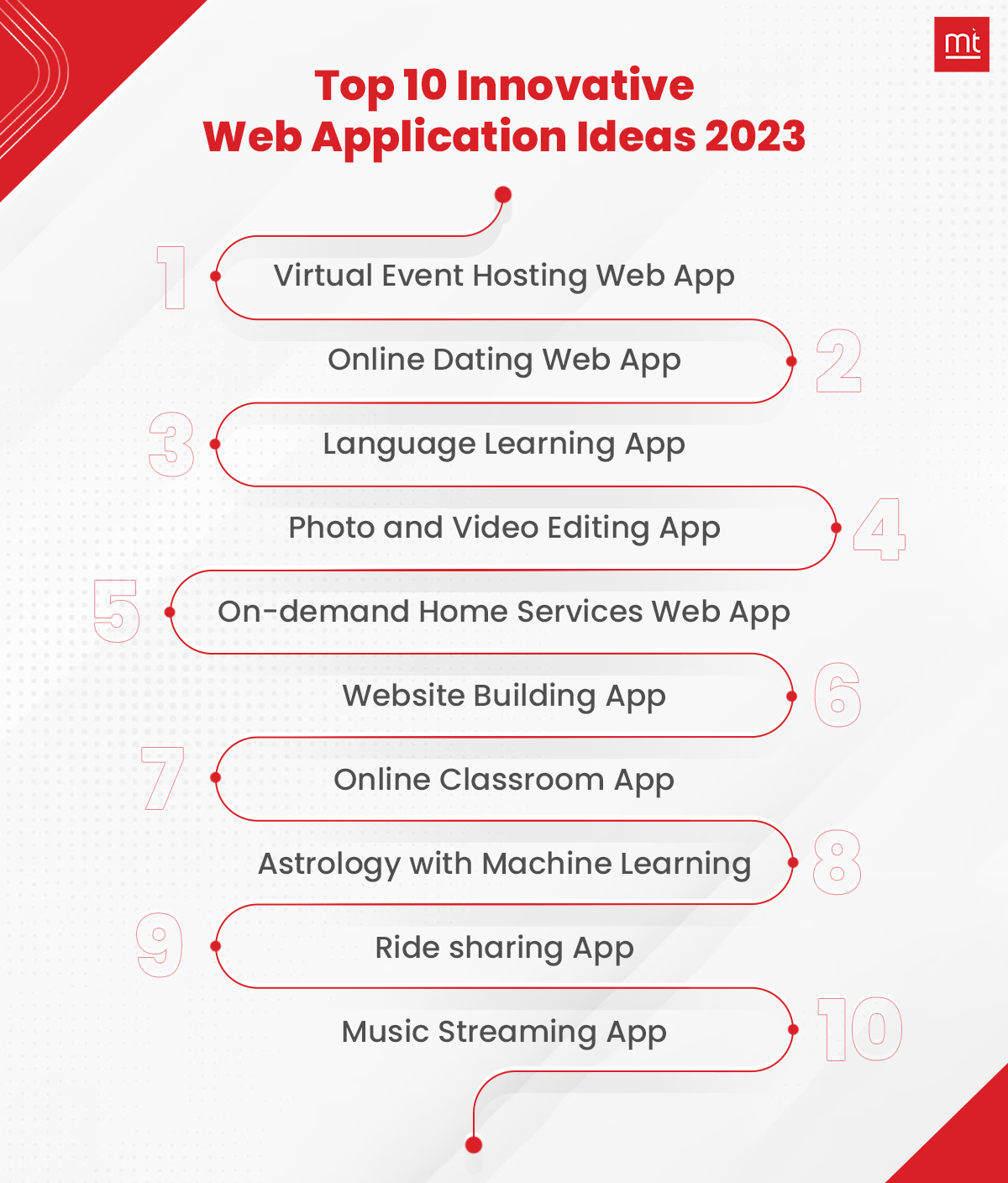
#1. Virtual Event Hosting Web App
Post Covid-19, virtual events have gained popularity across the world. With technologies such as AR and VR, you can host events on digital platforms. Developing a event web app that allows users to organize virtual events with highly advanced features can be a good idea.
Examples of Virtual Event Hosting Web App:
- GoToWebinar
- Livestorm
- Google Meet
- Zoho Meeting
- Eve Virtual
#2. Online Dating Web App
People love to date. Though various dating apps are already available, they would love to try a new one. You can add advanced features such as two-factor authentication, audio and video calls, etc. A well-designed dating app will surely hit the jackpot.
Examples of Online Dating Web App:
- OkCupid
- Match.com
- Hinge
- Bumble
- Tinder
#3. Language Learning App
It is also one of the lucrative web app development ideas to explore. People love to learn new languages. Sometimes, they have to learn a new language due to educational purposes.
You can create a language learning web app that systematically helps students to learn a new language. You can add features such as sign up/login, basic to premium steps for learning the language, expert lessons, certifications at the end of the course, etc.
Examples of Language Learning App:
- Duolingo
- Memrise
- Babbel
- Busuu
- FluentU
#4. Photo and Video Editing App
Though Instagram allows you to edit your photos and videos, you can create a photo and video editing app with some advanced features. Even professional photographers can use the app to fine-tune their photos and videos.
Examples of Photo and Video Editing App:
- Canva
- Vimeo Create
- Video Editor
- Animoto
- Photofunia
#5. On-demand Home Services Web App
Create a web app for booking home services like plumbing, gardening, cleaning, car washing, painting, and laundry whenever needed.
The app should allow users to search for and book the right technicians online. Also, customers should be able to pay them within the app. A user-friendly web app can help woo your potential customers instantly.
Examples of On-demand Home Services Web App:
- TaskRabbit
- Zimmber
- Mr. Right
- Family Handman
- Handyman
#6. Website Building App
This is one of the best web app ideas to explore. Here, a web app allows laymen to design and develop a website instantly. How does it feel to be a developer without a professional degree?
Yes, you can enable users to build a website with a few steps. Ensure you offer a comprehensive web enhancement guide and clear, step-wise instructions to make the journey easy and enjoyable.
Examples of Website Building App:
- Instant Website Builder App
- Odoo
- Jimdo Creator
- Constant Contract
- SimDif- Website Creator
#7. Online Classroom App
Let users learn online with a magnificent and feature-rich online classroom app. The trend of online learning is increasing after the Covid-19 pandemic, and it will continue to be so. Here, you can allow users to schedule online classrooms, allow live lecture-streaming, record lectures, and other advanced features.
Examples of Online Classroom App:
- PhotoMath
- Socrative
- Edmodo
- Scratch
- Kahoot
#8. Astrology with Machine Learning
We all love to predict what will happen in the future, don’t we? How about developing an Astrology app with machine-learning technology?
Machine learning is a high-tech tool that helps predict human behavior and buying habits using past behavior and history. You can develop an intelligent Astrology web app that can predict the future for users.
Examples of Astrology with Machine Learning:
- FutureForecast
- Prognosticator
- VisionaryInsight
- FutureTeller
- DestinyOracle
#9. Ride Sharing App
A ride-sharing app allows users to find other riders traveling in the same direction. The app shows geo-location-based maps with nearby riders traveling in the same direction. You can initiate a ride-sharing trip, contact the rider, and book a trip.
Examples of Ride Sharing App:
- Lyft
- Get
- Curb
- Wingz
- Uber
#10. Music Streaming App
Let users make their playlists and enjoy live music. People listen to music while jogging, working, cooking, and traveling. Developing a music streaming app that allows users to make their playlists can become an instant hit. You can also add subscription-based monetization models to earn some money.
Examples of Music Streaming App:
- TuneIn
- TIDAL
- Slacker Radio
- Pandora
- Deezer
#11. Project Management Web App
A project management web app will allow you and your team members to efficiently plan, track, and organize promotional product tasks. These applications facilitate an Improved ability for teams to collaborate with each other, enabling project members to meet deadlines and access real-time information on project completion. Project management web apps are being widely adopted by startup companies, medium to large businesses, and remote working teams.
Examples of Project Management Web App:
- Trello
- Asana
- Jira
- Monday.com
- ClickUp
#12. AI-Powered Resume Builder Web App
A job-seeker resume builder powered by AI will assist job seekers in creating their professional resumes by interpreting job description information and producing the best optimized content. Utilizing resume building applications can save job-seekers hours of time and help them be successful in gaining employment by allowing job seekers to create resumes that are compatible with applicant tracking systems (ATS). Job-seekers and recruiters/Human Resource (HR) professionals will find resume building applications to be very beneficial.
Examples of AI Resume Builder Web App:
- Resume.io
- Zety
- Rezi
- Kickresume
- Novorésumé
#13. Online Learning Management System (LMS)
The learning management system (LMS) web application is designed to allow institutions and organizations to develop, manage, and deliver online courses, training programs, and certifications. By including the features of track progress, track assessments, and provide video lessons, LMS web applications make it easier and more possible for organizations to provide learning experiences to an unlimited number of learners. LMS are critical to the continuing development of e-learning and corporate training programs.
Examples of LMS Web App:
- Moodle
- Canvas
- Teachable
- Thinkific
- TalentLMS
#14. SaaS-Based CRM Web App
CRM web applications allow businesses to track their communications with customers, follow the evolution of sales, as well as help automate communication. The data-driven analysis provided by CRM applications helps companies retain customers and boost sales performance. They are an absolute necessary element for any sales-oriented company.
Examples of CRM Web App:
- Salesforce
- HubSpot
- Zoho CRM
- Pipedrive
- Freshsales
#15. AI Chatbot Web App
AI chatbot web applications provide a method for a business to automate customer service queries, generate leads, and keep users engaged with the application. These applications use natural language processing and machine learning to provide quick and personalized responses to inquiries. Using chatbots can help a business cut costs while also improving customer satisfaction.
Examples of AI Chatbot Web App:
- Drift
- Intercom
- Tidio
- Chatfuel
- Freshchat
#16. Appointment Booking Web App
Appointment booking web applications provide users with the convenience of scheduling an appointment for services without requiring any manual coordination of scheduling. Appointment booking applications have become an important tool for companies in industries such as healthcare, salon and spa services, consulting, and other professional services. By automating their appointment booking processes, businesses can significantly decrease the number of no-shows and provide better overall customer services.
Examples of Appointment Booking Web App:
- Calendly
- Setmore
- SimplyBook.me
- Acuity Scheduling
- Booksy
#17. Expense Tracking Web App
Expense tracking applications allow individuals and businesses to monitor their spending. These applications allow users to create budgets and track their spending. They also provide financial reports, financial charts, and alerts. Expense tracking applications are popular among freelancers and small businesses.
Examples of Expense Tracking Web App:
- Expensify
- Mint
- Zoho Expense
- PocketGuard
- Wally
#18. E-commerce Website Builder
eCommerce website builders allow users to quickly create an online store for their products without requiring any technical skills. These eCommerce website builders also provide users with a variety of templates, the ability to integrate with payment solutions, and inventory management tools. These eCommerce website builders allow small-business owners to create a profitable online sales channel quickly.
Examples of E-commerce Website Builder:
- Shopify
- WooCommerce
- BigCommerce
- Wix eCommerce
- Squarespace
#19. Food Ordering Web App
Food ordering web applications provide a way for customers to order from their favorite local restaurants for delivery or takeout. Food ordering web applications provide an easy method for customers to browse menus, submit payments, and track orders. Food ordering web applications are among the most significant players in the ever-growing food tech ecosystem.
Examples of Food Ordering Web App:
- Zomato
- Swiggy
- Uber Eats
- DoorDash
- Grubhub
#20. Job Portal Web App
Job Portal Web Apps serve as an efficient connection between Businesses and Job Seekers, providing Job Listings, Resumes, and Applicant Tracking, making it easier than ever for Companies in any Industry to recruit People.
Examples of Job Portal Web App:
- Indeed
- LinkedIn Jobs
- Glassdoor
- Monster
- Naukri
#21. Real Estate Listing Web App
Real estate web-apps allow Home Buyers, Sellers, and Agents to List and Find Properties. The apps have filters, virtual tours, and location-based data to help people make better decisions about Property Purchases.
Examples of Real Estate Web App:
- Zillow
- Realtor.com
- Redfin
- Magicbricks
- 99acres
#22. Payment Gateway Web App
Payment Gateway Web Apps provide the ability to conduct secure transactions between businesses and customers during e-commerce. They offer numerous options for Payment Methods and Currency Types. These apps are essential to the success of every Digital Commerce Business.
Examples of Payment Gateway Web App:
- PayPal
- Stripe
- Razorpay
- Square
- PayU
#23. Social Media Management Web App
Social Media Management web-apps assist Brands in planning their social media content, measuring their online success, and managing multiple social accounts from one place. They are beneficial to agencies and marketers by providing a time-efficient way to plan and improve their marketing strategies on Social Networks.
Examples of Social Media Management Web App:
- Hootsuite
- Buffer
- Sprout Social
- Later
- SocialPilot
#24. Survey & Polling Web App
Survey Web Apps enable Companies to obtain User Feedback and perform Market Research on User Preferences. They provide customizable survey templates as well as analytics, which can be integrated with existing systems, enabling companies to make Data Driven Decisions.
Examples of Survey Web App:
- SurveyMonkey
- Typeform
- Google Forms
- Qualtrics
- Jotform
#25. Accounting Web App
Accounting Web Apps automate bookkeeping, invoicing and tax calculations. Startups and SMEs can use these applications for efficient financial management. Using Cloud Computing, Users can access their finances in Real Time.
Examples of Accounting Web App:
- QuickBooks
- Xero
- FreshBooks
- Wave
- Zoho Books
#26. HR Management Web App
Human resource (HR) web apps provide effective management of employee data, payroll, attendance records and reviews. They provide streamlined HR processes, allowing for easier management of a workforce. They have become necessary for expanding companies.
Examples of HR Management Web App:
- BambooHR
- Gusto
- Zenefits
- Rippling
- Keka
#27. Travel Booking Web App
Travel web apps enable customers to purchase airline tickets, accommodation bookings and a complete vacation package. Travel web apps often offer customers the ability to compare prices and read customer ratings. These applications are well-respected and commonly used by consumers who travel globally.
Examples of Travel Booking Web App:
- Booking.com
- Expedia
- MakeMyTrip
- Airbnb
- Skyscanner
#28. Healthcare Telemedicine Web App
Telemedicine web applications provide patients with access to physicians through an online platform for a telehealth visit. Telemedicine web applications help patients receive more rapid care and decrease the number of visits made to the emergency room or hospitals. After the pandemic associated with COVID-19, the use of telemedicine applications gained widespread acceptance and use.
Examples of Telemedicine Web App:
- Practo
- Teladoc
- Amwell
- Doctor on Demand
- MDLive
#29. Fitness & Workout Web App
Fitness and exercise web apps give customers access to a wide variety of exercise regimens, live classes and ways of measuring progress. They are an option for individuals who prefer to exercise at home versus going to a gym. Fitness and exercise web applications promote the health and fitness of users through online means.
Examples of Fitness Web App:
- Nike Training Club
- Peloton
- FitOn
- Freeletics
- ClassPass
#30. Online Stock Trading Web App
The stock trading web application provides a platform for customers to buy stocks, exchange-traded funds, and other types of investments through the Internet. Most stock trading applications provide customers with real-time stock quotes, charts, and data analytics. The stock trading web application enables the common person to enter the stock market with ease.
Examples of Stock Trading Web App:
- Robinhood
- Zerodha Kite
- E*TRADE
- Webull
- Upstox
#31. Content Management System (CMS) Web App
Content management systems (CMS) web apps make it easy for users to manage, create and edit digital content. They allow individuals to create websites (blogs) or other corporate websites and create portals for employees of an organisation. Due to their flexibility and scalability, CMS web applications are widely used.
Examples of CMS Web App:
- WordPress
- Drupal
- Joomla
- Ghost
- Contentful
#32. Video Streaming Web App
Video streaming web apps provide users with access to both on-demand video content and live video streams. Video streaming web apps often charge users a monthly subscription, advertise on the application, and/or use user ratings to recommend content. Video streaming web applications are the dominant force in the digital entertainment industry.
Examples of Video Streaming Web App:
- Netflix
- YouTube
- Vimeo
- Disney+
- Hulu
#33. Marketplace Web App
The most widely used marketplace web application connects buyers and sellers to a single platform. Most marketplace web applications provide product listings and payments, as well as reviews. The result of the integration of these capabilities allows the user to create a digital commerce platform that can be scaled.
Examples of Marketplace Web App:
- Amazon
- eBay
- Etsy
- Flipkart
- Alibaba
#34. Legal Consultation Web App
Legal consultation web applications connect legal professionals (attorneys) with consumers looking for information regarding legal documentation or other forms of communication. Legal consultation web applications have made it more affordable and easier for consumers to seek out services from legal professionals. Legal consultation web applications are rapidly growing in popularity as part of the increasing legal-tech trend.
Examples of Legal Consultation Web App:
- LegalZoom
- Rocket Lawyer
- LawRato
- Avvo
- UpCounsel
#35. Recruitment ATS Web App
Applicant Tracking System (ATS) web applications allow recruiters to manage resumes, interviews, and candidate pipelines, making it easier for them to hire the most qualified candidates. These web applications have been widely adopted by HR departments.
Examples of ATS Web App:
- Greenhouse
- Lever
- Workable
- Zoho Recruit
- iCIMS
#36. Event Ticket Booking Web App
Ticket booking web applications enable consumers to purchase tickets to concerts, movies, or other kinds of events, and they include an option to choose their seating location and to receive electronic tickets and payment confirmation via QR codes. This type of application increases access to entertainment.
Examples of Ticket Booking Web App:
- BookMyShow
- Eventbrite
- Ticketmaster
- Paytm Insider
- StubHub
#37. Blogging Platform Web App
Blogs are digital media used by many creators to publish and make money online. Many blogging applications offer features that assist with SEO and analytics, as well as custom designs that provide the creator with a way of standing out from the crowd. Blogging applications are ideal for both personal and professional use.
Examples of Blogging Web App:
- Medium
- WordPress.com
- Blogger
- Substack
- Ghost
#38. File Storage & Sharing Web App
File storage applications enable users to upload, manage, and share files online in a secure environment. By storing files in the cloud, users can access their files from anywhere, and this type of application is important for organizations with remote employees.
Examples of File Storage Web App:
- Google Drive
- Dropbox
- OneDrive
- Box
- iCloud
#39. AI-Based Content Writing Web App
AI content writing applications are used to automatically generate blog posts, advertisements, and social media content for marketers. These applications have improved productivity and saved time for marketers. By using AI to personalize their content, marketers can improve the quality of their content output.
Examples of AI Writing Web App:
- Jasper
- Copy.ai
- Writesonic
- Grammarly
- Rytr
#40. Code Collaboration Web App
Code collaboration web applications are utilized by software developers to collaborate in code writing/reviewing/approval. They provide version control/CI CD support for software development teams.
Examples of Code Collaboration Web App:
- GitHub
- GitLab
- Bitbucket
- CodePen
- Replit
#41. Form Builder Web App
Form building web applications allow users to design/formulate custom forms to collect data and use them to build products/solutions. These applications allow for integration with other web applications and automation tools. These form builders are often used by companies to generate leads and conduct surveys.
Examples of Form Builder Web App:
- Jotform
- Typeform
- Google Forms
- Wufoo
- Formstack
#42. Chat & Messaging Web App
Chat web applications allow users to communicate with each other in real time. Chat applications are integral to collaboration/communication and customer satisfaction. Secure messaging adds an additional layer of security/trust for users.
Examples of Chat Web App:
- Slack
- Microsoft Teams
- Discord
- Rocket.Chat
- Chanty
#43. Portfolio Builder Web App
Portfolio builder web applications allow professionals to showcase the work they have done on the internet. These web applications have many features that cater to the needs of designers, developers, and freelancers. The use of custom templates helps to give a more personal branding experience.
Examples of Portfolio Builder Web App:
- Behance
- Dribbble
- Wix
- Squarespace
- Adobe Portfolio
#44. Course Marketplace Web App
Course Marketplaces web applications provide instructors with the ability to offer/sell courses internationally. These applications are responsible for collecting payment, hosting videos, and giving students access to the courses. Web applications for course marketplaces empower digital educators.
Examples of Course Marketplace Web App:
- Udemy
- Coursera
- Skillshare
- edX
- Podia
#45. Website Analytics Web App
Website analytics web applications allow companies to track the number of visitors to their website and how users interact with the website. Businesses use the insights gained from tracking analytics to improve the effectiveness/efficiency of their websites. Data-driven decision making provides businesses with opportunities to improve their conversion rates.
Examples of Analytics Web App:
- Google Analytics
- Mixpanel
- Hotjar
- Kissmetrics
- Matomo
#46. Marketing Automation Web App
Marketing automation web applications are used to help businesses run their marketing campaigns and the “customer journey” through the funnel. Web applications for marketing automation allow businesses to automate the process of writing emails, workflows, and generating leads. These types of applications assist businesses with maximizing their marketing returns.
Examples of Marketing Automation Web App:
- HubSpot
- Marketo
- Mailchimp
- ActiveCampaign
- Pardot
#47. Password Manager Web App
Password management web applications allow individuals and organizations to securely store and manage their credentials. Password managers are important for improving security and preventing data breaches.
Examples of Password Manager Web App:
- LastPass
- 1Password
- Dashlane
- Bitwarden
- Keeper
#48. E-signature Web App
Online platforms for signing electronically secure documents will help you reduce the amount of paper you have to deal with, as well as speed up the process of getting your electronic signature approved by the respective party. Electronic signature platforms are used in multiple industries.
Examples of E-signature Web App:
- DocuSign
- HelloSign
- Adobe Sign
- SignNow
- PandaDoc
#49. Inventory Management Web App
With the help of an online application to manage inventory, companies can keep track of their inventory and the suppliers they purchase from. Inventory applications will prevent losses associated with expired product and enhance the functionality of supply chains for businesses that are engaged in retail and manufacturing.
Examples of Inventory Management Web App:
- Zoho Inventory
- TradeGecko
- inFlow
- Odoo
- StockIQ
#50. Customer Feedback Web App
The platform that collects customer feedback from web applications collects reviews, ratings, and suggestions from the users. By using this data, you can get insight into how happy the customer is, which will always allow improvement of the products and services offered.
Examples of Feedback Web App:
- UserVoice
- Canny
- Trustpilot
- Yotpo
- GetFeedback
#51. Task Automation Web App
The platform that allows you to automate all of your repetitive tasks (including many tools) saves time and allows for greater efficiencies in the workplace. As there is no need to know how to code, no-code automation is trending today.
Examples of Automation Web App:
- Zapier
- Make (Integromat)
- IFTTT
- Automate.io
- Peltarion
#52. Email Marketing Web App
Platforms used by email marketing web applications help businesses conduct their email campaigns. These platforms include templates, automation tools, and analytics, making email a highly effective (high-ROI) way to market.
Examples of Email Marketing Web App:
- Mailchimp
- Sendinblue
- ConvertKit
- Constant Contact
- GetResponse
#53. AI Image Generator Web App
AI image generator web apps create visuals from text prompts. These tools are used by designers and marketers. They reduce creative production time significantly.
Examples of AI Image Generator Web App:
- DALL·E
- Midjourney
- Adobe Firefly
- Leonardo AI
- NightCafe
#54. Website Builder Web App
Website builders provide an interface to develop your website through simple drag and drop and without needing any code. The platforms enable small businesses and creators to build up their online presence easily.
Examples of Website Builder Web App:
- Wix
- Squarespace
- Webflow
- Weebly
- Zyro
#55. Event Management Web App
Event management platforms assist with planning, managing, and analyzing events. By using these platforms, you’ll manage registrations, ticket sales, and event-related communication in one place rather than having to use multiple software platforms to manage everything on your own.
Examples of Event Management Web App:
- Cvent
- Eventzilla
- Whova
- Bizzabo
- Eventtia
#56. Customer Support Helpdesk Web App
Help Desk & Customer Service Web Applications manage customers’ inquiries and requests (or tickets). Help Desk Applications enable businesses to enhance their ability to respond quickly to customer inquiries, improving the quality of customer service provided. Help Desk Applications should be considered critical to the success of Software as a Service (SaaS) Companies.
Examples of Helpdesk Web App:
- Zendesk
- Freshdesk
- Help Scout
- Zoho Desk
- Kayako
#57. Time Tracking Web App
Time Tracking Web Applications monitor employee productivity and time; they assist Freelancers and Agencies with accurate timekeeping for billing purposes.
Examples of Time Tracking Web App:
- Toggl
- Clockify
- Harvest
- Hubstaff
- Time Doctor
#58. AI Translation Web App
AI Translation Web Applications convert text from one language to another in real-time. They enable successful communication with clients in different countries. AI Technology enhances the accuracy and context of translated text.
Examples of Translation Web App:
- Google Translate
- DeepL
- Microsoft Translator
- iTranslate
- Lingva
#59. Learning Assessment Web App
Assessment Web Applications conduct skill assessments, quizzes, and online examinations. These platforms provide automated grading and analytics. Additionally, Educators and Employers utilize the platforms for hiring and evaluation.
Examples of Assessment Web App:
- TestGorilla
- Mettl
- ProProfs
- ClassMarker
- ExamSoft
#60. SaaS Subscription Management Web App
Subscription Management Web Applications manage subscription plans and billings on a recurring basis. They help reduce “churn rates” and prevent unwanted cancellations and refunds, and they streamline payment processing. Thus, Subscription Management Applications are critical to the success of SaaS enterprises.
Examples of Subscription Management Web App:
- Chargebee
- Recurly
- Paddle
- Stripe Billing
- Zuora
#61. Cloud Backup Web App
Cloud Back-Up Web Applications backup and store data online with secure encryption. In addition to being necessary for Data Recovery in case of emergency, Cloud Backups are vital to keeping all data stored on the Cloud secure and safe from cybercriminals.
Examples of Cloud Backup Web App:
- Backblaze
- Carbonite
- Acronis
- IDrive
- CrashPlan
#62. AI Voice Generator Web App
AI Voice Generating Web Applications convert written text into natural-sounding audio. Audiobook Publishers, Video Producers, and Website Developers utilize these applications to provide accessibility for users who cannot read or hear. AI also increases the “realism” of the generated voice.
Examples of Voice Generator Web App:
- Murf AI
- Play.ht
- ElevenLabs
- Descript
- Speechify
#63. Document Collaboration Web App
Document Collaboration Web Applications allow teams to collaborate on documents in “real-time” simultaneously. They promote increased productivity among team members and enhance teamwork by allowing for seamless collaboration through the Internet.
Examples of Collaboration Web App:
- Google Docs
- Notion
- Microsoft Office Online
- Quip
- OnlyOffice
#64. AI SEO Tool Web App
AI SEO Tools analyze keyword strategies along with their corresponding Backlinks and search Rankings. These Tools help Businesses optimize their websites and improve Search Engine Visibility. By automating time-consuming tasks, marketers can focus on producing high-quality content that drives traffic to their websites.
Examples of SEO Web App:
- SEMrush
- Ahrefs
- Moz
- Surfer SEO
- Ubersuggest
#65. Chatbot Builder Web App
Business owners can create chatbots without needing programming knowledge by using Chatbot Builder platforms. Chatbot Builder platforms are designed specifically to automate conversations with customers. Because of their ease of use, no-code platforms typically have higher adoption rates than traditional coding languages.
Examples of Chatbot Builder Web App:
- ManyChat
- Botpress
- Landbot
- Tars
- Flow XO
#66. HR Payroll Web App
Payroll web app platforms are online platforms that automate the process of calculating and paying employee salaries and ensuring compliance with various laws regarding payroll. Payroll App platforms reduce human error associated with payroll processing and help ensure that employees receive their paychecks on time. Payroll App platforms are essential for HR departments because they allow HR departments to take on more responsibility without having to hire additional personnel.
Examples of Payroll Web App:
- ADP
- Paychex
- Gusto
- RazorpayX Payroll
- Keka Payroll
#67. SaaS Analytics Dashboard Web App
Analytics Dashboard platforms allow users to monitor business KPIs and visualize the metrics associated with them in real-time (i.e., on a dashboard).They were developed to provide quick and accurate reports to owners, managers, and employees about the performance of their business through data analysis. The vast majority of SaaS companies have adopted these products.
Examples of Analytics Dashboard Web App:
- Databox
- Klipfolio
- Tableau Cloud
- Looker
- Power BI
#68. Digital Wallet Web App
Digital Wallets allow people to securely store their payment information in an application so that the application can be used for online purchases in place of cash. This allows users to easily access and pay for products or services without needing to carry cash or credit cards.
Examples of Digital Wallet Web App:
- Paytm
- Google Pay
- Apple Pay
- PhonePe
- Skrill
#69. AI-Based Hiring Web App
AI Hiring Platforms help companies automate parts of the hiring and recruiting process, including screening and matching candidates. The platforms also help to eliminate bias in the hiring process and help speed up the hiring process. By using AI Hiring Platforms, organizations can improve the accuracy of their hiring decisions.
Examples of AI Hiring Web App:
- HireVue
- Pymetrics
- Fetcher
- HireEZ
- XOR
#70. Knowledge Base Web App
Knowledge Base Web Applications allow users to store Frequently Asked Questions (FAQs) and other types of documentation in one spot. As a result, the frequency and volume of customer support requests received by companies can be reduced. By providing customers with the ability to self-service their inquiries, companies can increase the overall quality of their customer experience.
Examples of Knowledge Base Web App:
- Confluence
- Zendesk Guide
- HelpDocs
- Document360
- Notion
#71. AI Meeting Notes Web App
Automating meeting recording and summarizing helps remote teams work together more efficiently. Automated Meeting Tools provide an increase in productivity and the sharing of knowledge. Consequently, automated meeting tools have become very popular among remote team members.
Examples of AI Meeting Web App:
- Otter.ai
- Fireflies
- Fathom
- Sembly
- tl;dv
#72. Influencer Marketing Web App
Influencer Marketing Web Apps connect brands looking to work with creators/influencers. The apps manage all aspects of an influencer marketing campaign, as well as the associated analytics. The rise of social commerce has made this type of app essential for many brands and creators alike.
Examples of Influencer Marketing Web App:
- Upfluence
- Aspire
- Modash
- CreatorIQ
- Traackr
#73. SaaS Product Feedback Web App
Product Feedback Web Apps help companies gather user insights regarding their products so that product development teams can determine which features to prioritize for future product improvements. Many companies use user-driven development to improve customer retention.
Examples of Feedback Web App:
- Productboard
- Canny
- Pendo
- Userback
- Hotjar
#74. Auction Web App
Auction web app have been created as a result of digital conversion. Auction websites allow users to place bids for products online. As a result, they provide a method by which users may participate in timed auctions. The two primary sectors where auction web sites are most successfully utilized are in the sale of collectibles and in B2B sales.
Examples of Auction Web App:
- eBay
- Catawiki
- Sotheby’s
- Heritage Auctions
- DealDash
#75. Learning Subscription Web App
Learning subscription apps offer subscription learning provide unlimited access to courses at all times. They allow learners to continue learning constantly while helping to create consistence revenue from subscriptions.
Examples of Learning Subscription Web App:
- LinkedIn Learning
- Pluralsight
- Skillshare
- Coursera Plus
- MasterClass
#76. AI-Based Code Review Web App
AI code review apps can scan code looking for errors, bugs and security problems. The overall quality of code will be improved as well as aiding development teams.
Examples of Code Review Web App:
- SonarCloud
- Codacy
- DeepCode
- CodeClimate
- Snyk
#77. SaaS Pricing Calculator Web App
Pricing calculator apps are applications that help the users analyze what their service(s) will cost. Pricing calculators provide transparency and can also increase your conversion rates for SaaS sales
Examples of Pricing Calculator Web App:
- Chargebee
- PriceIntelligently
- ProfitWell
- Paddle
- Baremetrics
#78. Community Web App
Community web apps connect users via like-minded interests, support conversations, and provide a means for creating and sharing content. Community web apps will drive increased user engagement.
Examples of Community Web App:
- Discord
- Circle
- Mighty Networks
- Tribe
#79. AI Email Writer Web App
AI email tools are applications that allow users to create personalized email content with ease. The use of these tools will lead to increased email response rates and have become very popular among sales and marketing teams.
Examples of AI Email Web App:
- Lavender
- Smartwriter
- Jasper
- Writesonic
- Copy.ai
#80. SaaS Compliance Management Web App
Compliance web apps assist businesses in meeting regulatory requirements. Compliance web apps will also automate the audit and report processes. They are designed to remove legal risks
Examples of Compliance Web App:
- Vanta
- Drata
- Secureframe
- LogicGate
- Sprinto
#81. No-Code App Builder Web App
No-code app builders allow end users to build applications without coding. No-code app builders utilize a drag and drop method of building applications and are intended to allow non-technical users to build applications quickly.
Examples of No-Code Web App:
- Bubble
- Adalo
- Glide
- OutSystems
- Mendix
#82. Survey Analytics Web App
Survey analytics apps are designed to provide a means to display feedback data visually. Survey Analytics will also aid in identifying trends with your survey results. The survey analytics applications will also provide an improved basis for making decisions.
Examples of Survey Analytics Web App:
- Qualtrics
- SurveyMonkey
- Alchemer
- QuestionPro
- Zoho Survey
#83. AI-Based Recommendation Web App
Personalized recommendations engines tailor the user’s experience based on their preferences. As a result, users are more likely to engage with content and will be more likely to convert. Personalized recommendation engines are quite popular with eCommerce companies.
Examples of Recommendation Web App:
- Amazon Personalize
- Algolia Recommend
- Dynamic Yield
- Salesforce Einstein
- Recombee
#84. Whiteboard Collaboration Web App
Collaboration gained momentum because of all the collaborative tools guided by online whiteboards (ww) which can be used to brainstorm new ideas and develop plans collaboratively in real-time and asynchronistically especially when working with remote teams!
Examples of Whiteboard Web App:
- Miro
- MURAL
- FigJam
- Microsoft Whiteboard
- Jamboard
#85. AI-Based Fraud Detection Web App
To help ensure secure financial transactions the Fraud Detection application(s) leverage machine learning and artificial intelligence technologies to detect anomalies; this increases both speed and accuracy.
Examples of Fraud Detection Web App:
- Stripe Radar
- Sift
- Feedzai
- Forter
- Riskified
#86. Digital Asset Management Web App
Digital Asset Management web applications allow businesses to curate their digital assets ensuring brand uniformity. Marketers commonly use digital asset management software.
Examples of DAM Web App:
- Bynder
- Brandfolder
- Widen
- Canto
- Adobe Experience Manager
#87. Quiz Web App
Quiz apps are intended to provide interactive learning, engagement, and reward through gamification of the learning experience; these types of tools create environment for people to participate with one another while utilizing technology.
Examples of Quiz Web App:
- Kahoot
- Quizizz
- Typeform
- Outgrow
- ProProfs
#88. Resume Screening Web App
Resume screening apps reduce the recruiter’s workload by automating candidate review processes while also allowing for quicker and more accurate matching of candidates to job roles through use of artificial intelligence.
Examples of Resume Screening Web App:
- HireVue
- Pymetrics
- Eightfold
- HireEZ
- Fetcher
#89. Customer Loyalty Web App
Customer loyalty programs increase the probability of repeat customers returning while growing the relationship between the customer and the business will encourage additional sales! Retailers often employ loyalty program(s) to stimulate continuing loyalty from their existing customer base!
Examples of Loyalty Web App:
- Smile.io
- LoyaltyLion
- Yotpo Loyalty
- Punchh
- Zinrelo
#90. SaaS Onboarding Web App
Web-based Onboarding applications develop structured processes for creating a unique first experience with a new customer, which ultimately results in reduced customer churn. New customers can benefit from the guidance given by interactive feature tutorials.
Examples of Onboarding Web App:
- Userpilot
- Appcues
- WalkMe
- Pendo
- Chameleon
#91. SaaS Referral Program Web App
Referral Programs provide opportunities for referrals made by current customers to create additional revenue streams of new customers. Referral applications are often more cost-effective than traditional advertising methods.
Examples of Referral Web App:
- ReferralCandy
- GrowSurf
- Ambassador
- Viral Loops
- Friendbuy
#92. AI Video Editing Web App
Video Editing (ai) automaticity are also becoming more prevalent; these applications support content creators who create video content in real-time and at scale.
Examples of Video Editing Web App:
- Descript
- Kapwing
- Pictory
- VEED
- InVideo
#93. SaaS Customer Retention Web App
Retention apps evaluate trends regarding churn through the analysis of complex datasets in order to inform businesses how to retain their customers as well as their potential lifetime value.
Examples of Retention Web App:
- ChurnZero
- Gainsight
- Totango
- ProfitWell
- Baremetrics
#94. HR Performance Management Web App
Performance management apps improve productivity and help HR teams manage employees; they also improve productivity and HR productivity and add support for human resources (HR) departments.
Examples of Performance Web App:
- Lattice
- 15Five
- Culture Amp
- Betterworks
- Leapsome
#95. AI Contract Review Web App
AI contract review apps review contracts and contracts and identify potential risk within contracts, as well as the potential to automate the cost of legal review.
Examples of Contract Review Web App:
- Ironclad
- LawGeex
- Evisort
- DocuSign CLM
- Kira
#96. Product Comparison Web App
Comparison apps enable consumers to make informed purchasing decisions by allowing them to compare multiple products before making their purchase. Many consumers use comparison platforms to do this, especially in the technology space.
Examples of Comparison Web App:
- G2
- Capterra
- GetApp
- TrustRadius
- SoftwareSuggest
#97. Online SaaS API Management Web App
API management apps is critical for developers to be able to manage the security, usage, and scalability of their APIs.
Examples of API Management Web App:
- Postman
- Apigee
- SwaggerHub
- Kong
- RapidAPI
#98. Knowledge Sharing Web App
Knowledge sharing apps encourages people to work collaboratively, and many employees store information and build organizational knowledge using knowledge-sharing applications.
Examples of Knowledge Sharing Web App:
- Confluence
- Notion
- Slab
- Guru
- Tettra
#99. AI-Powered Search Web App
AI search apps enables users to find relevant information faster and make better decisions about what they need. Many organizations have adopted artificial intelligence search applications as part of their larger enterprise platform.
Examples of AI Search Web App:
- Algolia
- Elasticsearch
- Meilisearch
- Coveo
- Typesense
#100. Customer Segmentation Web App
Segmentation apps allow for the personalization of customer experiences through user behavior analysis. Many organizations utilize segmentation tools to improve the likelihood of purchasing.
Examples of Segmentation Web App:
- Segment
- Mixpanel
- Amplitude
- CleverTap
- Heap
#101. SaaS Billing Automation Web App
Billing automation apps enables the management of invoices and payments and reduces human error, thus improving the efficiency of the financial operation within many organizations.
Examples of Billing Web App:
- Chargebee
- Zoho Billing
- Recurly
- Stripe Billing
- Paddle
#102. AI-Based Image Recognition Web App
Image recognition apps allows organizations to automate and secure visual data. AI improves image recognition accuracy.
Examples of Image Recognition Web App:
- Google Vision
- Amazon Rekognition
- Clarifai
- Imagga
- Azure Vision
#103. Document Verification Web App
Verification apps are used by many organizations to verify the identity of customers and prevent identity fraud. FinTech (Financial Technology) is one of the fastest-growing industries using identity verification applications.
Examples of Verification Web App:
- Onfido
- Jumio
- Trulioo
- Shufti Pro
- Veriff
#104. SaaS Workflow Management Web App
Workflow apps automate many of the daily business processes that organizations perform, which helps streamline operation and increase the efficiency of businesses. Workflow automation systems are becoming more prevalent in many large organizations.
Examples of Workflow Web App:
- Kissflow
- Pipefy
- Process Street
- Nintex
- Monday.com
#105. AI-Based Lead Scoring Web App
Lead scoring apps uses machine learning technology to score leads based on their likelihood to purchase a product or service, thus improving the sales effectiveness of sales teams. Many organizations utilize lead scoring solutions to improve their conversion rates.
Examples of Lead Scoring Web App:
- HubSpot
- Freshsales
- Marketo
- Zoho CRM
- Salesforce Einstein
#106. Chat Analytics Web App
Chat analytics apps allow organizations to analyze customer interactions and improve the quality of their customer support. Insights gained from conversational analysis also help improve customer experience.
Examples of Chat Analytics Web App:
- Zendesk Explore
- Freshdesk Analytics
- Sprinklr
- Chatbase
- Intercom Insights
#107. SaaS Feature Flag Web App
Feature flag apps enable the control of the rollout of specific functionalities, thus, minimising the risk of deploying new features in a production environment. Feature flags are designed to complement the principles of agile development.
Examples of Feature Flag Web App:
- LaunchDarkly
- Split
- Flagsmith
- Unleash
- ConfigCat
#108. AI-Based Sentiment Analysis Web App
Sentiment analysis apps assess the emotional response of individuals to particular products or services, thus providing businesses with valuable insights and improvements as a result of customer feedback. The use of AI for sentiment analyses provides a high level of understanding.
Examples of Sentiment Analysis Web App:
- MonkeyLearn
- Lexalytics
- Brandwatch
- MeaningCloud
- Talkwalker
#109. SaaS Customer Health Monitoring Web App
Customer health apps track user engagement and satisfaction in order to identify and prevent potential churn. The application of these technologies is critical for the growth and scaling of SaaS companies.
Examples of Customer Health Web App:
- Gainsight
- Totango
- ChurnZero
- ClientSuccess
- Catalyst
Conclusion
Developing a web app can be a good idea to reach out to a larger audience in a short time. Ensure you have one of the best web app ideas to explore. We have listed some web app ideas with a vast potential for the market. You can also explore some other ideas.
Hire a reputed web development company with a proven track record of developing feature-rich, scalable, and user-friendly web apps.
| [](https://www.manektech.com/blog/web-app-ideas#footer-form) |
Frequently Asked Questions (FAQs) – Web App Ideas
A web application is an application that uses a web browser to provide an interface for users to interact with the application. Through a web application, users can access the application over the Internet through a Web Browser since it does not have to be installed on any specific computer or device in order to run.
In comparison to previous versions of desktop applications, web applications are built at a price point that is generally lower than most desktop applications; they can be deployed quickly and provide a wider audience base across multiple platforms through the use of a single code base. They also provide an improved level of support for small businesses through greater ease of updates and maintenance.
The best web applications provide solutions to real-world problems in a manner that meets the needs of the target market. The first steps in identifying the best web app idea are to identify the ‘pain points’ that exist for users, validate your web app idea through engagement with potential users, and gain insight into competitive solutions. When evaluating the potential for future growth, you should also consider whether the web app will scale effectively and if there is potential for making a profit from the web app.
The demand for web applications continues to grow as a result of the growth of Software as a Service (SaaS), the use of Cloud Computing and advances in the integration of Artificial Intelligence (AI) into SaaS and web applications. As more businesses use Cloud Computing to automate processes, collect data, and engage with consumers through web-based solutions, the demand for cutting-edge web-based solutions will grow exponentially.
Trending concepts for web applications include SaaS powered by AI, builders for applications without coding, medical services web applications, financial services (fintech) solutions, tools to handle project processes, and analytical dashboards for data. There is a strong demand for web applications that utilize AI technology, automated processes, and customize user experiences (i.e., personalize).
The price to build a web application can range from $10,000 to over $150,000, depending on the complexity, feature set, and technological stack being utilized (i.e., set of tools used). A simple MVP prototype typically requires less investment than more complex or enterprise-level web applications (e.g., AI based applications/machine learning applications).
A basic or prototype web application (MVP) may require 2-4 months to develop while more complex or enterprise-level web applications may take 6-12 months to develop. Each web application development timeline depends on the number of features, integrations with other applications, and size of the development team.
Yes, various methods exist for converting a web-based application into a mobile app, including using React Native and Flutter as development frameworks. A developing trend is progressive web applications which provide web apps with many of the same capabilities of a mobile app without the need to create mobile applications separately.
The following are popular web application development technologies: React, Angular, Vue.js, Node/Express, Laravel, Django, Ruby on Rails, various cloud providers (AWS, etc.). The choice of technology stack depends on the requirements and scalability of the project.
MVPs provide the means to quickly validate a business concept, reduce costs associated with development, and gain real-time feedback from users before a full-scale launch.
Market research, landing pages, surveys, and clickable prototypes can validate a web application idea. Market viability will be confirmed with user feedback and initial traction from the idea.
The most common monetization models for web apps are subscriptions, freemium, in-app purchases, advertising, licensing, and transaction fees, with SaaS subscriptions being the most effective for web apps.
Ongoing maintenance of web applications is necessary to maintain security, optimize performance, and keep them compatible with newly developed web browsers and devices. Regular updates improve user experiences and allow for the introduction of new features.
Web app security protects users’ data and keeps users safe from cyber threats. Therefore, security should be a top priority from the start, and practices such as encryption, secure authentication, and regular audits and compliance with standards must be implemented from day one.
Custom web applications enable small businesses to automate their operations, improve customer connectivity, and scale their businesses in a scalable manner. As a result, customized web app solutions for small businesses often have a higher ROI than off-the-shelf software.
The primary difference between websites and web applications lies in website usage and functionality. Websites provide information while web applications provide users with interactive features and the ability to take actions or store data on a web application.
Most startups begin building a web app due to the lower cost and wider access. Once the web app has been validated, it can be expanded to become a mobile or PWA based on what users want.
AI helps web apps improve through automation, personalization, predictive analytics, chatbots, and intelligent recommendations. AI backed features enhance user engagement and make operations more effective.
No-code and low-code platforms can be trusted for MVP creation and internal tools as they expedite development times, but may have limitations in creating highly complicated and customized applications.
Begin with solidifying your idea, getting user validation, developing an MVP, and then selecting a development partner/team. By having a defined roadmap and scalable architecture you will have the foundation for a successful long term product.
More articles on the topic
An app's user base using Firebase Analytics, a free and unlimited analytics solution. You'll be able to learn who your users are and how they interact with your app.
7 Min ReadFeb 27, 24

Nikhil Solanki
Mobile Lead at ManekTech
Data Visualization technologies provide us with a proliferation of insights into the data obtained. Google and Microsoft, for instance, gather and utilize Big Data to shape the future of their commercial operations.
4 Min ReadFeb 29, 24
Ruchir Pandya
Delivery Head of Web at ManekTech