


How to Validate a SaaS Idea Before Hiring Developers or Spending on Development?

Key Takeaways:
- Most SaaS products fail because there is no real market need , not because of bad code.
- Building without validation leads to wasted budget, time and features nobody uses.
- Talking to users early helps you confirm real problems before development.
- Testing demand (signups, pilots, payments) reduces risk and guesswork.
- A small, focused MVP reaches product-market fit faster than feature-heavy builds.
- Validate first → build second → hire developers last.
Do you know that SaaS idea validation is the process of confirming real customer demand, willingness to pay, and problem severity before building software. Founders test interviews, landing pages, and MVPs to reduce risk. Validated ideas reach product-market fit faster and avoid wasting development budgets.
Why Do Most SaaS Products Fail Before Launch? (And How Validation Prevents It)
Most SaaS ideas don’t fail because of bad code; they fail because nobody needed that product. SIMPLE NO GENUINE DEMAND, In fact:
- 42% of startups fail due to no market need , CB Insights Startup Post-Mortem Report
- 90% of startups fail overall , Startup Genome
- Teams that run MVP experiments ship 30“50% faster , McKinsey & Company product research
- Customer discovery before build reduces rework costs by up to 60% Harvard Business Review product strategy analysis
These numbers tell a clear story: When founders skip validation, they gamble the company’s runway on assumptions and most lose that bet.
What this means
Skipping validation = building on assumptions.
Validation first = building with evidence.
Skipping validation is the biggest reason behind these failures. Startups that test demand before coding are up to 3× more likely to achieve product-market fit within 12 months. (StartupBricks MVP Metrics)
Most often, as founders, you might rush into development, assuming speed might reduce risk. On the contrary, unvalidated ideas start leaking your budgets. You end up building features that no one uses, roadmaps that expand without traction and burn rates that escalate.
You might notice budgets slipping away, time running out and teams burnt out building a solution for a market that doesn’t need it.
In this article, we will show you why you must slow that rush. You will learn why you need proof and not opinions before hiring developers or committing with a dedicated team. These validations can help you test assumptions and confirm demands.
How to Start With the Problem (Not the Product) to Reduce SaaS Risk
Every SaaS journey begins with this clear and rather uncomfortable question: What is the real problem we are solving? It doesn’t start with a feature list or the pitch deck idea; it is all about a problem that the founder or a person with an idea wants to solve.
If you skip this step, you risk wasting your budgets, working with misaligned teams and investing resources for months with no returns.
Why Are Ideas Risky but Problems Profitable?
Ideas feel exciting and easy to talk about. However, it is the problem behind the idea that makes it bankable, as it is costing someone both time and money. The urgent problem is what drives actual action.
Validation can help you understand how often a problem occurs, the actual pain users are facing and whether they are ready to fix the issue with alternatives.
Confirmation bias can put you on the back foot with regard to your idea. With just a few positive reactions, you may assume there is demand, but soon enough, you realize the users may not be committed to the idea.
Validation will force you to check for resistance and indifference towards the alternative you are suggesting in the early stages. This can help avoid churn or missed revenue targets.
When you validate the problem, your scope becomes sharper. It also helps you build a small but better product. It is only after validating the problem does it makes sense to bring in an expert like Manektech - SaaS Development Services Company that is focused on building a proven problem instead of guessing through development efforts.
How to Validate Real Market Demand Before Writing a Single Line of Code
You need proof that the market is paying attention before you begin writing the code for your application. Most software development ideas will sound great in your head or when you discuss them with close peers.
But a product doesn’t succeed because it came out of an interesting idea; rather, because it solved a problem that people wanted to fix actively. At this stage, you must replace your assumptions with actual evidence to determine real demand for your idea.
JUST PROVE: THE PROBLEM IS REAL, PEOPLE ACTIVELY WANT A SOLUTION AND THEY’RE WILLING TO PAY
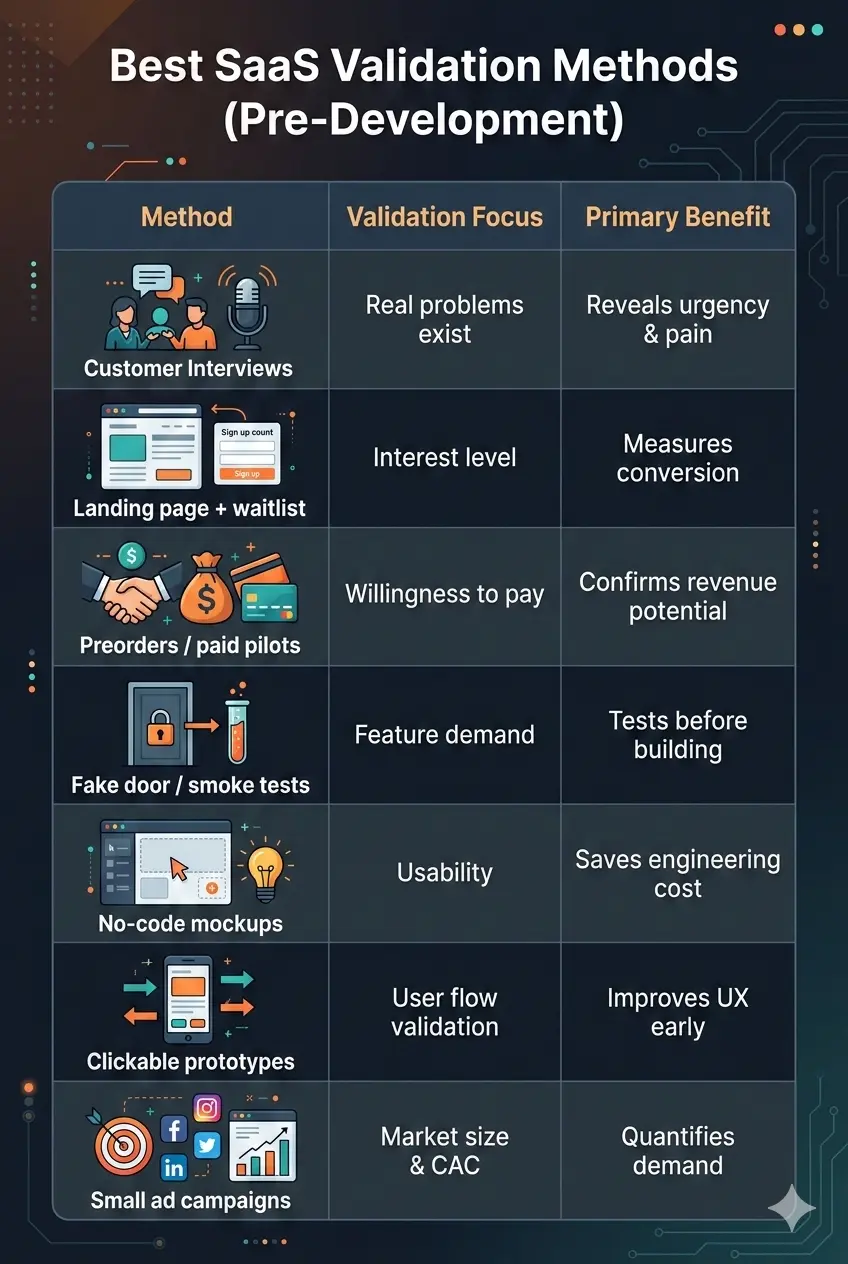
Do People Actually Care? How to Test Demand With Real Signals
At this point in product development, most founders tend to make avoidable mistakes. They rely on assumptions instead of data, test within a small circle and collect feedback from small samples. Most often, it is very similar to their own perspective. When you review the positive reactions in this case, you would note they stem from politeness, not demand
So, instead of relying on guessing, you should use simple validation methods. Begin with customer interviews that help understand how people handle these problems and what it costs them. Follow it up with surveys to get a broader understanding and an in-depth insight into the patterns. Lastly, test the intent using landing pages, waiting lists and preorders.
With these simple steps, you can know whether people are willing to take action or just offer their opinions.
You should prioritize these measurable signals to get the actual insight:
- Conversion rates, giving you an insight into how many visitors actually sign up
- Engagement signals, including replies and follow-ups
- Early interest without intense persuasion
You must validate the demand early to protect both your budget and energy. It will also ensure you are building something that is for the market, and not something that you must convince people about.
Need help building MVP tests? Explore MVP development cost .
What Are Users Using Today?
Before you start building something new, you should take a close look at what users are already using. Only a few problems exist in vacuum. People almost always have a way to get the job done, even if the approach is clunky and inefficient. By understanding the existing behaviors, you can determine the real opportunity and how it can help someone switch.
How Alternatives Reveal Your True Opportunity?
You must take note of both direct competitors and indirect substitutes, while checking for alternatives. Some users may be paying for a product that feels similar to what you are building. Several others may rely on spreadsheets, emails and manual processes. You should note what they quietly tolerate and things that they openly complain about.
Insights like slow workflows, confusing steps or even repeated data entry can push the users to look for alternatives. Instead of blaming the competition for weak solutions, you must pay attention to why their users stick or choose workarounds. These reasons will help you understand what matters and help you define the value proposition for your product.
By mapping the patterns, you will notice the gaps better. You can even begin seeing frustrations that occur, costing users time and money. Using this context can help turn a vague idea into a more focused solution that is built for today’s users.
How to Validate Willingness to Pay Before Building?
Validating demand doesn’t stop at judging the interest of your users. Likes, signups and positive feedback seem encouraging; however, they don’t translate into revenue for your idea. That’s why your main goal is to test whether users would notice the value you are delivering with your solution, enough to pay for it.
Interest –‰ Revenue: How to Test Real Purchase Intent
There’s a major difference between curiosity and purchase intent. A lot of people may explore your idea, join the waitlist or even say it is interesting without actually opening the wallet. That gap causes products to fail quietly.
Introduce money or commitment early into the ideation stage to close this gap. Start by running small paid pilots by testing your idea with handful users. Test your pre-sell campaigns to check if potential users would be ready to pay for the product. Next, add letters of intent to validate the budget ownership in B2B deals. Lastly, use fake door tests that uses “buy” and “upgrade” buttons to reveal their purchase intent.
Look for red flags using these aspects. When you notice a strong interest paired with zero interest, it is a warning sign. The other red flag would be low engagement after an initial excitement towards purchase.
If there is willingness to pay, you would notice a better positioning for your product. This will also help refine the pricing, scope and audience before you start investing in the development.
How to Scope a Smart MVP?
Once you have validated the demand for the product idea and willingness to pay, you may risk overbuilding the solution. Many founders try to impress the early users with features instead of solving the actual problem.
Smart MVP development isn’t about speed alone; it is also about focusing on the right aspects of product development. By narrowing the scope, you can learn faster, control the costs and avoid building complex solutions your users don’t need.
Why Less Features = Faster Product-Market Fit
Start the development by attaching your MVP to a single primary job that needs to be done. Ask yourself what your users may hire your product to do on day one and what it might end up doing someday for them.
This will help you separate the must-have features from the nice-to-have ones. If the feature doesn’t support the core job, it doesn’t belong to the MVP version.
You should also avoid creating multi-year feature roadmaps at the launch stage. This will make you work on assumptions that haven’t been tested yet. That’s why, instead of a roadmap, define the success metrics at this stage. These include activation, usage frequency and time saved. These metrics will help know define if the app is working for you.
An MVP should ideally solve one pain problem in depth. This will create trust, learning and momentum that matters at this early stage. With this disciplined approach, you can iterate faster, achieve cleaner feedback and expand intentionally in the future, avoiding costs. Check out some Software Development Trends.
What Are the Best SaaS Validation Methods Before Development Starts?
It is crucial to choose the right validation methods before committing to product development. As a founder, you may feel like jumping straight into development as it feels productive. However, early validation is faster, cheaper and even informative.
The goal is to test your assumptions in a simple way so that you learn what works before you invest time and money.
Lean Validation Techniques That Save 80“90% Development Cost
You don’t need to build a full product to start learning about your users. Smoke tests can help you gauge your user’s interest by presenting them with the idea or tracking signups/clicks. No-code mockups allow you to show actual product experience without writing the actual code. Clickable prototypes let users interact with the idea, revealing where confusion or friction appears.
When you pair these tests with customer validation conversations, you can understand user reactions in real-time. Ask what feels useful, what is missing and whether the users will use them or pay for it. You can even conduct A/B messaging tests to check if these value propositions attract attention and conversions.
Using these lean methods, you can test ideas quickly and discard weak assumptions in the early stages. So, instead of spending months building features no one needs, you can gather real signals in days or even weeks. With this learning, you can reduce costly development cycles, ensuring you start building a product that has already been validated by your users.
Competitor & Market Gap Analysis: Is There Room for Your SaaS?
Validate if the market truly needs another solution for the problem or a clearer proposition before you build a product. The competitor and gap analysis isn’t just about copying others; it is also about understanding where demand exists and where all the users feel underserved.
A crowded market isn’t the problem if you are unable to explain why your product is better.
Using this framework, you can assess the landscape quickly before committing your resources. It helps validate the demand, identify hidden competitors and determine opportunities to differentiate from others.
| Step | What to Check | Why It Matters? |
|---|---|---|
| Direct competitors | 5-10 tools that solve the same problem | Proves demand exists |
| Indirect alternatives | Spreadsheets, agencies, manual work | Real competition is DIY |
| Pricing tiers | How much users are already paying | Validates willingness to spend |
| User complaints | Reddit, reviews, G2, Capterra | Reveals unmet gaps |
| Differentiation | Speed, UX, automation, AI | Defines unfair advantage |
You can also avoid false differentiation with this framework. Several products claim innovation; however, users care about practical improvements alone like fewer steps, faster outcomes and lower risk.
By studying pricing and complaints, you will know what customers are ready to accept and the things that frustrate them enough to make a switch. These signals are more reliable as compared to brainstorming sessions. With this clarity, you can prevent wasted builds and sharpen your strategic focus.
This approach can force clarity. If you cannot articulate why, you are ten times better, faster, simpler and more valuable, you will be unable to enter a crowded marketplace without a real edge. Strong positioning starts with honest market awareness.
What Metrics Prove Product-Market Fit? (Benchmarks to Track)
Launching your product based on positive feedback alone can be a big mistake from your part. Your potential users may like your idea, praise the interface and even use it someday. However, none of it proves a product-market fit.
Real validation comes from user behaviour and not opinions. Instead of relying on compliments, you can track measurable signals that show if users depend on your product. Here are all the early SaaS benchmarks to watch.
Activation rate (30 to 40%+)
A strong percentage of new users should complete the core action that delivers actual value. This is the moment where the user will understand how the product works for them. If signups are high while activation is low, it can signal confusion, friction or a weak value proposition.
Week-4 Retention (25 to 40%+)
Quarter to half your users should still stay active after nearly four weeks of the first sign-up. The retention will show if your product is able to solve a recurring problem. In case users drop-off quickly, core value may not be strong enough.
CAC Less than One-Third of LTV
Your customer acquisition cost should be below a third of your lifetime value. This will ensure you grow your business without burning unsustainable amounts of cash. If CAC keeps rising, you may need to adjust positioning.
20%+ Users Willing to Pay
A meaningful amount of your users should either convert to a paid plan or show a clear purchase intent. This will indicate real demand, not just interest or experimentation.
NPS above 30
With a positive Net Promoter Score, your users are satisfied enough to recommend your product. With strong recommendations, you can expect organic growth and lowered acquisition costs.
Organic Referrals Increasing
When new users arrive via word of mouth, it is a strong sign that you are creating real value. Referral growth indicates trust and consistent satisfaction.
Users Upset When the Product is Removed
In case users complain, access, or feel frustrated, when the product is unavailable, it seems that users can rely on it. This emotional response is a clear sign of product-market fit.
In simple summary of all above points, Your product is working well when many new users quickly see its value, a good number keep using it after a month, it costs much less to get customers than what they pay you over time, many are willing to pay, they happily recommend it to others, more people join through word of mouth and users feel upset or miss it when it’s gone.
Should You Build an MVP or Scale Fully? (Decision Matrix)
Choosing between an MVP and a full-scale launch isn’t about ambition; it is about clarity. The right decision will depend on how much you know about your problems, users and revenue model. Rushing into a full build without proper evidence can increase risk. However, staying in MVP mode can slow down your growth at a time when signals are strong.
| Situation | Build MVP | Scale Fully |
|---|---|---|
| Problem clarity low | ✔ | ✖ |
| No paying users yet | ✔ | ✖ |
| Pricing validated | ✖ | ✔ |
| Stable retention | ✖ | ✔ |
| Clear ICP | ✖ | ✔ |
If you aren’t clear about the problem, MVP is the safest way to develop the solution. As you are still learning what matters to your users, focused builds can help test assumptions quickly. A full-scale launch will lead to wasted features with unclear positioning.
In case you have no paying users yet, you should stay in MVP mode. In the absence of proof that users are willing to pay, scaling the product will increase costs without actual validation. In case pricing is validated, and customers start paying, it indicates strong value for your product. Going with a full-scale launch makes sense at this stage as you have proven the core value and revenue model for the product.
Stable retention is also an indication that users keep coming back to your product, revealing its true value. Scaling at this point can help expand reach while enhancing user experience.
Lastly, having a clear ideal customer profile can also signal scaling the product. When you know who will benefit the most from the product, you can make growth predictable and efficient.
Best Low-Cost Tools to Validate a SaaS Idea Without Developers
As a modern founder, you don’t need heavy engineering or large budgets to test your idea. With no-code or low-code tools, you can easily validate demand, messaging and the user’s willingness to pay before hiring developers for your project. These tools let you assemble lightweight validation stack and start learning from your users in the early stages before spending months building the product.
Figma or Framer help you create clickable prototypes that simulate the product experience. It can help you test usability and gather feedback without writing the code. You should use WebFlow to enable demand testing. This tool builds simple landing pages that explain the problem and value proposition.
In case users show interest in the product, you should connect stripe to collect pre-orders or deposits. Even small payments are excellent validation signs of paying customers. Typeform can help run structured interviews and surveys to capture consistent feedback from potential customers.
Hotjar is crucial to understand the user’s behavior on your landing page. Heatmaps and session recordings give you an insight into how users move through the product and where they drop off. LinkedIn and Google Campaigns can help test messaging and audience’s real interest in the product.
Using this validation stack, you can reduce total cost of building a product from the start by 80 to 90%. Once you have validated the demand, pricing and positioning, you can move to production by partnering with specialists like ManekTech SaaS development services.
When Should You Build, Pivot, or Pause? (Decision Signals Explained)
Before you start spending on product development, you must pause and read the signals thoroughly. Not every idea you have must be converted into a product. Some ideas need refinement while others should be stalled permanently. This decision framework has been created to help understand if you should proceed with the idea, change direction or just let the idea go.
Decision framework before spending on development
- You should build if you see strong interest signals without persuading the user. The users are able to describe the pain on their own and early converters are even willing to pay, pre-order or commit time to test the solution. These signals suggest that the problem you are looking at is real.
- Pivot the idea if you are receiving mixed signals and the demand is inconsistent. In this case, you will notice that some users feel deeply about the idea while there are others who don’t see the value. This means the problem, audience or even positioning needs adjustment. A small change can even unlock clarity
- Pause the idea if you don’t see any traction despite trying to validate it multiple times. If you have been experiencing low engagement, weak interest or zero conversions, it means you should not invest in the idea.
When Should You Hire Developers or a Dedicated SaaS Team?
You don’t need a full-fledged development team from the first day itself. When your idea has gone beyond assumptions stage, and is fully validated, you can begin hire dedicated developer team.
Ideal timing
Once you have validated the core problem and confirmed with real users that they care about solving it, you can begin hiring the dedicated team. At this stage, you would have a clearly defined MVP scope instead of a list of feature ideas.
You should have clear signals regarding signups, pre-orders and pilot users. This will ensure you are not using building on assumptions. It is equally important to have a clear budget and timeline before you start building the product. When all these aspects are in place, your dedicated team can execute your idea efficiently.
Why a Dedicated Team Works
Dedicated teams blend speed, structure and cost efficiency, making them the preferred model for idea execution. They can onboard faster than in-house recruits. As they offer better control, accountability and even consistent delivery than freelancers, they are excellent for your business.
You will also gain access to their skillset from day one. This will include UI/UX and graphic designers, backend engineers and API specialists along with QA professionals and cloud experts that handle deployment and scaling. Instead of assembling the team one-by-one, this model lets you work with a coordinated team that is fully aligned with your product goals.
With this integrated approach, you can reduce delays, improve product quality and even move from MVP to stable product stage faster.
At-a-glance Comparison Table
| Hiring Model | Speed | Quality | Cost | Control |
|---|---|---|---|---|
| In-house | Slow | High | Very High | High |
| Freelancers | Fast | Variable | Medium | Low |
| Dedicated Team | Fast | High | Optimal | High |
Why Dedicated Teams Deliver Faster & Safer SaaS Launches
- Ready-to-start team (no 3“6 month hiring cycle)
- Pre-built workflows, sprint processes, and QA
- Access to UI/UX, backend, cloud, and testing experts together
- Lower cost than in-house + more reliable than freelancers
- Faster MVP → quicker product-market fit → less burn rate
How Manektech Helps You Move From Validation to Production Faster
At ManekTech, the experts support startups at the most critical transition point, which is moving from a validated idea to a real product. The dedicated team will work closely with the founders on the SaaS strategy, and product validation to create the MVP scope before starting development.
Using MVP design and rapid prototyping, they can help you save time and cost by developing the aspects that matter. They will also offer dedicated SaaS development services teams with backend and API experts across Android, iOS and cross-platform to enable fast product development.
With agile delivery and regular sprint reviews, the team ensures you stay in control, learn from users fast and launch with confidence.
Common Risks Founders Should Avoid
As a founder, you don’t fail because an idea was bad; instead you struggle because the timing was wrong. One of the biggest risk you face is when you start too early without confirming what matters to your users. In some cases, you might end up hiring the developers too soon, before defining the scope for the product development. As a result, you might experience constant changes and increasing costs.
MVPs also fail when you add too many features instead of working on the core problem. If you begin developing the product diea without taking a look at the real user feedback, you might be moving along the wrong path. It is possible nobody needs the product, and you are risking failure here.
Lastly, choosing the low-cost option instead of working with a high-value partner can also lead to quality and scaling risks. To avoid these risks, you should validate the product idea before proceeding with development.
SaaS Opportunities Dominating 2026
By 2026, SaaS success will move from feature-heavy platforms towards AI-powered, mobile-first and workflow-integrated solutions. You should focus on markets where pain point is clear, adoption cycles are faster and budgets are available.
1. AI-Integrated Vertical SaaS
This segment prioritizes in-depth and industry-specific issues instead of broad horizon tools. For example, healthcare automation, legal workflow platforms, HR onboarding automation or fintech compliance systems. When the problem is major and stakes are real, you will note a willingness to pay. You can validate the issues in this space faster as customers are already suffering from the inefficient solutions.
2. Micro-SaaS + Niche Problem Solvers
Even within existing ecosystems, this would target specific issues faced by specific users. Shopify analytics add-on, Slack workflow bots and Notion integrations are a few examples of such products. In this case, you won’t build the entire platform; instead, you would enhance the tools that users are already using. This makes validation faster and ensures the audience is fully defined. MVPs are smaller and development cycles are faster, reducing risks while helping you create a more meaningful product.
3. Mobile-first SaaS Platforms
As most teams rely on distributed teams that works remotely, it has become more important to create solutions that solve their issues. Logistics app, sales team CRMs and healthcare visit tracking are a few examples among others. These products must work on the mobile devices effortlessly, even in low-connectivity environments. If you are entering this market, you should plan for performance, offline capabilities and even intuitive interface design.
4. AI + Automation Internal Tools
There are companies that are investing in tools to improve internal efficiency. Workflow automation, internal dashboards and data orchestration systems are examples of such platforms. These tools aim to save time and reduce errors within the organization. As value is tied to productivity, businesses are ready to invest in these tools. To build these solutions, you need scalable backend architecture with strong integrations.
Real SaaS Giants That Validated First (And Won Big)
Some of the top SaaS companies didn’t succeed by building fast; rather, they won because they validated the product idea first. Let’s look at some of these top companies.
1. Slack
They began as an internal tool, testing it quietly with small teams before it went on to become a product. They observed real usage, removed what the internal teams ignored and doubled down on the features that were popular. Once they were satisfied with the validation, they scaled engineering. They proved that internal validation beats premature building for a sustainable SaaS growth.
2. Dropbox
The SaaS company launched a simple demo video to validate the idea. Once thousands of people signed up overnight for the idea, they were sure of the idea and began hiring confidently. They showed how demand-first thinking can reduce product risk and wasted efforts during the early stage of SaaS journey.
3. Airbnb
They began as a manual concierge style MVP devoid of the complex technology. This helped them validate the demand personally, managing everything from listings to bookings themselves. Once they were sure of the traction, they invested in scalable technology. They showcased that you need to prove that people need your idea before you invest in platforms or long-term scalability decisions.
4. Calendly
They focused on the small scheduling problem and built a minimal MVP to solve it. With a tight scope and budget, they gained steady adoption. They gradually scaled the product, resulting in faster ROI and long-term sustainability.
5. Notion
The SaaS company spent years iterating the idea with small and passionate user groups. The tight feedback loop helped them shape the features. They relied on a small and dedicated team to build a product that users care about, before they expanded into a global productivity platform.
Conclusion “ Validate First, Then Build
Building a SaaS product without proper validation is one of the fastest ways to burn your time, momentum and money. By validating the idea first, you de-risk the entire journey by confirming the real problem, actual demand and willingness to pay before writing code.
You can optimize the development spend to focus on features and scope that matters instead of building unused features and irrelevant product. The clear validation signals can accelerate the product’s time-to-market as you can make decisions faster and confidently. You are no longer building a team based on guesswork, as it gives you the exact team and stack you need.
If you have a validated SaaS idea, connect with our team at Manektech. Our dedicated SaaS development services team can help translate the validated idea into a full-fledged scalable product.
SaaS Validation FAQs (Quick Answers for Founders)
It takes about 4 to 8 weeks to test demand, collect feedback and see early traction before you can begin hiring the dedicated team.
The cheapest way to test a SaaS idea include landing pages, no-code prototypes and surveys. Despite being low-cost, these approaches can reveal interest and intent.
Waitlists, conversions, paid pilots, or preorders. Actions matter more than feedback.
Pivot the idea, refine the target market, or pause. It’s cheaper to adjust early than rebuild later.
Dedicated teams offer consistent quality and better coordination while freelancer are cost-effective and short-term. If you want faster delivery and scaling, you should go with dedicated team; however, if you need someone for short-term at a low-cost, you can go with freelancers.
In 2026, basic SaaS MVP costs between $20,000 and $80,000. The actual cost depends on complexity, integrations, platforms and developer’s experience.
More articles on the topic
An app's user base using Firebase Analytics, a free and unlimited analytics solution. You'll be able to learn who your users are and how they interact with your app.
7 Min ReadFeb 27, 24
Nikhil Solanki
Mobile Lead at ManekTech
Data Visualization technologies provide us with a proliferation of insights into the data obtained. Google and Microsoft, for instance, gather and utilize Big Data to shape the future of their commercial operations.
4 Min ReadFeb 29, 24

Ruchir Pandya
Delivery Head of Web at ManekTech